





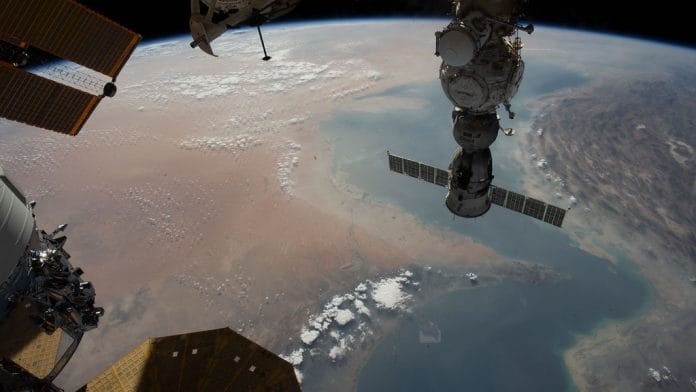


New Delhi: From the moment the Strait of Hormuz effectively became a hostage in the Iran war, energy executives in the region began plotting the biggest logistics exercise the sector has ever seen: reopening a waterway critical to the world’s oil supply and unwinding the region’s biggest production cut in history.
The unprecedented nature of the closure left many people working blind and without a timetable.
In the United Arab Emirates, one official says the country spent the early days of the conflict working out how to stagger oil-well shutdowns to ensure production would be best-placed to rebound. Both the UAE and Saudi Arabia have managed to keep enough pressure in their fields to potentially return to prewar production rates within two weeks, officials say. Saudi supertankers have passed up millions of dollars in earnings since April waiting on standby to pick up the kingdom’s crude at a moment’s notice should the Strait reopen.
Within hours of the interim peace deal being signed by the US and Iran on Wednesday, three Saudi supertankers emerged outside the strait, among the first in a swelling flow of traffic.
Other players are more circumspect and want further reassurances on a demining program and the order that ships will be allowed out of the gulf. But the deal signed by US President Donald Trump and his Iranian counterpart Masoud Pezeshkian should be the signal for oil wells and refineries dotted across the region to crank into gear — a restart so big that it should be visible from space, where thousands of megawatts of heat signatures will be picked up as fields burn off gas.
Read: Kuwait Oil Chief Says Output to Swiftly Rise to Prewar Level
“We should be able to restore normal operations across this entire market within the next six months, provided that we truly return to a period when the strait is open,” Patrick Pouyanne, chairman and chief executive officer of TotalEnergies SE, told the French parliament on Wednesday. “Everyone will be watching to see what’s actually happening on the ground.”
Critical for the Gulf states, the restart of production and barrels flowing out of Hormuz also offers the prospect of lower energy prices and an easing of the inflation fears of central bankers across the world. For Trump it has the added attraction of lowering fuel prices ahead of November’s midterm elections and giving the US an opportunity to restore inventories that have hit bare-minimum levels.
To run smoothly, the reopening needs to be properly choreographed with ships in the right place, wells restarted, infrastructure repaired and agreement on a demining operation. It could easily be derailed if not enough owners are willing to enter Hormuz soon enough to carry the barrels, or if Iran begins imposing tolls as the interim deal implies it could or if Trump’s peace plan falters and hostilities resume.
At times during the last four months, Gulf oil exports were down almost 15 million barrels a day — a 60% drop from where they were in February. And benchmark crude prices topped $126 a barrel, a price that didn’t go higher in recent months only because of record releases from emergency oil reserves and plunging demand which helped ease global supply shortages. Iranian attacks have caused about $42 billion of damage to major facilities from refineries to pipelines, consultant Rystad Energy estimates. Imposition of a US blockade designed to curb Iranian oil revenues further halted traffic. Some refining units could take months to fully return, say senior oil executives.
And all the time more than 100 oil-laden tankers with hundreds of crew members onboard have been stuck inside the Persian Gulf, analysts at shipbroker E.A. Gibson estimate.
Saudi and Emirati officials are bullish about how quickly they can restore crude flows. Restarting the refineries that process oil into consumable fuels will likely be a longer-term process, requiring bespoke equipment and complex engineering. Collectively, the six largest refining plants in the region had about 1.4 million barrels a day of processing capacity offline, according to IIR Energy, which analyzes such data, a volume that is more than a fifth of the amount of refined fuel exported through Hormuz before the war.
Not all producers have had the same success in keeping their fields running optimally while the conflict raged. Saudi Arabia and the UAE were able to divert some oil supplies through pipelines to Yanbu on the Red Sea and Fujairah in the Gulf of Oman to bypass Hormuz.
Even within the same country the picture is confused. One official warns that restoring Iraq’s fields to previous levels will be a slow process because the prolonged shutdown has left wells clogged with substances like paraffin. At the same time, Iraq’s output is already showing signs of an increase, with a top official at the southern Basra Oil Co. saying this week that production had risen by about 500,000 barrels a day from earlier in the war.
“Restoring supply on this scale is wholly unprecedented,” said Fraser McKay, head of upstream analysis at consultant Wood Mackenzie, which estimates that 70% of prewar production can be returned within three months and 90% within six months. “There will be pleasant surprises for producers but also setbacks.”
In fact, the reopening of Hormuz has been quietly underway for weeks. Each day, a handful of oil tankers, starting with a trickle but more recently carrying as many as five million barrels a day — somewhere between a quarter and a third of the normal prewar traffic — were hugging the coast of Oman and escaping the 21-mile wide waterway.
That flow should now turn into a gush if the Middle East’s oil industry restarts in earnest. The heavy lift will see Saudi oilfield engineers, Indian tanker captains and others working around the clock to try and return the oil market to something more closely resembling normality.
“You don’t need to be back at 100% of prewar flows right away,” says Saad Rahim, chief economist at commodity trader Trafigura Group, “but you need to be back to at least 50% fairly quickly.”
Where Are All The Ships?
Almost as soon as Trump announced on Sunday that a deal would be struck this week, Gulf producers were inundated with calls from clients seeking clarity and further details about how real any resumption in shipments might be.
On Thursday many were still seeking that same reassurance. The world’s main oil tanker trade group Intertanko, called for urgent clarity on what steps would be needed to get ships through Hormuz safely, with owners needing to be reassured that there are no mines present before risking a crossing.
It’s still not clear what a demining operation in Hormuz would look like or who would do it, but security officials say it would be an operation that’s likely to take weeks rather than days.
“Everyone would like to get the ships out, but the mood is that you don’t necessarily need to be the first one,’’ says Jan Rindbo, chief executive officer of D/S Norden A/S. “Obviously with traffic resuming that will build confidence. But it’s still fragile, it will not take a lot for that confidence to disappear again.”
For those willing to take the risk, there could be a handsome financial reward. Shipowners think there’ll be hundreds of thousands of dollars a day to earn by getting their ships in the right place at the right time. On Wednesday at least six supertankers, capable of hauling 12 million barrels of crude, conducted screeching turns in the middle of the Indian Ocean and began sailing toward the Persian Gulf on the prospect of reopening. Some Greek owners and an enigmatic South Korean shipowner, Ga-Hyun Chung, who recently became the world’s largest operator of supertankers, have also been sending vessels close to the Gulf of Oman.
Their wager is that there’ll be a surge of cargoes and not enough ships in place to carry them. Clarksons Securities estimated this week that the equivalent of about 140 supertankers would be needed to restore flows from the Persian Gulf. There are about 120 empty supertankers, east of the Malacca Strait that could in theory get to Hormuz within a week, though some will also need to sail to other destinations around the world.
One Chinese oil company was looking for a ship to carry an Iraqi cargo of crude this week and several shipbrokers said tanker owners were quoting a rate above $600,000 a day — at least 10 times the price of last year. Oil companies are balking at those numbers.
For those who have been stuck onboard tankers in the strait it’s a different calculation. Abhjit Chopra, the captain of a tanker with 22 crew, has spent 110 days stranded and now just wants to go home to his family in India. He heard about the deal via mobile phone messages that woke him on Thursday morning, but says there was no celebration onboard or from the ships around them.
He paints a picture of mundane days over the last few months broken up by occasional missiles flying overhead and says he and the crew are now just waiting for instructions.
“There has definitely been a sense of strain and uncertainty over this 100-plus days where we do not have clarity of what is about to happen,” says Chopra. “The vessels are being careful. We are all waiting for instructions from our shore offices to carry out the next steps.”
The Asia Market
Reopening will present a further opportunity for commodity traders who thrive in times of major market shifts. Several of the industry’s biggest energy traders have so far this year seen their highest profits since Russia’s invasion of Ukraine in 2022.
As the restart plays out, barrels are set to flood toward Asian refiners — the biggest buyers of Middle Eastern crude. After months of shortages that have forced processing cuts and four-day weeks to ration energy supplies in some nations, buyers from Japan to Vietnam say they are already inundated with cargo offers. One of the first tankers to leave Hormuz on Thursday was loaded with liquefied natural gas destined for Pakistan, which has faced severe fuel shortages since the war began.
A series of workarounds — some unexpected such as a plunge in Chinese imports, others more deliberate initiatives including the release of emergency reserves, and a diversion of flows through pipes in the Middle East helped stave off higher prices. Until now, those levers have kept the market in balance, and the added supplies could push it back into a surplus. But countries and companies will also be looking to rebuild more than a billion barrels of inventories that have been lost since the conflict began.
“With China’s ability to swing demand so much and so quickly, the system is pretty secure against supply shocks,” said Rory Johnston, oil market researcher and founder of Commodity Context. “This is obviously the ultimate supply-shock test, and the market so far seems to have passed.”
Several commodity traders said that once the oil market has worked its way through this most recent shock, they expect it to return to what had been expected prewar for 2026: a period where supply far outstrips demand. That means oil prices, which stood at around $79 on Thursday, are poised to tumble even further.
China recently began tapping its commercial oil reserves, and there’s little sign of its imports picking up. Lower prices and more barrels flowing through Hormuz, traders say, could soon change that.
Focus will then quickly turn to lessons learned from the conflict. The UAE has already announced plans to build more pipelines to bypass Hormuz so that if conflict breaks out again it will be better insulated and able to export at least some of its oil. Traders and refiners in Asia say processors — which typically purchase oil via long-term contracts for Middle Eastern crudes — will be reassessing their huge reliance on the region.
There are also expectations that the barrels that emerge will quickly flow into storage tanks depleted over the course of the war. The US strategic reserve is now at its lowest level since the 1980s, while Japan has released about 15% of the stock it holds since March. Some expect that refilling process to put a floor under oil prices into the end of the year at least, and keep demand for the tankers hauling barrels across the world supported.
“Everyone is going to look around and say we need to rebuild inventories,” says Trafigura’s Rahim, “crude producers and refiners will run as hard as they can.”
–With assistance from Serene Cheong, Yongchang Chin, Sarah Chen, Mia Gindis, Nicholas Lua, Jack Wittels, Paul Burkhardt, Stephen Stapczynski, Anthony Di Paola, Mitchell Ferman, Khalid Al Ansary and Alaric Nightingale
This report is auto generated from the Bloomberg news service. ThePrint holds no responsibility for its content.
Also Read: Is it a toll? Is it a fee? Trump, Iran aren’t on same page about ships transiting Strait of Hormuz