



By Pietro Lombardi and Corina Pons
MADRID, Oct 7 (Reuters) – Maricarmen Abascal, the 87-year-old Spanish woman whose dramatic eviction last month sparked mass housing protests that led to an early election, has died, the Madrid tenants’ union said on Wednesday, as thousands demonstrated over her death.
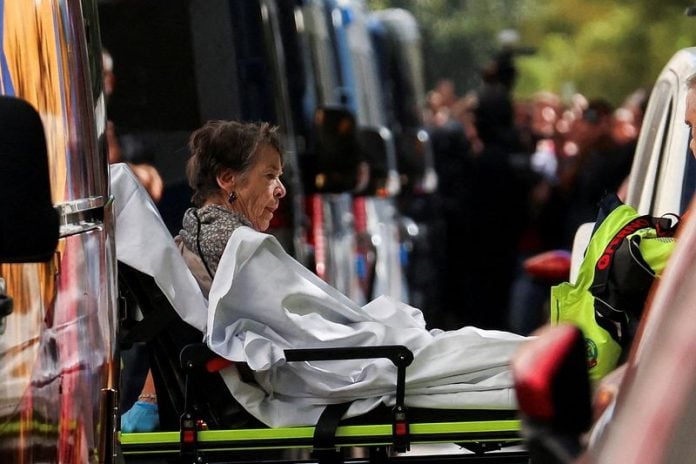
Abascal had been in hospital for severe anxiety and exhaustion since her eviction on September 23 from her home of more than 70 years, when police and social workers removed her by stretcher.
Her case ignited protests over a mounting housing crisis including a shortage of homes and surging rents. Activists camped out in a major Madrid square.
Following news of Abascal’s death on Wednesday, thousands marched from the square, Puerta del Sol, towards parliament, chanting: “This is not a death. It’s a murder!” A cause of death was not announced.
“This was a completely avoidable death that symbolizes the drama that is the housing crisis in Spain,” said 36-year-old marcher Dario Gomez in Madrid.
Demonstrators also held protests in Barcelona.
Trade unions on Wednesday announced a nationwide general strike over housing issues on November 11.
The protests, along with parliament’s rejection last week of decrees aimed at curbing evictions and limiting rent pressures, prompted Prime Minister Pedro Sanchez to call an early election for November 29.
Sanchez is seeking to shift the political narrative from his government’s handling of a migrant crisis in Spain’s North African enclave of Ceuta and a series of corruption cases involving his Socialist Party and his family to the housing crisis, hoping to tap into growing resentment over rising rents.
“Now, following her passing, we are left with the example of the fight she waged and the legacy Maricarmen has left behind. And, above all, we will honour what she always asked of us: ‘Fight, keep fighting for what is yours,'” the tenants’ union said in a statement.
Sanchez lamented Abascal’s death in an X post. “A hug as well to all of us who feel this loss as our own today,” he wrote.
The leader of Spain’s centre-right opposition People’s Party, Alberto Nunez Feijoo, said on X that Abascal’s death shouldn’t be politicised. There should be “no campaigns, no political parties, no other interests here,” he wrote. “In the face of someone’s death, respect is all that matters.”
HOUSE BOUGHT BY INVESTMENT FUND
Abascal was evicted after an investment fund bought her house. Several days later, her lawyer said she reached an eight-year agreement with her landlord that would allow her to return home and pay rent at the same prior amount.
She had planned to sign the deal once she felt better, but never had the opportunity to leave hospital.
A neighbour of Abascal, whose home was near Madrid’s famed Retiro Park, said she was shaped by living through Spain’s authoritarian Franco regime, which ended in 1975.
“She was a fighter, with very clear ideas, a somewhat broad sense of justice, and, above all, perhaps a social conscience and ideas about solidarity,” he said.
Guillermo Ruiz, 31, an audiovisual specialist at the mass march, said he felt pessimistic about change. “The best homage we can pay to her is to continue the fight, continue to mobilise, fight for a dignified life and that what happened to her doesn’t happen to anyone else.”
(Reporting by Pietro Lombardi, Corina Pons, Aislinn Laing, Andrei Kalip, David Latona, Jesus Aguado, Guillermo Martinez; Editing by Andrei Khalip, Rosalba O’Brien and Cynthia Osterman)
Disclaimer: This report is auto generated from the Reuters news service. ThePrint holds no responsibility for its content.