





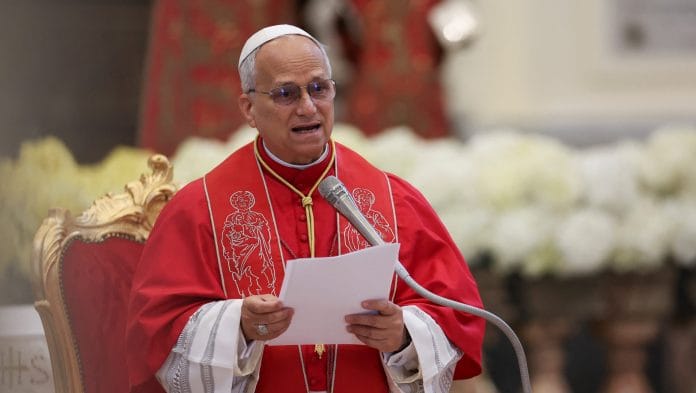


New Delhi: Pope Leo XIV Monday urged Catholics across the globe to be mindful about use of Artificial Intelligence, and the place of AI in the modern world. And he used a 400-year-old papal document to do so.
The pope released his first encyclical Monday titled “Magnifica humanitas” (Magnificent Humanity), an authoritative letter to Catholic Bishops which is supposed to act as moral and social guidance. Yet, it lacks the legal basis of a commandment.
The first ever encyclical “Ubi primum” was published in 1740 by Pope Benedict XIV. Since then, these letters have become foundational for understanding biblical teachings in changing contexts.
In a chapter titled, “The grandeur of humanity in the light of the promises of AI,” the pope, begins his remarks by saying that ‘technology’ is not simply a tool. He adds that technology has the power to reduce humans to “mere cogs in a system driven toward ever greater efficiency”.
Continuing his predecessor’s legacy, he highlights that “technology is never neutral, because it takes on the characteristics of those who devise, finance, regulate, and use it”.
Pope Francis, who was head of the Catholic Church and sovereign of Vatican City from 13 March 2013 until his death in 2025, was vocal about his criticism of technology. He wrote: “Technology, which, linked to business interests, is presented as the only way of solving these problems, in fact proves incapable of seeing the mysterious network of relations between things and so sometimes solves one problem only to create others.”
However, Pope Leo XIV does not limit himself to talking about technology in abstract terms. He spends considerable length of the encyclical talking about the newest global technological boom: artificial intelligence. He also gives a disclaimer that any remarks on AI could become quickly outdated, given the pase of its evolution. He cautions against AI, warning that the most powerful technology may not necessarily be the best.
On the question of the whether morality can be introduced to AI, he says that the makers of AI will impose their own moral vision. “A more moral AI is not enough if that morality is determined by a few.”
“AI tends to amplify the power of those who already possess economic resources, expertise and access to data,” he adds.
Above all, the pope advocates for a usecase of AI that is guided by the moral voice of many, not few. Especially when AI penetrates the domain of public goods and fundamental rights, he says that it must be guided by a clear criteria and effective oversight, “grounded in participation and subsidiarity”.
The latest encyclical before “Magnifica humanitas” was published by Pope Francis in 2020.
The social encyclical titled, “Fratelli tutti”, aimed to promote a universal aspiration toward fraternity and social friendship in the backdrop of Covid lockdown.
Pope Leo XIV presented his encyclical in person at the Vatican, with Christopher Olah, a founder of the American AI giant Anthropic in attendance.
(Edited by Amrtansh Arora)
Also read: We need an AI pause button. It’s time to stop and think