


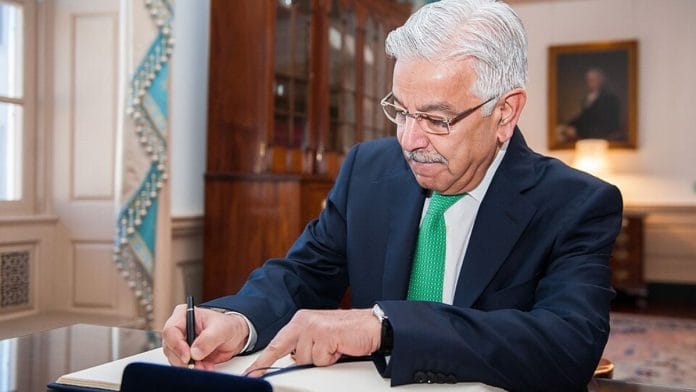
New Delhi: Pakistan’s civilian coalition is facing a fresh political test over proposals to redraw the country’s provincial boundaries, with defence minister Khawaja Asif saying Monday that discussions on a possible referendum will take shape by the end of the year.
Speaking on ARY News programme ‘Sawal Yeh Hai’ Sunday, Asif said discussions among political stakeholders were expected to produce a more definitive proposal by the end of the year, with the process likely to advance early next year.
“Perhaps by the year-end, all this debate and discussion that is taking place will take some definitive shape,” he said, adding that a conclusion could be expected soon. He declined to give a specific date, but said the need to create new provinces was becoming increasingly difficult to ignore. “I can certainly say that it is not going to take two to four months,” he added.
He also said, the government intended to develop a joint document incorporating the views of all stakeholders, including those opposed to the proposal.
When asked whether the government intended to build consensus on the referendum question to secure the PPP’s support, Asif said this was indeed the objective.
Last week, speaking to Geo News, he had said that the new year would usher in a new system, adding that consensus could pave the way for positive change in the country’s political landscape.
The defence minister’s comments came days after PPP chairman Bilawal Bhutto delivered a fiery speech at the Karachi Press Club last week, rejecting what he described as attempts to impose changes to provincial boundaries without the consent of the people concerned.
Bilawal said the PPP was not opposed in principle to the creation of new provinces, provided the initiative reflected public demand and followed constitutional and legal procedures. But he drew a firm line at Sindh, which his party has governed for 18 years.
“The people of Sindh do not want Sindh’s division,” he said, warning that any forced attempt to split the province could lead to bloodshed in Karachi and spread to Hyderabad, Mirpurkhas, Tando Allahyar and Nawabshah.
He argued that provincial boundaries could not be redrawn through political pressure or a referendum designed to bypass constitutional requirements. The Sindh Assembly, he noted, had repeatedly expressed its opposition to dividing the province.
Bilawal also questioned the political legitimacy of any leader who might agree to such a proposal against the wishes of his constituents. Even if he personally endorsed the division of Sindh, he said, his own party could revolt against him.
The PPP chairman’s remarks prompted a pointed response from Asif, who questioned his authority to criticise the country’s political system while his party had governed Sindh for nearly two decades.
The dispute gathered momentum in Pakistan this year after Interior Minister Mohsin Naqvi in September this year called for the creation of additional administrative units, arguing that Pakistan’s existing system of governance had collapsed and required a fundamental restructuring.
On 12 November, Naqvi proposed holding a referendum to gauge public opinion, presenting it as a possible way to resolve a longstanding and politically sensitive question. Minister for Parliamentary Affairs Tariq Fazal Chaudhry subsequently said that a referendum on the issue would take place.
Pakistan has previously undergone major changes to its administrative structure, including the creation of One Unit and its subsequent dissolution, which restored the country’s provincial framework. The One Unit Scheme was an administrative restructuring introduced by the Pakistan government between 1954 and 1970, aimed at consolidating the country’s provinces into a single administrative unit.
But the current debate carries particular political sensitivities because provincial identity, ethnic representation and control over territory remain deeply contested.
Asif meanwhile has expressed confidence that negotiations will eventually produce an agreement, describing politics as “the art of the possible”. Bilawal, however, made clear that any agreement that threatens Sindh’s territorial integrity without popular consent would face fierce resistance.
Current proposals for the creation of new provinces centre on the division of the country’s four existing provinces—Punjab, Sindh, Khyber Pakhtunkhwa and Balochistan—and do not formally extend to PoK.
For now, reports say it is likely to be a 12-province model, which would see Punjab divided into four provinces, Sindh into two, and Khyber Pakhtunkhwa and Balochistan into three each.
(Edited by Viny Mishra)
Also read: 28th amendment for Pakistan? Sindh’s boundaries stand in way of Munir’s gamble to expand power