



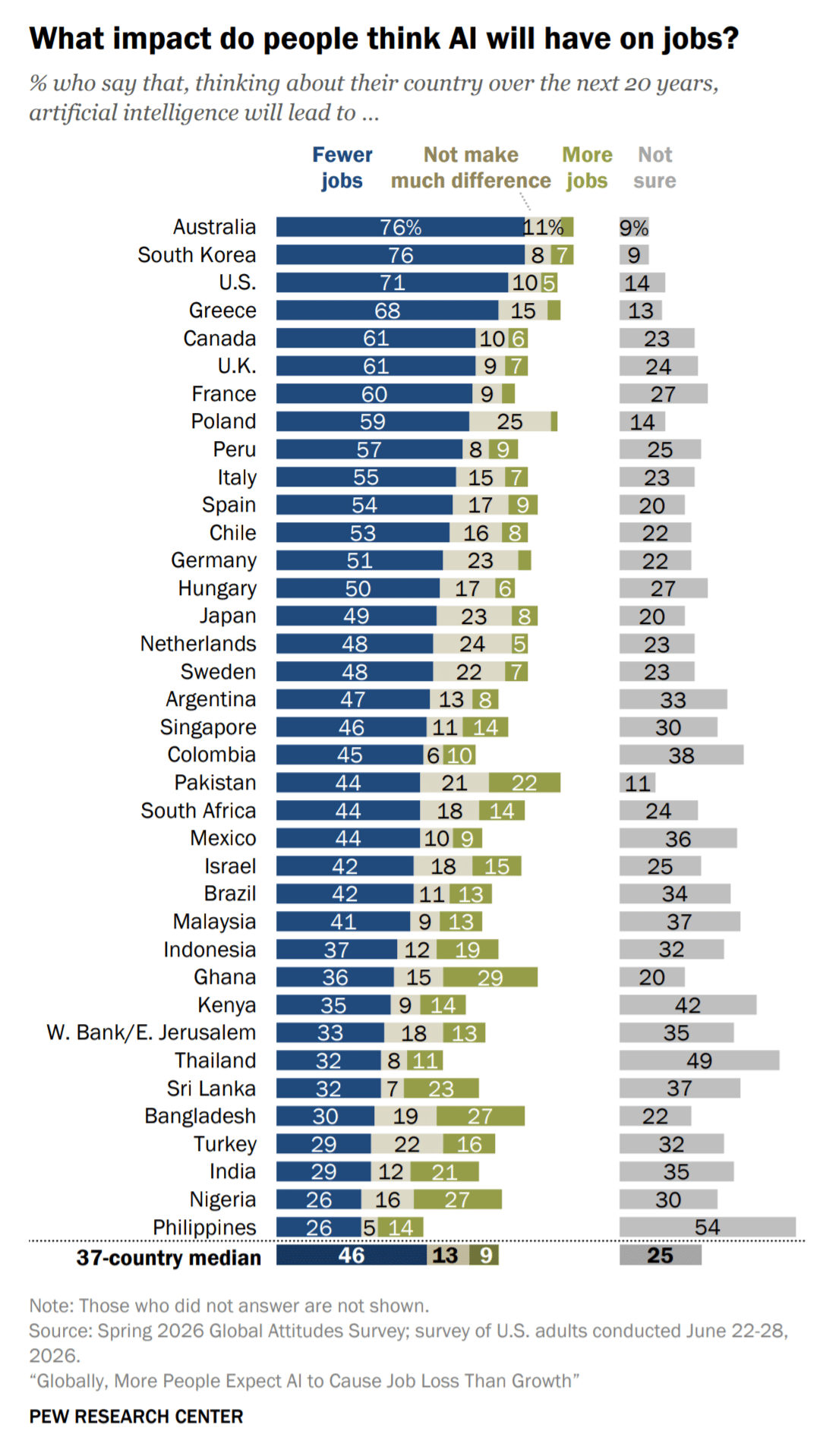
New Delhi: Artificial intelligence is seen more as a potential source of job losses than job creation across much of the world, with people in 34 of 37 countries surveyed saying AI is likely to result in fewer jobs over the next 20 years.
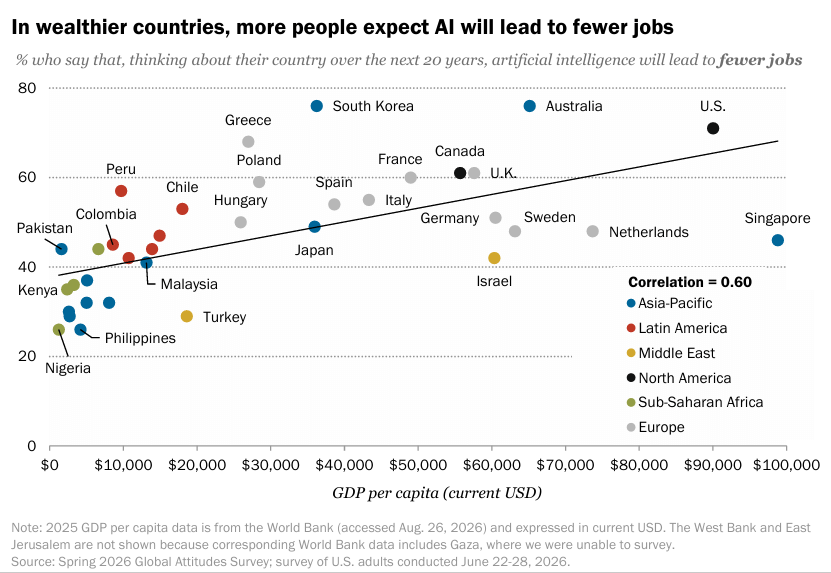
At 76 per cent each, Australia and South Korea record the highest share expecting job losses, followed by the United States at 71 per cent. A majority in Greece, Canada, France and the UK also expect AI to reduce jobs.
The report comes amid global warnings from tech executives, researchers and world leaders against using Artificial Intelligence, including an apocalyptic statement from a researcher at Anthropic that AI could lead to possible loss of human lives in a decade.
The findings come from a Pew Research Center survey of 42,151 adults across 36 countries, conducted in the first half of this year. Adding the US makes that number 37. Across much of the world, people see AI as more likely to reduce jobs than create them, with the concern particularly strong in wealthier countries.
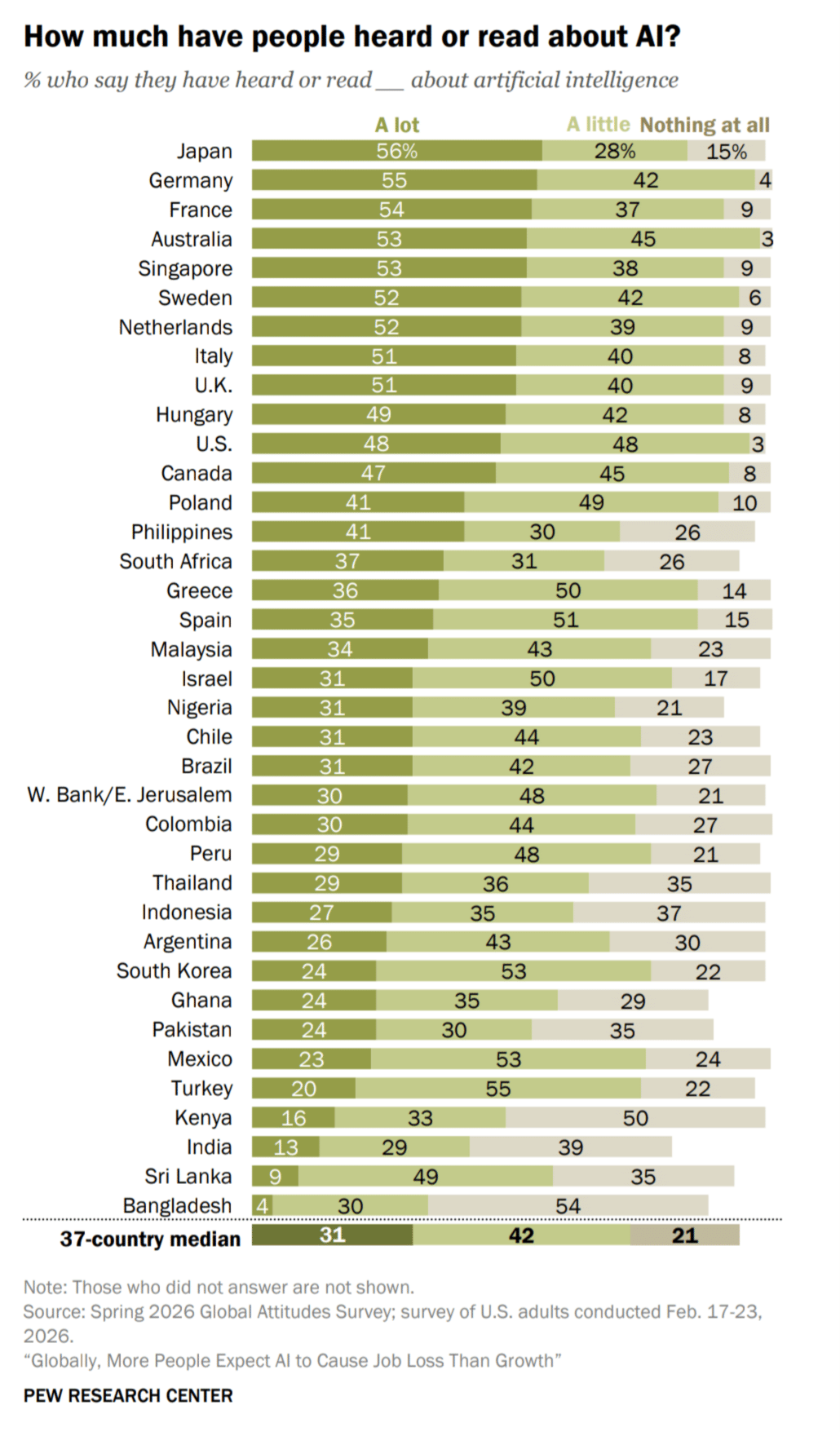
At the same time, awareness of AI is rising, but remains sharply divided by income and age. People in wealthier countries are much more likely to say they have heard or read a lot about AI, while younger adults are more aware than older adults across all 36 countries where the comparison was possible.
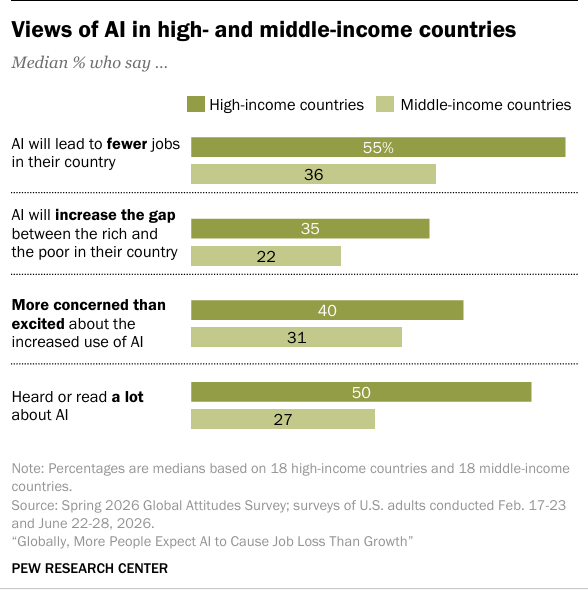
The findings show a clear divide between wealthier and middle-income countries, both in expectations about jobs and in awareness of AI. More than half of adults across 18 high-income countries expect AI to lead to fewer jobs, compared with 36 per cent across 18 middle-income countries.
Where India stands
India has been categorised under middle income countries along with Argentina, Bangladesh, Brazil, Colombia, Ghana, Indonesia, Kenya, Malaysia, Mexico, Nigeria, Pakistan, Peru, the Philippines, South Africa, Sri Lanka, Thailand and Turkey, based on World Bank classifications.
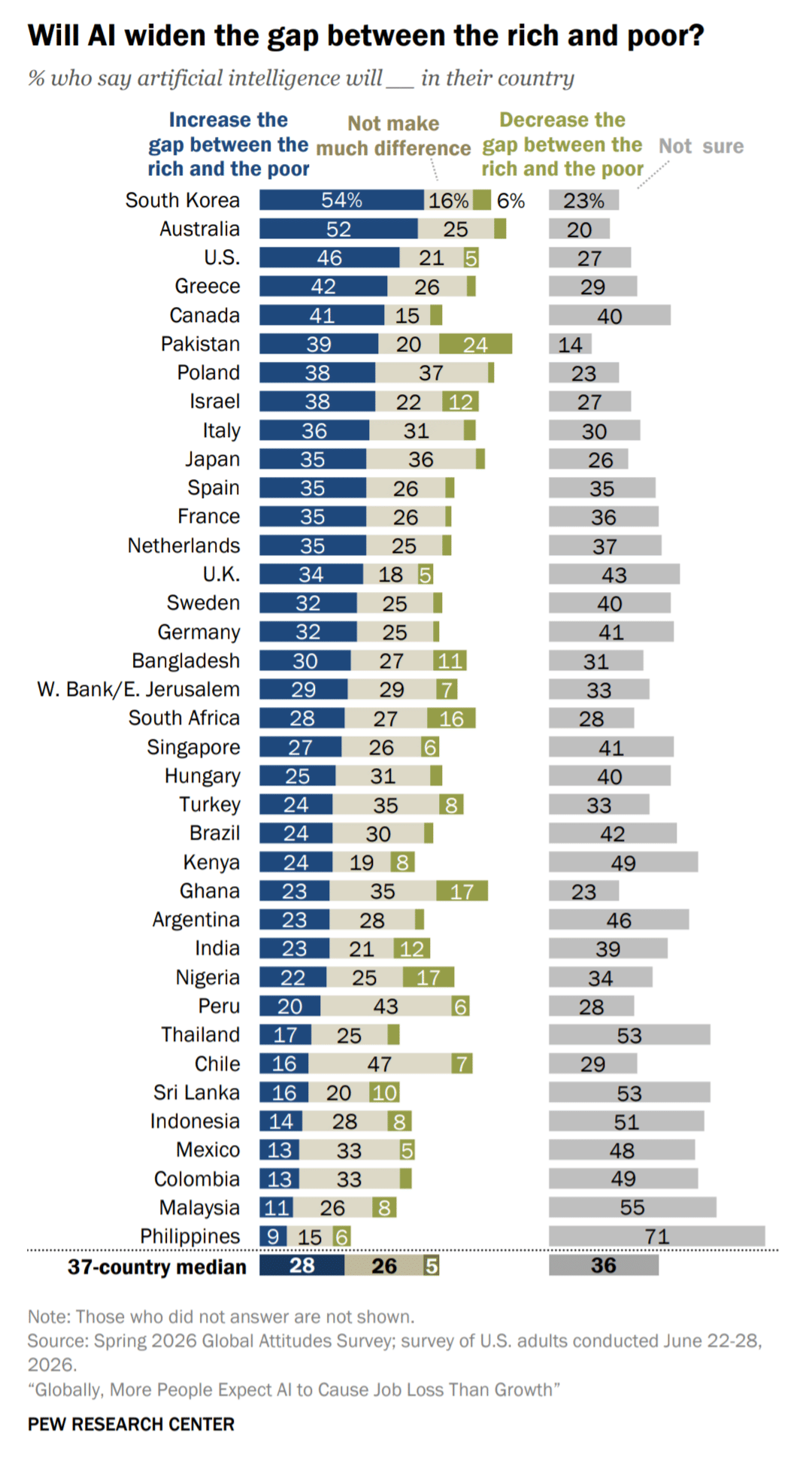
India stands low in the chart on believing that AI will lead to more loss of jobs than employment. India also weighs on the side of believing that AI will increase the gap between the rich and the poor. Awareness about AI remains quite low in India, in proportion with being unsure about its consequences.
Wealthy nations more concerned
The countries with the largest shares expecting AI to reduce jobs are among those classified as high-income. Australia and South Korea record 76 per cent each saying AI will lead to fewer jobs over the next 20 years. In the US, the figure is 71 per cent, followed by Greece at 68 per cent. Canada and the UK are both at 61 per cent, France at 60 per cent, Poland at 59 per cent, Italy at 55 per cent, Spain at 54 per cent and Germany at 51 per cent.
The share of Americans saying AI will lead to fewer jobs rose from 64 per cent in August 2024 to 71 per cent in June 2026, an increase of seven percentage points. Several nations with high levels of general concern about AI such as Australia, Canada, Greece, Italy, Poland and the US also stand out for having large shares who are worried about job loss.
A median of 40 per cent in high-income countries say they are more concerned than excited about AI, compared with 31 per cent in middle-income countries. By contrast, the median shares saying they are more excited than concerned are 14 per cent and 13 per cent respectively.
Many respondents in both groups say they are equally concerned and excited. Israel is the only nation in which more people are primarily excited than primarily concerned.
Countries where fewer expect job losses
Expectations are more mixed in several middle-income countries, where larger shares of respondents are also unsure about AI’s impact on employment. Nigeria and the Philippines record 26 per cent each in saying AI will lead to fewer jobs. The figure is 29 per cent in India and Turkey, 30 per cent in Bangladesh, 32 per cent in Thailand and Sri Lanka, and 35 per cent in Kenya.
Indonesia stands at 37 per cent, Malaysia at 41 per cent, Brazil at 42 per cent, South Africa, Pakistan and Mexico at 44 per cent each, Colombia at 45 per cent and Argentina at 47 per cent.
Uncertainty is particularly high in some of these countries. In the Philippines, 54 per cent say they are not sure how AI will affect jobs. The figure is 49 per cent in Thailand, 42 per cent in Kenya, 38 per cent in Colombia, 37 per cent in Malaysia and Sri Lanka, and 35 per cent in India.
In India, 29 per cent say AI will lead to fewer jobs, while 21 per cent expect more jobs, 12 per cent say it will not make much difference and 35 per cent are unsure.
Nations more aware of AI see it as a threat
The share of adults saying they have read or heard a lot about AI has increased in seven high-income countries and four middle-income countries where trends from last year are available. People in countries with higher Gross Domestic Product (GDP) per capita also tend to say they have heard a lot about AI relative to people in less wealthy nations.
The 18 high-income countries are Australia, Canada, Chile, France, Germany, Greece, Hungary, Israel, Italy, Japan, the Netherlands, Poland, Singapore, South Korea, Spain, Sweden, the UK and US.
The 18 middle-income countries are Argentina, Bangladesh, Brazil, Colombia, Ghana, India, Indonesia, Kenya, Malaysia, Mexico, Nigeria, Pakistan, Peru, the Philippines, South Africa, Sri Lanka, Thailand and Turkey.
Young people more likely to say AI will negatively impact jobs
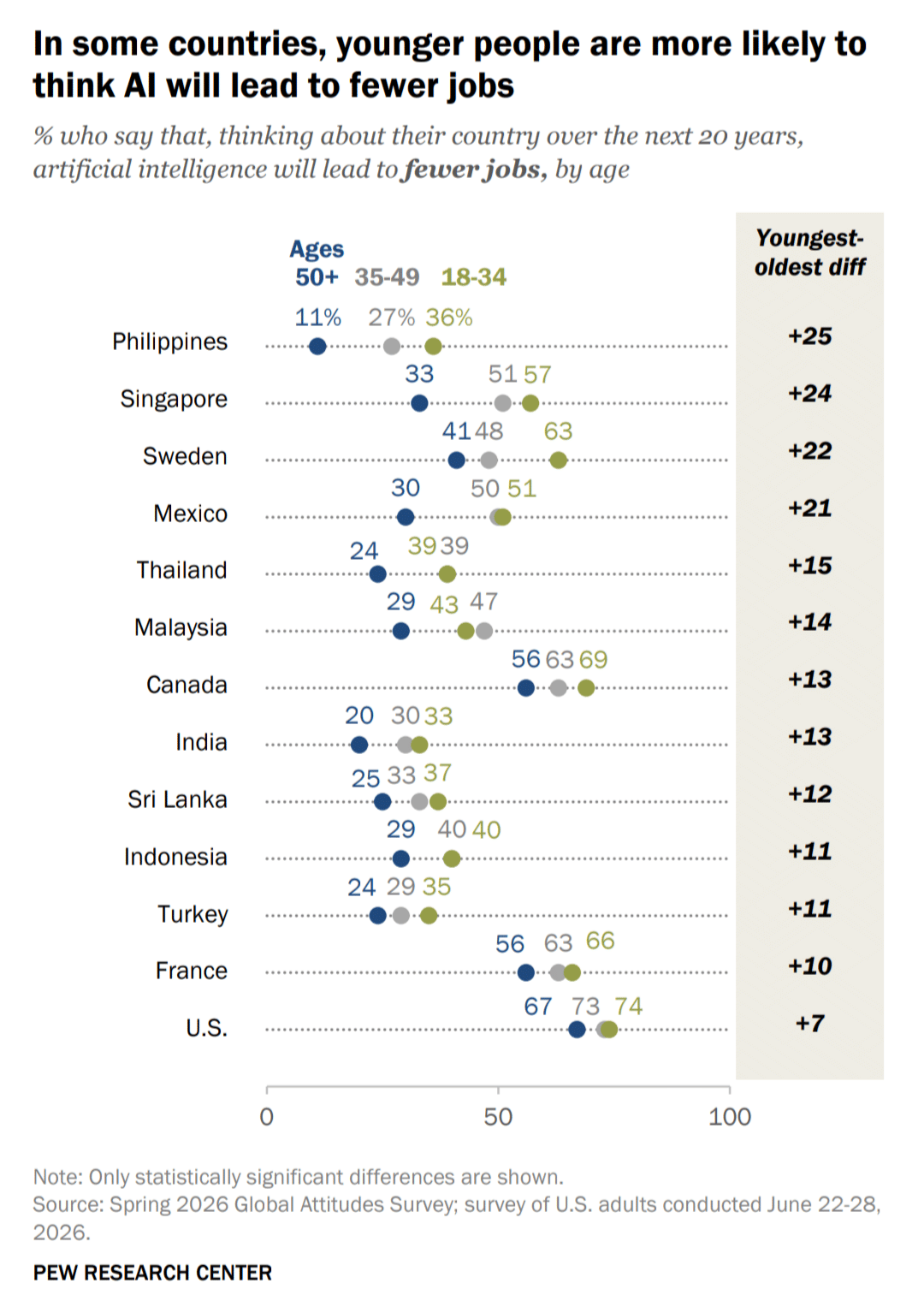
The study finds that people overall are more likely to believe AI will lead to fewer jobs rather than more jobs in their country. But the pessimism is especially high in young people in most countries.
In the United States, large majorities across age groups think AI will cause job losses in the coming decades. Americans aged 18 to 34 are, however, more likely to say this than those aged 50 and older.
The age gap is among the largest in the Philippines, where 36 per cent of adults under 35 say AI will lead to fewer jobs over the next 20 years, compared with only 11 per cent of those ages 50 and older. There are significant differences in 12 other nations as well.
Trust in China higher than in US & EU on regulating AI
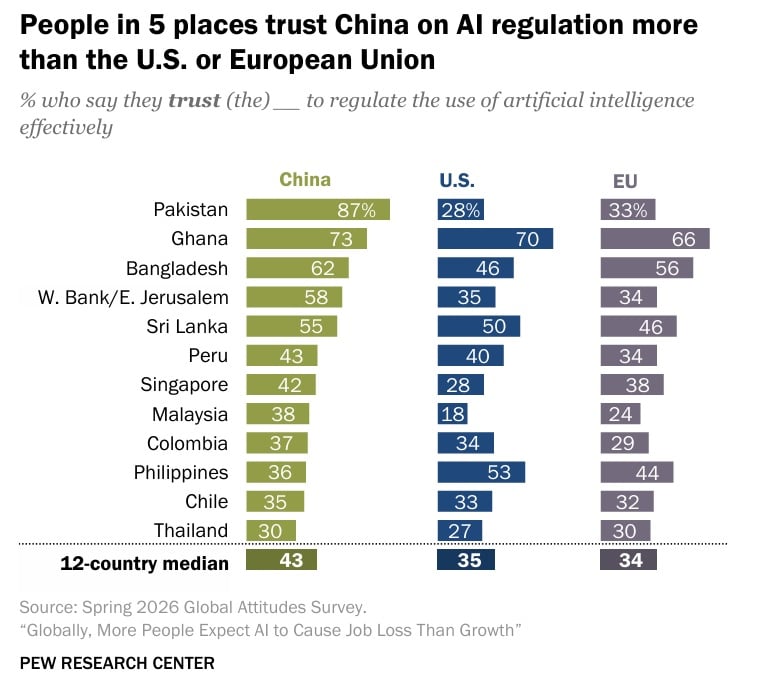
In 12 countries Pew Research Center surveyed this year, the team asked people how much they trust the US, China and the European Union to effectively regulate artificial intelligence.
Across these 12 countries, China emerged as a clear winner with a median of 43 per cent trust to regulate AI, compared to 35 per cent for the US and 34 per cent for the EU.
How the survey was conducted
Pew Research Center’s main survey covered 42,151 adults in 36 countries between 8 February and 13 May 2026. The United States was covered through separate surveys of 5,119 adults in February and 3,488 adults in June 2026.
Respondents were asked to think about the next 20 years in their country and say whether AI would result in more jobs, fewer jobs, not make much difference to the number of jobs, or whether they were not sure.
The 36 countries in the main survey were Argentina, Australia, Bangladesh, Brazil, Canada, Chile, Colombia, France, Germany, Ghana, Greece, Hungary, India, Indonesia, Israel, Italy, Japan, Kenya, Malaysia, Mexico, the Netherlands, Nigeria, Pakistan, Peru, the Philippines, Poland, Singapore, South Africa, South Korea, Spain, Sri Lanka, Sweden, Thailand, Turkey, the UK, and the West Bank/East Jerusalem.
The findings show that expectations about AI’s effect on employment remain sharply different across countries. While a majority in most countries surveyed expect AI to reduce the number of jobs, the strength of that expectation varies alongside income, awareness, ideology and age.
(Edited by Nardeep Singh Dahiya)
Also Read: Elon Musk warned AI could kill humanity. 3 years later, he’s still sounding the alarm