





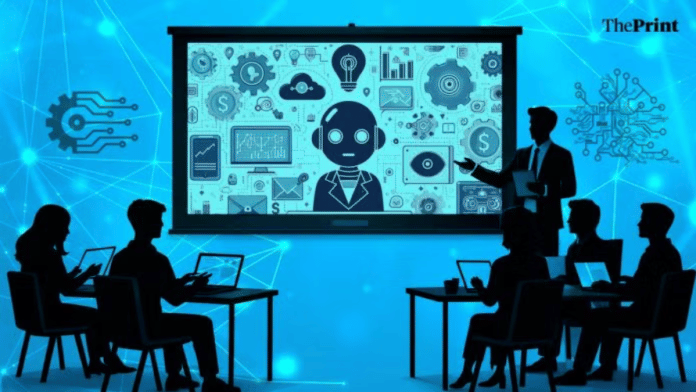

New Delhi: As the world grapples with the rise of Artificial Intelligence and its ripple effects across fields, Norway has announced a near complete ban on the technology for its younger populace effective from the upcoming academic year starting late August.
“The uncritical use of AI causes students to skip important learning steps,” Prime Minister Jonas Gahr Stoere said in a press conference Friday, announcing his government’s plan to come up with national recommendations on age guidelines for the use of artificial intelligence in schools.
A Nordic country, Norway is known for its strong emphasis on education with schools placing emphasis on values such as equality, inclusion, and sustainability. Its education system is universally recognised for being highly inclusive and free of charge.
The new move is in contrast to India, where policymakers are systematically integrating AI into school education.
According to the new Norwegian basic framework, students from grade 1 through 7, aged from 6 to 13, should, ‘as a general principle’, not be using AI at all. AI tools can be used, with caution, by lower secondary school students, aged 14 to 16, under the supervision of their teachers. Only in the senior grades should students learn the use of AI so as to prepare them for further education and work.
“The most important thing in school is that our children learn to read, write and do mathematics,” Stoere said.
he AI ban is not the only educational reform being introduced by Norway in the new school year. Teachers are being reinstated with greater authority “to manage teaching and behaviour”.
The use of computers and tablets, in use in Norwegian classrooms since the 1990s, will be reduced, with the government announcing plans to fund the use of more books and physical aids.
Indian approach
Norway’s move away from AI in education stands apart from India’s approach to the technology. In contrast, the Indian educational policies have adopted artificial intelligence much more wholeheartedly.
Under the National Education Policy (NEP) 2020 and the National Curriculum Framework (NCF) 2023, AI has been introduced in school curricula across the country through Central Board of Secondary Education (CBSE) and National Council of Educational Research and Training (NCERT).
At the level of primary education, the Ministry of Education has three initiatives to promote AI for students and educators. DIKSHA (Digital Infrastructure for Knowledge Sharing) is a mobile application that offers ‘engaging learning material’ for the needs of prescribed school curriculum.
The SOAR (Skilling for AI Readiness) programme includes modules for both students and teachers to build AI awareness and skills. The ministry’s SWAYAM (Study Webs of Active Learning for Young Aspiring Minds) platform has more than 110 free AI courses from IITs & IISc, with 41.2 lakh-plus students enrolled.
The CBSE also offers courses in the technology for students of classes 6 onwards, while the NCERT has incorporated AI content in its computer textbooks.
To support India’s growing AI sector, the government launched the IndianAI mission in March 2024, allocating a budget of Rs 10,371.92 crore over five years to provide computing infrastructure for developing AI models, create datasets for training, and develop practical applications across sectors including education.
(Edited by Tony Rai)
Also Read: Karma Chameleon 2.0—Boy George re-records 1983 hit with ‘ethical AI’ use
Funny how the best way forwards is sometimes to take a step backwards.
Perhaps here’s cause to reflect on the failure of a strictly linear view of history?