





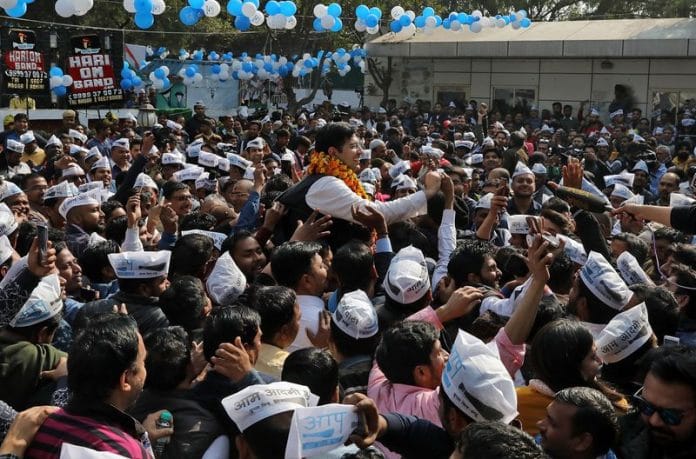


NEW DELHI, April 27 (Reuters) – Indian Prime Minister Narendra Modi’s BJP party strengthened its position in parliament’s upper house after seven opposition lawmakers joined it, a parliamentary list showed on Monday, a shift that could ease the government’s passage of legislation.
All seven defectors are from the Aam Aadmi Party (AAP), led by one of Modi’s most high‑profile critics, Arvind Kejriwal. The party governs the northern state of Punjab and previously ran the national capital territory of Delhi.
The defections leave the AAP with just three seats in the Rajya Sabha house, while Modi’s Bharatiya Janata Party now has 113 members, 10 short of a simple majority in the 245‑member chamber. Modi’s broader National Democratic Alliance coalition holds about 140 seats in the house, also known as the Council of States.
Rajya Sabha members are elected for six‑year terms by elected members of state legislatures and federal territories with legislatures, using a proportional representation system. Modi’s coalition rules 19 of India’s 28 states and two of its three federal territories with legislatures.
The defectors include former Indian cricketer Harbhajan Singh and Raghav Chadha, the de facto leader of the group who gained prominence by raising middle‑class concerns such as the high cost of food at airports.
Chadha accused the party of being run by “corrupt and compromised” people. The AAP said the defectors were being opportunistic.
All but one of the former AAP members were elected from Punjab, where state polls are due next year and Modi’s party has never won a majority on its own. Several other AAP leaders, including Kejriwal, have faced court cases over corruption allegations.
A New Delhi court in February declined to proceed with a trial against Kejriwal and other party colleagues in one such case, which the AAP has described as politically motivated. The matter is now before a higher court.
(Reporting by Rajesh Kr. Singh and Krishna N. Das in New DelhiEditing by Bernadette Baum)
Disclaimer: This report is auto generated from the Reuters news service. ThePrint holds no responsibility for its content.