



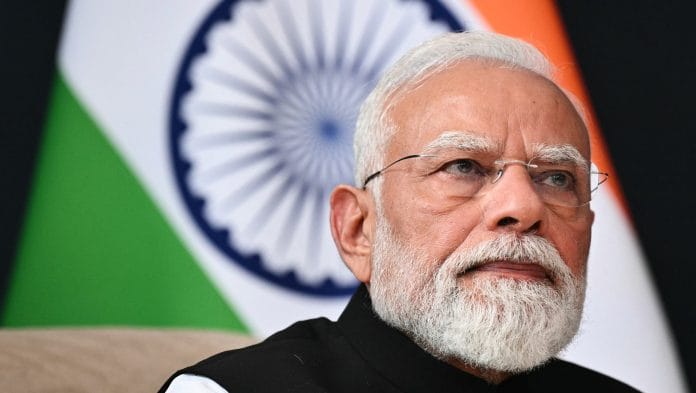
Indian Prime Minister Narendra Modi is taking steps to reduce key imports into the economy in order to protect supply chains and ease pressure on the currency as geopolitical risks escalate.
Modi’s office ordered key ministries to identify categories of goods in which import dependence is high, and can be replaced by locally made products, according to officials familiar with the matter. The government is considering subsidies and other incentives to help boost domestic production, they said, asking not to be identified because the discussions are private.
The Ministry of Commerce and Industry is preparing a list of more than 100 products, including electronics, chemicals, key drugs, fertilizers, semiconductors, automobiles and machinery, which could be scaled up, the people said. The discussions are taking place across several ministries and a decision hasn’t been finalized yet, the officials said.
The latest move to boost domestic manufacturing came on Wednesday, with Modi’s cabinet approving a plan to increase financial support for chip and smartphone production by another 1.9 trillion rupees ($19.7 billion). It also approved a policy to raise local fertilizer production following shortages linked to the closure of the Strait of Hormuz.
India’s manufacturing is heavily reliant on imported inputs, especially from China, making the industry vulnerable if supplies are restricted, as India’s auto and tech industries have experienced over the past year. The Iran war has only exposed India’s dependency even further, with severe energy shortages and soaring import bills in recent months, which pushed the currency to record lows.
“Export controls are being used to deny critical components — from rare earths to semiconductors — to countries that need them. If this is the world we have to live in, where industrial policies are weaponized, self-reliance is the need of the hour,” said Gaurav Kapur, economist with IndusInd Bank.
India imported nearly $775 billion worth of goods during the financial year ending March, with almost a fifth of that coming from China alone.
Building domestic capacity is now a key pillar of Modi’s economic agenda, with an objective to narrow the trade deficit, preserve foreign exchange and position India as an alternative manufacturing hub to China. India’s free trade agreements with partners such as the European Union are also expected to attract fresh investment and deepen the country’s manufacturing base, economists said.
“Such self-reliance is born out of necessity, not necessarily a search of economic efficiency,” said Dhiraj Nim, economist with ANZ Banking Group. “Bringing up domestic industries will have a positive impact on manufacturing metrics and jobs, undoubtedly. But much depends upon scale,” he said.
Shaktikanta Das, a former central bank governor and now principal secretary in Modi’s office, is spearheading a taskforce that’s drawing up an import substitution blueprint for the economy, officials familiar with the matter said. Members of the Prime Minister’s Economic Advisory Council are also involved in the project.
Modi has instructed key government ministries to identify areas where India can produce goods more efficiently and at lower cost, the officials said. The government may consider extending manufacturing incentives to private and foreign investors to set up factories in the country or ask state-owned firms to scale up their own capacity through joint ventures, they said.
Modi’s office and the Ministry of Commerce and Industry didn’t reply to a request for further information.
Commerce Minister Piyush Goyal this month urged states and industry to identify products that can be manufactured competitively in the country. He added that the efforts would help in cutting import dependence, saving foreign exchange while strengthening domestic supply chain to reduce vulnerabilities arising from excessive dependence on foreign suppliers.
India is the world’s third-largest oil importer, with most of its purchases coming from the Middle East and Russia, making the country vulnerable to geopolitical tensions. The US is proposing new sanctions on the five largest buyers of Russian oil and natural gas — including India and China — which would give President Donald Trump the authority to impose tariffs of up to 100% on those countries.
Officials in New Delhi said that while imports of crude oil, gold and critical minerals are difficult to replace, the government sees scope to reduce dependence on other items, including pulses and edible oils through agricultural reforms.
In sectors where replacing imports is not immediately feasible, the government plans to pursue a long-term strategy to build domestic production, the people said. In some areas, such as key intermediate products needed for electric vehicles, China is critical in global supply chain and cannot be substituted.
Among other proposals on the table are options to relax export obligations for exporters if they use more locally-made capital goods for their exports, one of the people said.
Officials are also weighing changes to the Advance Authorization program, which allows exporters to import raw materials without paying customs duties, provided they export finished products of a specified value within a set timeframe and add at least 15% value domestically. The discussions are mainly around whether value addition norms can be relaxed if exporters increase the use of locally-made intermediate products, the person said.
For fertilizers, the government is targeting a 30% reduction in imports over the next three years, a person familiar with the matter said. As part of the effort, authorities plan to revive dormant domestic fertilizer plants, with some projects expected to be completed over the next year, the person said.
–With assistance from Ruchi Bhatia and Diksha Madhok.
(Updates with analysts’ comments)
This report is auto-generated from Bloomberg news service. ThePrint holds no responsibility for its content.