



By Branko Filipovic and Fedja Grulovic
SARAJEVO/BANJA LUKA, Oct 4 (Reuters) – A Bosniak left-leaning moderate, a pro-Russian Serb nationalist and a Croatian nationalist are leading Sunday’s election for Bosnia’s inter-ethnic tripartite presidency, the election commission said, based on ballots from more than 90% of polling stations.
The results were largely in line with expectations and with projections by the Poliwave tracking platform, although voter turnout was low at a combined 42.2% in Bosnia’s two entities, the Bosniak-Croat Federation and the Serb Republika Srpska. Voters also cast ballots for the national parliament, alongside regional races in the two entities.
Voter frustration has grown over an economic slowdown, the slow pace of EU entry talks and a lingering political crisis in which ethnically based dominant parties from the two entities have repeatedly stalled decisions by the weak central government that links them.
Denis Becirovic, a Bosniak of the Social Democratic Party (SDP-BiH) and part of the current tripartite presidency, garnered 26.66% of votes in the Bosniak-Croat Federation, ahead of the candidate for the centrist and traditionalist Bosniak Muslim Party of Democratic Action (SDA). The two had been considered close favourites in the election.
Also leading in the Bosniak-Croat Federation was newcomer Darijana Filipovic of the nationalist and pro-European Croatian Democratic Union (HDZ-BiH), with 14% of the vote.
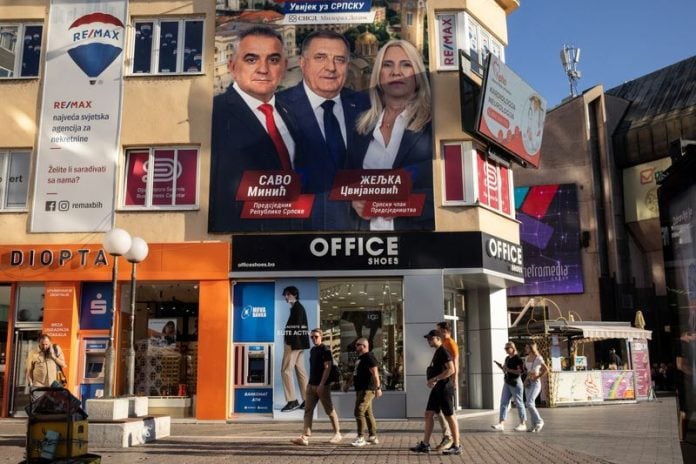
In Republika Srpska, Zeljka Cvijanovic, an existing member of the tripartite presidency from the Serb and pro-Russian nationalist Alliance of Independent Social Democrats (SNSD), secured 55.34% of votes, the election commission said.
Voting continued in some polling stations after the 7 p.m. (1700 GMT) deadline due to delays related to a new electronic balloting system, Bosnia’s Central Election Commission head Jovan Kalaba told reporters in Sarajevo.
The election commission redesigned ballots and introduced new biometric voter identification and electronic scanners, which it said were aimed at curbing voting fraud.
Speaking in Banja Luka, the largest Bosnian Serb city, Milorad Dodik, a separatist and pro-Russian leader of the SNSD who visited Moscow and met Russian President Vladimir Putin last week, said his party’s candidate Savo Minic won the most votes for president of the Republika Srpska entity.
“We have won the member of the (Bosnian) Presidency, and the president of the Republika Srpska. An unexpectedly high result,” Dodik said.
Since the Bosnian war ended in 1995 under the US-brokered Dayton peace accord, the country has been split along ethnic lines into two entities linked by the weak central government and tripartite presidency.
Bosnia, which has struggled to recover from the 1992-95 war, secured EU candidate status in December 2022 and approval to open accession negotiations in 2024. Actual talks have not started, however, because the domestic legislatures have yet to enact core requirements such as bolstering judicial oversight and passing anti-corruption laws.
Borjana Kristo, the deputy-head of the Croat HDZ-BiH, said that overall progress could be made through dialogue after the elections.
“Bosnia must make progress solely on the principle of consensus, dialogue, and mutual respect,” she told party supporters, cautioning against rhetoric that would drag the country backwards.
Many voters in the country of 3.4 million people say they want to move beyond divisive rhetoric but its politics have become deadlocked.
The EU and Russia have been vying for influence over Bosnia, with the EU seeking to expand its membership across the Balkans while Russia wants to slow that process down and preserve its influence over the Republika Srpska.
The US has also sought to bolster its influence in Bosnia, pushing for a $1.5 billion pipeline project to import US liquefied natural gas. The EU has said, however, that the selection of the company for the project lacked competitive transparency, while Washington and Brussels have also clashed over the role of the High Representative, the international peace overseer for the country.
(Writing by Aleksandar Vasovic; reporting by Branko Filipovic in Sarajevo and Fedja Grulovic in Banja Luka; Editing by Alison Williams, David Goodman, Emelia Sthole-Matarise and Edmund Klamann)
Disclaimer: This report is auto generated from the Reuters news service. ThePrint holds no responsibility for its content.