





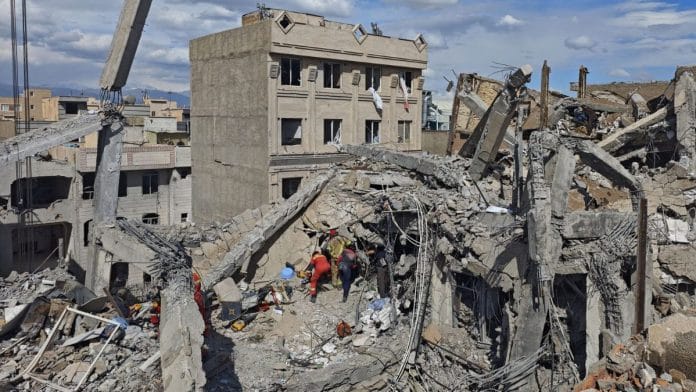


Iran, Ukraine, Lebanon, Sudan: We hear and read thousands of words daily about their bloody tumults. But when, in connection with any, do you hear mention of the United Nations as dove of peace? When I first visited New York in 1966, UN Plaza was a tourist “must,” to pay tribute to one of the world’s most important institutions.
Secretary-generals such as Dag Hammarskjoeld and U Thant were important figures on the world stage. By contrast, in 2026 the UN is about to choose a new chief, and you are unlikely to know a roster of candidates that includes Rafael Mariano Grossi and Rebeca Grynspan.
At the UN’s 1945 foundation in San Francisco, its declared ambition was to prevent wars. The Americans and Europeans hoped to see a continuation of the wartime Grand Alliance against fascism. In the event, of course, Western and Soviet worldviews quickly diverged, Cold War descended.
There was a freakish moment in 1950, when North Korea invaded the South. The US, Britain and France were able to exploit a temporary Soviet boycott of the Security Council to push through a vote endorsing military action to expel the communists, which continued until the 1953 Korean armistice. American and allied forces fought under the UN’s banner, not the Stars and Stripes.
The UN was the scene of many famous orations and melodramas. In 1960, Fidel Castro delivered the longest single speech in the General Assembly’s history, almost five hours long, and Soviet leader Nikita Khrushchev banged his shoe on the rostrum to hammer home a menacing message to the West.
The body’s perceived relevance has declined steeply since the Cold War’s ending. At its foundation it had only 51 members. Today it has 193, all with equal voting rights. Many are in thrall to one or other superpower, and thus unlikely to achieve consensus.
It is depressing to behold the manner in which North Korea, for so long a pariah and the object of repeated condemnatory UN resolutions, has become the openly avowed ally of Russia and China. Presidents Vladimir Putin and Xi Jinping find Kim Jong Un and his arsenals useful, and care nothing for the enslavement of his people.
The 2002-2003 Iraq crisis was the last in which the UN dominated the news. Britain sought to insist upon a UN mandate before participating in George W. Bush’s invasion of Iraq. The mandate was not forthcoming. The US then announced that “diplomacy has failed” and invaded anyway, with the British trailing along in hopes of American gratitude. Most today acknowledge the shambolic consequences. In 2004 UN Secretary-General Kofi Annan had characterized the American action as “not in conformity with the UN Charter… It was illegal.”
Back then, some still took heed of the UN. In 2026 I doubt many Bloomberg readers even noticed that on Feb. 28th Secretary-General Antonio Guterres said: “I condemn today’s military escalation in the Middle East. The use of force by the United States and Israel against Iran, and the subsequent retaliation by Iran across the region, undermine international peace and security.”
I have just read an essay written by U Thant’s grandson and biographer, Thant Myint-U, deploring the UN’s absence from today’s peacemaking. He calls for a revival of the lost status of multilateral institutions:
“The real disaster is the abandonment of the twin convictions of no war and no empire by states and publics alike, caused not by the American retreat but by an erosion of the international moral leadership and collective memory that once sustained them. It’s a crisis of imagination produced by a compound amnesia, not just of war and empire but also of the extraordinary peacemaking successes of an earlier United Nations.”
In principle, many of us would endorse what Thant says. We yearn for restoration of a moral dimension to international affairs, and especially to US foreign policy. Yet such lamentations are unlikely to make headway unless the great powers become willing to defer to UN processes.
Israel has for years ignored UN censure. In a world in which President Donald Trump treats America’s allies with contempt, it would be fanciful to imagine that he will involve the UN, which he despises even more, in attempts to escape from his Iranian imbroglio, or to settle the Ukrainian war.
Trump deals only bilaterally, often seeking a percentage for his family. Neither Xi nor Putin shows interest in involving the UN in their various international disputes. They know they would not like its conclusions.
Many UN agencies, not least the human-rights bodies, have decayed, and the US has wearied of funding them. Yet its withdrawal from aid and disease-prevention bodies is a disaster for the world. International responses to the current outbreak of Ebola in the Democratic Republic of the Congo are crippled by the near absence of the US, following its renunciation of the World Health Organization.
Rather than aspire to restore the clout of the UN Security Council, it seems more realistic to work to the more limited goal of persuading world leaders that traditional diplomacy — jaw-jaw rather than war-war, to borrow Churchill’s phrase — can assist their policymaking. I once read the memoirs of a Foreign Office official who spent years of the Cold War representing Britain at international disarmament talks. At first sight, he said, he had wasted his life, because the Soviets stonewalled every proposal. Yet he argued that merely keeping talking contributed to keeping us all alive.
I agree. I believe passionately in the virtues of professional diplomats, of whom the US State Department, the British Foreign Office and their kin in other countries bred outstanding examples. Such people devoted their lives to studying other societies; to long-haul bargaining with friends and foes.
By contrast the only virtue of Jared Kushner, Steve Witkoff and their ilk as emissaries is that Trump trusts them. Knowing little of history or the world, bereft of a moral compass, they are unfit to represent their nation at the negotiating table. It would be a significant first step toward a less scary international scene if countries revived respect for foreign-service professionals, and banished amateurs.
The UN can be reformed and resurrected as a platform for humanitarian relief and peacekeeping in the quarrels of lesser states. This is an attainable objective if Washington, or at least some successor to Trump, once more accepts that it should fulfil some higher purpose than the pursuit of plunder.
It would be naïve to suggest morality ever dominated international affairs. Today, however, the smash-and-grab culture promoted by the superpower leaders does not serve the best interests of their own nations, never mind those of the world.
It should be possible to revive diplomacy, humanitarian concern and respect for others, without sacrificing the self-interest which is always at the heart of policymaking. The UN cannot be what it once was. But it can be resurrected as a force for doing a little good to a lot of people.
This report is auto-generated from Bloomberg news service. ThePrint holds no responsibility for its content.