







Until the US and Israel launched a war on Iran, prompting Tehran to close the Strait of Hormuz, ships transiting the world’s most important artery for trading oil and liquefied natural gas didn’t pay to transit it.
Now, as the strait begins to reopen, Iran and Oman, the two countries that border it, have raised the prospect of establishing a permanent system to charge ships to travel through the waterway. Oman, which has told European officials there’s no going back to the pre-war status quo, has been analyzing how other global shipping chokepoints are managed.
The prospect of transit fees in Hormuz has focused attention on how vulnerable global supply chains are to a handful of strategic waterways — and has heightened concerns that it could reshape how they are managed. “The final disposition of the Strait of Hormuz may set a new precedent with global implications,” writes Adam Farrar, a senior geoeconomics analyst at Bloomberg Economics.
International law generally guarantees ships a right of transit passage through straits used for international navigation, and coastal states aren’t allowed to charge vessels simply for exercising that right. The rules do, however, permit charges for “specific services rendered to the ship.” Oman is a party to the UN Convention on the Law of the Sea, or UNCLOS; Iran isn’t.
Manmade waterways such as the Suez and Panama canals operate under different legal arrangements. They are considered sovereign infrastructure whose operators can charge ships to sail through their waterways.
Strait of Hormuz
The Strait of Hormuz connects the Persian Gulf with the Gulf of Oman and the Arabian Sea. It carries roughly one-fifth of the world’s oil trade from Saudi Arabia, Iraq, Kuwait, the United Arab Emirates, Qatar and Iran to markets in Asia, Europe and beyond. The strait is a natural waterway used for international navigation, and ships have long enjoyed a right of free passage through it. But the US-Israel war against Iran disrupted the status quo.
After the conflict began, Iran effectively closed the strait by launching attacks on ships. For those vessels that did cross, it imposed ad-hoc transit fees, demanding as much as $2 million per voyage, creating an informal toll system. Since the US and Iran agreed to a ceasefire in June, traffic through Hormuz has picked up, though continued, sporadic strikes on vessels have made shipowners uneasy.
Iran is now requiring commercial vessels to obtain explicit approval to sail through the waterway. As part of its truce with the US, Iran said it would suspend charging for transit during a 60-day waiver period to allow trade to resume. But it insists that after the waiver expires in August, it will again require payments. Rather than a toll just for the privilege of crossing the strait, Iranian officials say these will be fees, for example for “navigation, security and environmental services,” according to Foreign Ministry spokesman Esmail Baghaei.
The US and its allies oppose Iran’s plan. Critics of it say that the fees constitute a toll by another name. It also could theoretically expose those who pay to the risk of being sanctioned by the US for financial dealings with Washington-blacklisted entities, although the US has agreed to unwind all its sanctions on Iran.
It’s unclear what level of fees Iran has in mind. In projecting how much money the country might raise, the semi-official Tasnim News Agency in March made two calculations, one using $2 million per vessel and another using $400,000, its estimate of transit costs through the Suez and Panama canals.
Bosphorus/Dardanelles Straits
The Bosphorus and Dardanelles straits run through Turkish territory, connecting the Black Sea with the Mediterranean. The waterways are a vital shipping corridor from Russia, Ukraine and other Black Sea states such as Georgia, Romania and Bulgaria. They carry crude oil, gas and grains, as well as containerized cargo. More than 40,000 vessels transited the straits last year.
The Turkish straits are governed by the 1936 Montreux Convention. The agreement restored Turkey’s control over the waterways, replacing an international regime established after World War I, while preserving freedom of passage for merchant vessels.
The convention explicitly permits certain fees for services. Rather than a toll for transit, Turkey charges ships for such things as lighthouse and salvage services and for pilotage or navigation assistance. Large ships, including some tankers, are required to pay an extra fee for a tug boat escort.
Fees are based on a vessel’s net tonnage and calculated in gold francs — a historical accounting unit that was used as the reference point in the Montreux Convention. Turkey periodically updates the exchange rate. As of July 1, a typical Suezmax oil tanker would pay around $240,000 in fees for a return trip through both straits.
Turkey’s earnings from the straits have risen almost sixfold since 2021 to $223 million in the year through June 2025, according to state-run Anadolu Agency.
The Turkish straits have also been tested by geopolitical tensions. As the Black Sea’s only outlet to the Mediterranean, these waterways are strategically important not just to commercial shippers but also to regional military powers, particularly Russia, which has a major naval base in the Black Sea. Following Russia’s invasion of Ukraine in 2022, Turkey invoked the Montreux Convention to prevent an escalation in fighting by closing the waterway to the warships of belligerent states. It excepted Russian warships transiting the waterway to return to their home bases, as permitted under the treaty.
Oresund Strait
The strait, also known as the Sound, separates Denmark and Sweden and is one of several gateways from the Baltic Sea to the Atlantic Ocean. It’s also part of a wider group of waterways known as the Danish Straits.
The route services major ports in Sweden, Finland, the Baltic states, Poland and Germany, carrying cargoes ranging from cars and grains to oil. While the strait is generally open to international shipping with no transit tolls, pilotage is mandatory for certain vessels, and fees apply in those cases.
The Oresund Strait has taken on greater strategic importance since Russia’s invasion of Ukraine as the North Atlantic Treaty Organization has strengthened its presence in the Baltic region, and the Danish Straits have become a key corridor for commercial shipping as well as the monitoring of Russian energy exports.
Malacca Strait
The Strait of Malacca provides the shortest sea route between the Middle East and East Asia by linking the Indian Ocean with the South China Sea and the wider Pacific. While there are alternative routes through Indonesia’s archipelago, they aren’t as convenient or easy to navigate. More than 20% of the world’s seaborne trade — worth an estimated $2.4 trillion — passes through the 800-kilometer (500-mile) waterway, including shipments of crude oil, propane and vehicles.
Indonesia, Malaysia and Singapore, which border the strait, coordinate its management. They work with Thailand, which has a short coastline at its northern end, on security and safety measures, including anti-piracy efforts and joint patrols.
Ships aren’t charged a transit toll. However, Indonesia, Malaysia and Singapore receive voluntary financial contributions through a fund that helps maintain navigational aids such as buoys, beacons and lighthouses. Japan, China, India, South Korea and the United Arab Emirates — along with industry organizations and maritime foundations — have all provided financial support. The fund had a balance of about $4.11 million at the end of the third quarter of 2025, according to the International Maritime Organization, an agency of the United Nations. A budget of $4.8 million has been approved by the committee for this year.
The idea of charging ships to transit the strait has, however, recently surfaced. Indonesian Finance Minister Purbaya Yudhi Sadewa caused a stir in April when he floated — and quickly walked back — the possibility of introducing transit charges after Iran effectively shut down the Strait of Hormuz. After meeting with Singapore Prime Minister Lawrence Wong in early July, Indonesian President Prabowo Subianto said the countries would continue working to ensure the unimpeded passage of vessels through the Malacca Strait, in accordance with UNCLOS.
Bab el-Mandeb Strait
The Bab el-Mandeb Strait is a stretch of water at the entrance to the Red Sea, linking the Indian Ocean with the Suez Canal. It’s called the Bab el-Mandeb — Arabic for “Gate of Tears” — because for centuries seafarers fell victim to its crosscurrents, unpredictable winds, reefs and shoals.
Bordered by Yemen to the east and Djibouti and Eritrea to the west, the strait until recent years handled about 15% of global seaborne trade and more than 22,000 annual transits of vessels carrying crude oil, liquified natural gas, grains and consumer goods. But traffic in the waterway has fallen sharply since late 2023, when the Iran-backed Houthi militants that control part of Yemen began to periodically attack commercial ships in the Red Sea, prompting many vessels to sail around Africa instead.
There are currently no fees for transiting the Bab el-Mandeb Strait. However, Lloyd’s List reported in April that the Houthis were considering plans to impose tolls on ships passing through the waterway, after Iran set the precedent by doing so in the Strait of Hormuz.
Taiwan Strait
The Taiwan Strait — a waterway separating Taiwan from mainland China — connects Northeast Asia with Southeast Asia, Europe and the Middle East, making it vital for the export-driven economies of South Korea, Japan, Taiwan and China. About $2.45 trillion worth of goods, or more than one-fifth of global maritime trade, transits through it each year. Commercial vessels aren’t charged transit fees for passing through the strait.
Ships can bypass the Taiwan Strait by sailing east of Taiwan, although rerouting farther into the Pacific adds time, distance and fuel costs. Taiwan, meanwhile, relies almost entirely on the strait for its seaborne trade.
China, which claims Taiwan as part of its territory, argues that the Taiwan Strait is not international waters but rather part of China’s internal waters. The US and many other countries reject that interpretation, and they continue to sail their naval vessels through the strait despite protests from Beijing.
While commercial shipping has gone largely unaffected, the Taiwan Strait is a major geopolitical flashpoint. China has increased naval exercises around Taiwan in recent years, often deploying warships following political developments. These activities have raised concerns that a military conflict could threaten one of the world’s busiest maritime trade routes.
Strait of Gibraltar
The Strait of Gibraltar is a critical commercial shipping lane sandwiched between Europe and Africa that links the Mediterranean Sea to the Atlantic Ocean. With Spain and Morocco on either side, the waterway, at its narrowest point, is just 13 kilometers wide. As a gateway to the Mediterranean, it is an indispensable conduit for countries in western and northern Europe looking to trade with Asia.
More than 100,000 commercial vessels pass through the strait every year, or 10% of international maritime tarffic. There is no fee to transit the Strait of Gibraltar.
Cape of Good Hope
The Cape of Good Hope, at the southern tip of Africa, is not a maritime chokepoint but rather a vital alternative route for ships between Asia and Europe. The open-ocean route that goes around South Africa links crucial trade routes between the Americas and Asia. Ships on this corridor tend to hug the African coastline to stay away from the rougher waters in the Atlantic and Indian Oceans. There is no transit fee.
Traffic along the open-ocean route typically increases when geopolitical disruptions make passage through the Suez Canal, the Red Sea or Strait of Hormuz too risky. Recent disruptions in the Strait of Hormuz have driven traffic around Southern Africa up by as much as 90%.
While the Cape offers a safer alternative, it comes with a steep operational cost because diverting around Africa adds thousands of miles to a voyage.
Panama Canal
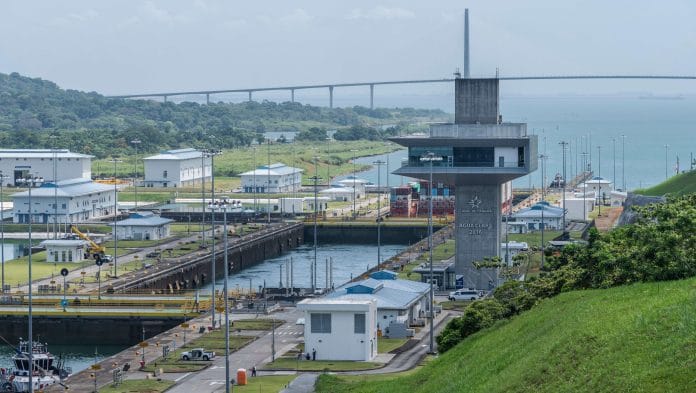
The 80-kilometer Panama Canal cuts through Panama, connecting the Atlantic and Pacific oceans and creating the fastest sea route between Asia and the US East Coast. It also shortens voyages between Europe and the west coast of the US.
Built largely by the US, the man-made waterway opened in 1914. It handled 13,404 transits in fiscal 2025, reflecting a 19% increase over the previous year. Some 6% of global maritime trade passes through it. It’s been operated by the Panama Canal Authority, an agency of Panama’s government, since 1999 when the the US transferred control to the Central American country.
Unlike natural international waterways, which are governed by maritime law, the Panama Canal is considered sovereign infrastructure owned and operated by Panama. The canal authority is therefore permitted to charge transit tolls and does so based on vessel type, capacity and cargo. A medium-sized oil tanker pays roughly $350,000 to $400,000 to reserve a slot to pass through the canal, but auctioned slots can push up the cost to about $1 million during droughts or periods of geopolitical disruption. The Panama Canal Authority generated $5.7 billion in revenue from the waterway in fiscal 2025.
The Panama Canal is not immune to geopolitical tensions. The operation of the Balboa and Cristobal ports there by Hong Kong-based CK Hutchinson Holdings Ltd made the canal a focus of US-China tensions starting last year when President Donald Trump raised concerns about Beijing’s potential influence over the strategic maritime route. Panama in early 2026 invalidated CK Hutchison’s contract to operate the terminals.
Suez Canal
The 193-kilometer Suez Canal cuts through Egypt, linking the Mediterranean and Red seas and providing the shortest sea route between Europe and Asia. It is a vital artery for trade between Europe, the Middle East and Asia, eliminating the need for ships to sail around the southern part of Africa.
Opened in 1869, the man-made canal handled 26,434 vessels in 2023, its highest annual traffic in nearly five decades, and typically carries about 15% of the global maritime trade.
It is operated by Egypt’s state-owned Suez Canal Authority, which oversees navigation and sets transit rules. Like the Panama Canal, the Suez Canal is sovereign infrastructure and the Suez Canal Authority charges tolls on commercial vessels based on the type of ship and the cargo being carried. For a laden tanker of the most common type in the global fleet, one-way passage through the canal can cost around $380,000.
Revenue from the canal reached $4.67 billion in the 2025/2026 fiscal year, Suez Canal Authority Chair Ossama Rabie said in a televised interview.
The canal has repeatedly been at the center of global shipping disruptions, including during the 1956 Suez Crisis, when Egypt nationalized the canal and Israel, the UK and France launched a military intervention that failed to overturn the move. More recently, the canal was blocked for six days in 2021 after a cargo ship got wedged diagonally across it. Revenue from the canal fell 61% in 2024 as a result of ships bypassing the Red Sea to avoid the risk of Houthi attacks. As more vessels returned to the waterway, earnings for fiscal 2025/2026 represented a 23% increase from a year earlier.
–With assistance from Jon Herskovitz, Isabelle Chong, Peter Millard, Alaric Nightingale, Mirette Magdy, Julian Lee and Shadab Nazmi.
This report is auto generated from the Bloomberg news service. ThePrint holds no responsibility for its content.