



Kuwait airport suspended flights and an oil facility was struck after Iran unleashed a heavy attack in retaliation for strikes by the US, as concerns over a re-escalation of the war pushed crude prices sharply higher.
The Gulf state suffered one of its heaviest barrages since the Middle East conflict began, triggering multiple rounds of sirens from around dawn Saturday.
Kuwait Petroleum Corporation said an unspecified oil site sustained “significant material losses” after Iranian attacks, resulting in an evacuation and a number of injuries, according to the state-run Kuwait News Agency. Kuwait Airways rescheduled the majority of its flights, while the Ministry of Electricity and Water said firefighting was underway at a power and desalination plant struck by Iran.
US Central Command earlier said that a seventh night of strikes against the Islamic Republic was halted at 9.30 p.m. Eastern Time Friday, after its forces hit surveillance sites, military logistics infrastructure, underground weapons storage and maritime capabilities.
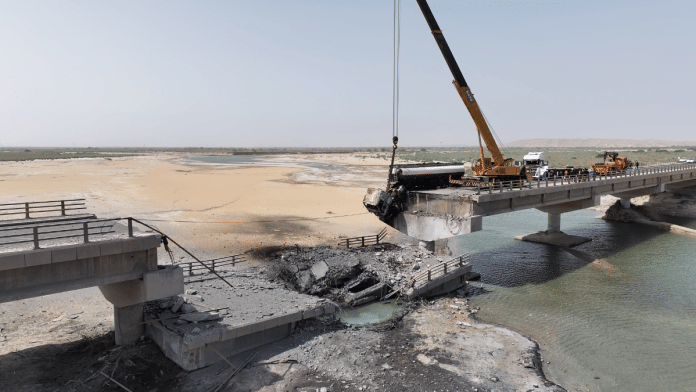
A week of back-and-forth strikes by both sides has expanded beyond strictly military targets to include bridges, utilities and port facilities, suggesting little prospect of a return to the fragile ceasefire signed last month.
Brent crude surged, rising about 4.6% on Friday to settle around $88 and notching its biggest weekly advance since April. That followed an Axios report that the Trump administration notified Israel it is sending more refueling planes to the country, a possible signal that US military operations could be widened. An Israeli military official on Saturday confirmed the plan for the US to boost its Israel-based aircraft fleet.
Tehran has responded to US attacks by targeting American bases in Kuwait, Jordan and Bahrain — the three countries that have borne the brunt of the Islamic Republic’s counterstrikes since fighting picked up early last week — and on Oman’s As Salamah Archipelago, which sits on the strait.
Saudi Arabia’s civil defense said on Saturday it issued warning messages overnight of incoming threats in Yanbu and Kharj governorate. An alert was issued later saying the danger had passed, without providing further details.
Iran also struck at US radar and aircraft in Qatar, one of the main mediators between Washington and Tehran, according to the Tasnim news agency.
Several US service members were injured in Iranian attacks on at least two Jordanian bases this week, CBS reported citing unnamed US officials. Axios separately reported that Iran launched a ballistic missile at a US base in Saudi Arabia.
Central Command did not immediately respond to a request for comment on Friday night.
The escalation has prompted concerns that the ceasefire agreement, meant to help reestablish regular shipping through the Strait of Hormuz and establish a process for longer-term peace talks, can no longer be salvaged.
Addressing the nation on Thursday night, US President Donald Trump again painted the situation in the Mideast as a success. The US is “winning big in Iran, and you will see the fruits of that labor very, very shortly,” he said, before turning his attention toward domestic issues.
China and Pakistan expressed concern over the developments, calling on both the US and Iran to cease hostilities and resume dialogue.
Beyond bombing Iran more often, the US is again blockading its ports and has scrapped a waiver for sanctions on its oil exports.
The worsening hostilities are still far from the scale seen at the height of the war in March and early April. Then, the US and Israel were bombarding Iranian cities on a mass scale and Tehran was firing thousands of drones and missiles at Gulf Arab states and Israel.
Yet with Iran continuing maritime attacks and insisting that all ships seek its permission before sailing through the strait, there’s a good chance both sides continue to escalate, according to Mehran Kamrava, a professor of political science at Georgetown University’s campus in Qatar.
The attacks are “an ominous sign of more to come, worse to come,” Kamrava told Bloomberg TV on Friday from Doha. “Neither side wants to see this escalation but both have become dependent on the path of an escalatory cycle from which they cannot back out. This tit-for-tat is now very dangerous in the sense of attacks and counter attacks on critical infrastructure.”
Disclaimer: This report is auto generated from the Bloomberg news service. ThePrint holds no responsibility for its content.