




By Sakshi Dayal, Shilpa Jamkhandikar and Liz Lee
NEW DELHI, Sept 12 (Reuters) – India and China’s leaders pledged on Saturday to build up business and transport links, New Delhi said, as both rebuild ties badly damaged by a 2020 military clash on their disputed Himalayan border.
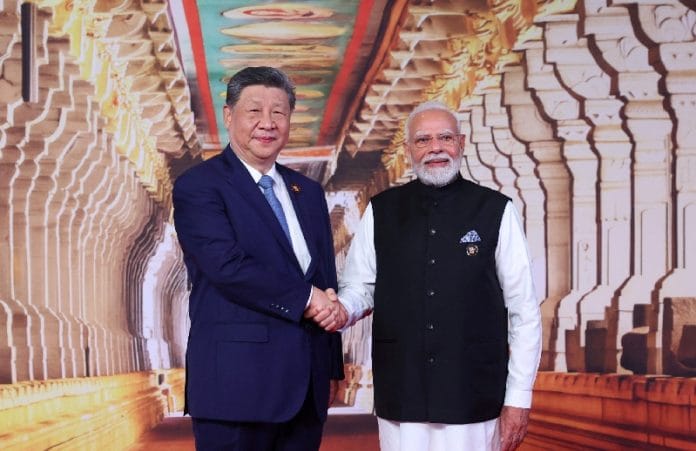
Prime Minister Narendra Modi and President Xi Jinping met on the sidelines of a summit of the BRICS group of emerging nations in New Delhi — Xi’s first trip to India in seven years.
Military tensions have eased, but businesses in both countries say they continue to face hurdles, including red tape, visa delays and restrictions on selling industrial equipment.
“The two leaders … underscored the need to further promote cultural exchanges, business linkages and greater mobility between the two countries,” the Indian foreign ministry said in a statement.
“On economic and trade relations, they underlined the need to address each other’s concerns, including structural trade imbalance and supply chain issues, and facilitation of meaningful and predictable market access,” it said.
Bilateral trade reached a record $155.6 billion in 2025, according to Chinese customs data.
China has become India’s largest source of imports, with Indian purchases from China rising to about $132 billion in the 2025/26 fiscal year. India’s exports to China remain much smaller, leaving New Delhi with a trade deficit of more than $100 billion.
Xi said China has always viewed and developed China-India relations from a strategic and long-term perspective, state-run Xinhua news agency reported.
Institutional exchanges between the two countries are gradually being restored, the list of areas for cooperation is growing and bilateral trade has reached a new high, Xi said according to Xinhua.
China and India fought a brief but brutal border war in 1962, and their relationship soured again after the 2020 border skirmish killed 20 Indian and four Chinese soldiers.
Ties began recovering at the end of 2024 after Xi and Modi agreed to end their military stand-off in the western Himalayas.
Irritants remain as both countries continue to maintain substantial military deployments in the Himalayas and border talks make slow progress.
Modi said that peace in the border areas remained an essential basis for the continued development of bilateral relations, according to the Indian statement.
The nuclear-armed neighbours share a roughly 3,800-km (2,400-mile), largely unmarked frontier.
(Reporting by Sakshi Dayal, Shilpa Jamkhandikar and Hritam Mukherjee in Delhi, Liz Lee and Liam Mo in Beijing; Writing by YP Rajesh; Editing by Andrew Heavens)
Disclaimer: This report is auto generated from the Reuters news service. ThePrint holds no responsibility for its content.