





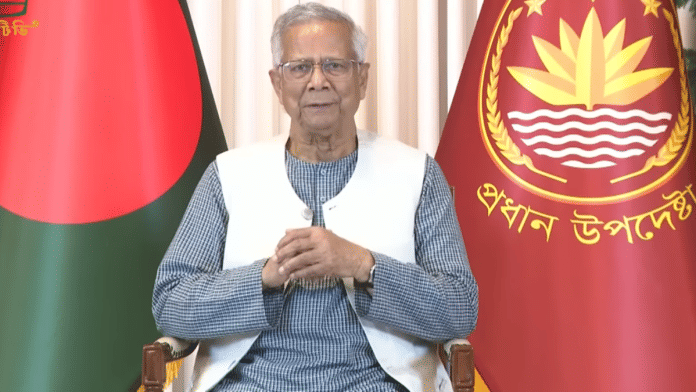



Dhaka: In his farewell address to the nation a few hours before the new government was sworn in, Muhammad Yunus closed out his 18 tumultuous months at the helm of Bangladesh’s interim government with a speech that mixed self-congratulation, nationalist rhetoric and pointed messages to India and China.
Speaking for roughly 25 minutes on national television late Monday night, the Nobel laureate reflected on the upheaval that brought him to office, defended his government’s record and outlined a vision of Bangladesh as a self-confident regional power. But it was his renewed reference to India’s northeastern states — without explicitly mentioning India — that is likely to draw the sharpest reaction from New Delhi.
“It is a great opportunity for Bangladesh to join the global economy. With Nepal, Bhutan, and the Seven Sisters, there is a great possibility of economic growth in this area. With the help of economic control, trade, and free trade in the free market, this area will become a strong and prosperous development center”, Yunus said.
The “Seven Sisters” is a term used to describe India’s northeastern states, a sensitive and strategically vital region. Yunus first raised the issue during a visit to China last year, referring to the region as landlocked and suggesting that Bangladesh could serve as its maritime outlet.
Indian leaders, including External Affairs Minister S. Jaishankar, sharply criticised those remarks at the time. Yunus’s decision to revisit the theme in his final speech as the chief adviser of his outgoing administration, again without naming India, appeared to highlight the strained relations between the two neighbors during his tenure.
‘It is a great opportunity for Bangladesh to join global economy. With Nepal, Bhutan & Seven Sisters, there is a great possibility of economic growth in this area,’ Muhammad Yunus in farewell speech.
Throughout his address, Yunus portrayed Bangladesh as shedding what he described as a “submissive” foreign policy.
“Today’s Bangladesh is confident, active and responsible in protecting its independent interests,” he said. “Bangladesh is no longer dependent on the instructions and advice of other countries.”
The remarks were widely seen as a veiled critique of the previous government led by Sheikh Hasina, whose administration was often viewed by critics at home as being closely aligned with New Delhi.
Also Read: Mohammad Yunus’ departure is good riddance. He misused caretaker’s remit to tilt to Pakistan
Praise for China
The outgoing chief adviser, however, emphasised on what he called a strategy of “strategic balance,” highlighting deepening ties with Beijing. He pointed to progress on a Chinese-backed restoration project on the Teesta River and the construction of a large international hospital in northern Bangladesh—projects that India has watched warily, given their proximity to the Siliguri Corridor, the narrow strip of land linking mainland India to its Northeast.
“In March last year, President Xi Jinping and I announced expanded trade cooperation,” Yunus said, referring to the Chinese leader. “We have strengthened our cooperation with China and moved forward on key development projects.”
Mr. Yunus framed such initiatives as part of a broader effort to reposition Bangladesh in the global economy. He argued that the country’s access to the Bay of Bengal, its youthful workforce and improved trade terms had reduced borrowing costs and opened opportunities for higher-value exports.
Bangladesh, he said, could become a dependable manufacturing and trading hub for partners in East Asia, Europe and North America.
The speech also revisited the dramatic circumstances under which he assumed office. Recalling the turmoil of 5 August 2024 which he described as a day of “liberation” but also of chaos, Yunus said he had initially been reluctant to accept the role while abroad, only agreeing after being persuaded that the country needed a steady hand.
“Our first task was to restore order,” he said, describing a state apparatus hollowed out by corruption and political flight. He cast his administration’s mission as one of rebuilding institutions and restoring democratic dialogue after years of polarisation.
Yet his tenure was marked by domestic criticism as well. Rights groups and opposition voices accused the interim government of failing to curb violence and protect minority communities, including Hindus.
Yunus did not directly address those allegations in detail, instead urging unity and invoking the sacrifices of those who had “given their lives for the nation”.
(Edited by Ajeet Tiwari)
Also Read: Yunus just offered Indian Ocean to China. India must respond to the neighbour’s shenanigans