








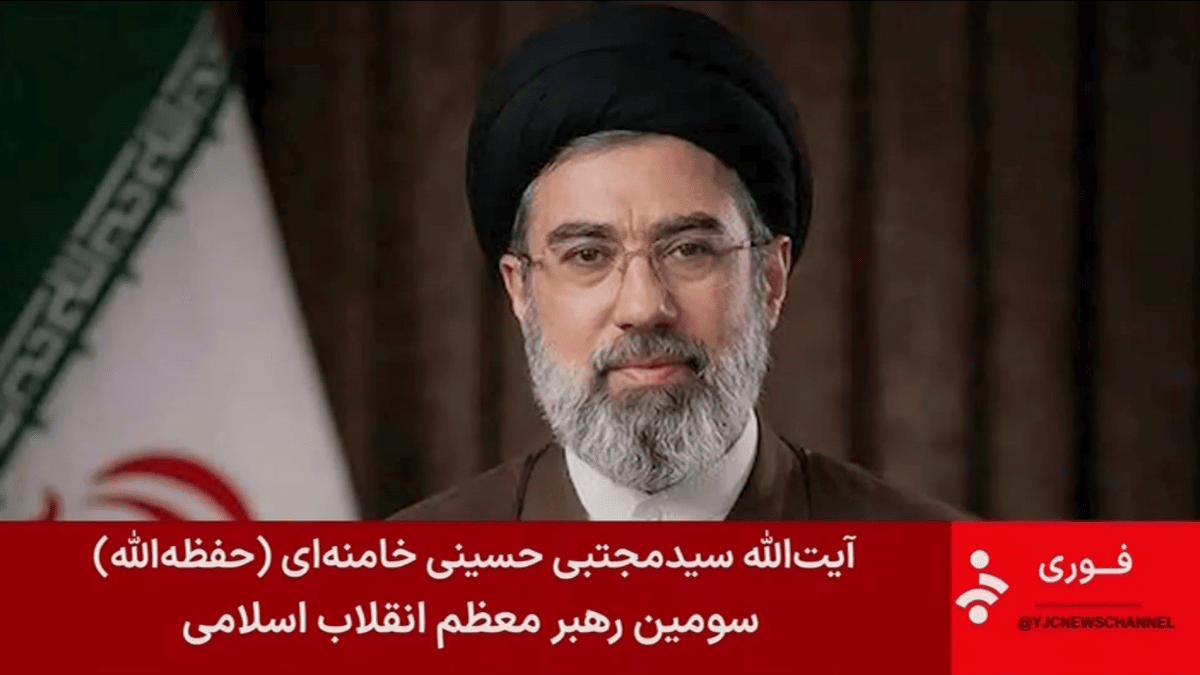
Iran Monday named Mojtaba Khamenei to succeed his father Ayatollah Ali Khamenei as Supreme Leader, signaling that hardliners remain firmly in charge in Tehran a week into its conflict with the US and Israel.
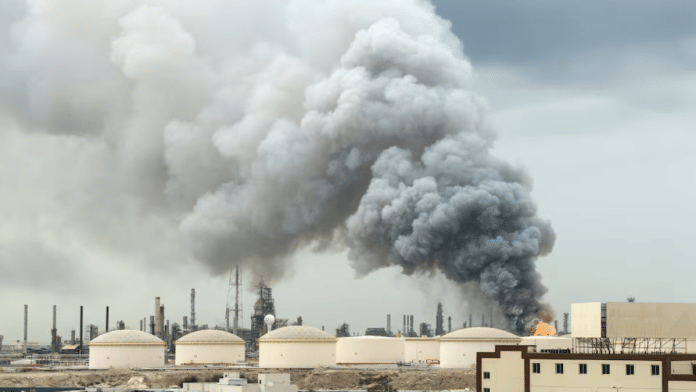
Fighting escalated on day nine of the US-Israeli campaign against Iran. Thick black smoke hung over Tehran Sunday after strikes on oil storage facilities had lit up the night sky with plumes of orange flame.
The war began after the US and Israel struck Iran on 28 February, and more than a dozen countries have been sucked into the fray. Iran has so far reported 1,332 deaths, alongside widespread destruction. Scores of others were killed elsewhere in the region, most of them in Lebanon where Israel has been fighting Iran-backed Hezbollah militia. Seven US service members have lost their lives.
While US President Donald Trump has pressed for an “unconditional surrender”, Iran has said it was not seeking a ceasefire to the war and would punish aggressors.
Israeli Prime Minister Benjamin Netanyahu said his government would press on with the assault and strike Iran’s rulers “without mercy”. “We have an organised plan with many surprises to destabilise the regime and enable change,” he said in a video statement.
Iran and Israel-US conflict | HIGHLIGHTS
4.10 pm: Putin writes to Mojtaba
Kremlin has said that Russian President Vladimir Putin has written to Iran’s new Supreme Leader Mojtaba Khamenei to congratulate him on the appointment.
“At a time when Iran is confronting armed aggression, your tenure in this high position undoubtedly requires great courage and dedication. We are confident that you will honorably uphold your father’s legacy and unite the Iranian people in the face of severe trials,” he wrote.
Putin reiterated Moscow’s “continued support for Tehran”.
3.55 pm: Rahul questions why govt isn’t discussing West Asia crisis
Leader of Opposition Rahul Gandhi told reporters outside Parliament Monday that the West Asia conflict will cause major losses to the Indian economy.
“This will cause a major loss to our economy. You saw the stock market. PM Modi has signed the deal with the US. The country is going to suffer a major blow. So, what problem do they have in discussing that? We can have a discussion on other issues after that. Is West Asia matter not important? Fuel price and economic devastation are not important matters of discussion? These are public issues,” Rahul said.
He said Opposition parties deem the issue important and want a discussion in Parliament over it.
They do not want a discussion because other things will come out of that, because PM’s position will come out of it. How he is compromised and how he is being blackmailed will come up… You saw how the PM ran away from the Parliament. He will not be able to come, I am telling you,” the Congress leader said.
His remarks come after ruckus in Parliament as External Affairs Minister S. Jaishankar addressed both Houses on India’s stand over the conflict. Opposition parties said they wanted a discussion, instead of a statement by the minister.
Jaishankar spoke about New Delhi’s efforts to evacuate or relocate Indians in Iran, the government’s insistence on dialogue to de-escalate tensions, and asserted that it prioritised national interest in energy security.
The minister also said three Iranian ships had sought permission to dock at Indian ports. IRIS Lavan on 4 March docked in Kochi, and its crew is at Indian naval facilities, he said, without explaining what happened to the other two ships.
On 4 March, a US submarine torpedoed Iranian frigate IRIS Dena, killing over 80 crew members on board, off Sri Lanka’s coast. IRIS Dena was on its way back after participating in a multilateral exercise hosted by the Indian Navy in Visakhapatnam.
3.40 pm: One dead in central Israel
CNN reports that one person died in an Iranian ballistic missile attack in central Israel Monday.
Israel’s emergency responders said two others were seriously injured. The country’s authorities said the attack was a result of cluster munitions.
3.15 pm: Iran ‘adamant on friendly relations’ with Gulf nations
Iran Foreign Ministry spokesperson Esmaeil Baghaei, holding a press briefing, said Tehran is “adamant to maintain friendly relations” with countries in West Asia.
But Iran has the “right to defence” if other countries are being used to launch attacks on Iran, he added.
“Our act of defence cannot be interpreted as an act of hostility towards any of these counties,” he said.
The statement comes days after international media reported that Iran’s President Masoud Pezeshkian apologised for strikes across Gulf nations, though IRGC later weighed in, saying Tehran has “committed no aggression against them”.
“However, should the previous hostile actions continue, all military bases and interests of criminal America and the fake Zionist regime on land, at sea, and in the air across the region will be considered primary targets and will come under the powerful and crushing strikes of the mighty armed forces of the Islamic Republic of Iran,” IRGC said.
Pezeshkian later clarified on X that Iran had not in fact attacked any of its neighbours but rather “targeted US military bases, facilities, and installations in the region”.
2.45 pm: Explosions in Tehran
AFP reports that explosions were heard in several parts of Tehran. It isn’t clear what caused the blasts.
Earlier, Israel had said it was launching a fresh wave of attacks on Iran.
1.50 pm: Bahrain’s BAPCO declares ‘force majeure’
Bahrain’s state-owned energy company BAPCO declared force majeure after its refinery took a hit amid the West Asia conflict. Declaring force majeure allows a company to be excused from contractual obligations when an extraordinary event happens that is beyond its control.
1.40 pm: HRW says Israel used white phosphorous in Lebanon
New York-based Human Rights Watch (HRW) has released a report that says Israel used white phosphorus in residential areas of Lebanon’s Yohmor earlier this month, in violation of the international humanitarian law.
The use of white phosphorous is not allowed in residential or civilian areas. The chemical is used in artillery shells, bombs and rockets. It ignites when exposed to oxygen, potentially setting afire homes, agricultural areas and other civilian objects.
“The Israeli military’s unlawful use of white phosphorus over residential areas is extremely alarming and will have dire consequences for civilians,” said Ramzi Kaiss, Lebanon researcher at Human Rights Watch, in a statement published online.
Kaiss added, “The incendiary effects of white phosphorous can cause death or cruel injuries that result in lifelong suffering.”
The report was released even as Israel Defense Forces (IDF) issued a warning, saying it will hit “terrorist infrastructure belonging to Al-Qard Al-Hassan Association”. Israel says the outfit provides monetary support to Iranian regime-affiliated Hezbollah.
12.35 pm: ‘Interest of Indian consumer a priority’
Addressing Lok Sabha, EAM S. Jaishankar said the interest of Indian consumer is paramount for the government.
“In view of the implications of this conflict for our energy security, the government remains committed to ensuring that it takes into account the availability, cost and risks of the energy markets. For us, the interest of the Indian consumer is and will always be the overriding priority,” he said
12.30 pm: What analysts say about impact on Indian economy
Analysts said the sharp increase in crude prices could significantly impact the Indian economy, given the country’s high dependence on imported oil.
“Oil price hit to GDP, current account deficit and inflation will be huge given that India meets more than 85 per cent of its crude oil requirements from imports,” Ajay Bagga told news agency ANI.
He added that the surge in oil prices is likely to result in higher fuel prices domestically.
“We expect retail petrol and diesel price hikes. Cooking gas price was already hiked last week for both consumers and commercial users. Jet aviation fuel prices will also go up,” Bagga said.
Several sectors, he said, will face pressure due to rising oil prices, such as paints, aviation, autos, tyres, chemicals and downstream industries using oil derivatives.
12.20 pm: Protests in Lok Sabha as EAM makes a statement
Opposition leaders raised slogans and displayed placards as Jaishankar address the lower house of Parliament on India’s response to the West Asia crisis.
12.15 pm: BJP’s Naqvi condoles Ali Khamenei’s death
BJP leader Mukhtar Abbas Naqvi signed the condolence book for slain Supreme Leader Ayatollah Ali Khamenei, who was killed in Israeli and US attack on 28 February.
#WATCH | Delhi: BJP leader Mukhtar Abbas Naqvi signed the Condolence Book and offered condolences to Supreme Leader of Iran, Ayatollah Ali Khamenei, who was killed in Israeli and US attacks. pic.twitter.com/3B9vLolOH0
— ANI (@ANI) March 9, 2026
12.00 pm: G7 ‘to discuss’ oil crisis today
The Financial Times has reported that finance ministers of G7 countries — Canada, France, Germany, Italy, Japan, the UK and US — will hold an emergency meeting Monday to discuss a possible joint release of oil reserves to control the surge in prices.
Oil reserves are coordinated by the International Energy Agency (IEA).
Three G7 countries, including the US, have so far expressed their support for a possible joint release, FT reported.
The FT cited one person as saying that some US officials believe a joint release in the range of 300 million to 400 million barrels, or around 25 percent to 30 percent of the 1.2 billion barrels in reserve, would be appropriate.
11.55 am: Bahrain industrial zone targeted?
Reports say an industrial zone, where Bahrain’s national oil company is located, was on fire in Riffa Monday morning. Before this, Iran is believed to have struck the town of Sitra, about 6km from Riffa.
11.40 am: ‘Relocated Indian students, sent others to Armenia’
Jaishankar said the Indian Embassy has “facilitated the relocation of several Indian students in Tehran to places outside”.
He added that Indians in Iran on business “were facilitated to cross over to Armenia to return to India. Our embassy in Tehran remains fully operational and on high alert. We are committed to supporting the Indian community at this time,” he said.
11.30 am: PM closely monitoring situation, says EAM in Parliament
The Prime Minister is “closely monitoring” the emerging developments, and relevant ministries are coordinating to ensure effective responses, External Affairs Minister S. Jaishankar tells Parliament as he makes a statement in Rajya Sabha on the situation in West Asia.
Amid slogans raised by Opposition MPs, Jaishankar said the Indian government had issued a statement, expressing deep concerns and urging all sides to exercise restraint. “We continue to believe that dialogue and diplomacy should be pursued to de-escalate the tensions,” he said, as the second phase of Budget session of Parliament began Monday.
Before parliamentary proceedings began, Congress MP K.C. Venugopal said the party had been demanding a discussion on the West Asia crisis. “India is going to be affected in a very big way. An energy crisis is happening everywhere. Fuel prices are rising day by day. People are in distress,” he said.
#WATCH | Delhi | Opposition MPs, including LoP, Lok Sabha, Rahul Gandhi and LoP, Rajya Sabha, Mallikarjun Kharge, protest at Makar Dwar in Parliament on the West Asia conflict issue pic.twitter.com/zlCcykUhFa
— ANI (@ANI) March 9, 2026
11.25 am: 50 flights by Indian carriers today
West Asia Airspace Situation – Indian carriers plan 50 flights today.
Read more – https://t.co/ibHp76PIDU pic.twitter.com/sWTMlC1evC
— India in UAE (@IndembAbuDhabi) March 9, 2026
11.10 am: Iran calls on public to pledge allegiance to new leader
Iran’s Islamic Propagation Coordination Council Monday called on the public to gather “simultaneously across the country” at 3 pm local time and take an oath of allegiance to the new Supreme Leader, Mojtaba Khamenei, according to the state-run Islamic Republic News Agency (IRNA). In Tehran, IRNA said, the main gathering will take place at Inqelab Square.
10.55 am: Trump ‘not happy’ with Mojtaba’s elevation
Fox News reports that US President Donald Trump is “not happy” that Iran has appointed hardline cleric and Ayatollah Ali Khamenei’s son Mojtaba Khamenei as its new Supreme leader.
Fox News anchor Brian Kilmeade said in a programme that he spoke with the President, who told him, “I am not happy.” Trump is yet to react publicly to Iran’s announcement, made after midnight local time.
10.40 am: Bangladesh to close universities to conserve fuel, power
Reuters reports that Bangladesh has closed all universities Monday, bringing forward the Eid al-Fitr holidays as part of emergency measures to conserve electricity and fuel amid a worsening energy crisis linked to the conflict in West Asia. Authorities said the decision applies to all public and private universities across the country. Officials said the move will not only reduce electricity consumption but also ease traffic congestion.
10.35 am: On the ground
International media reports say Israel launched strikes on central Iran, hours after Tehran announced Mojtaba Khamenei as the country’s new Supreme Leader. Iran’s Islamic Revolutionary Guard Corps also announced new missile launches.
On Monday, Israel continued pounding Beirut, where it says it was targeting Hezbollah infrastructure.
10.30 am: South Korea to cap fuel prices
As markets world over tumble, South Korean President Lee Jae Myung said the government would “swiftly and decisively implement” a maximum price system on petroleum products.
According to a Bloomberg report, South Korea imports almost all of its energy supplies, with about 70 percent of its oil cargoes typically shipped through the Strait of Hormuz. The move to impose a price cap—the first time such a measure will have been used in nearly 30 years—is part of a broader effort to stabilize domestic energy markets as geopolitical tensions disrupt supply chains.
10.25 am: Ending war will be ‘mutual’ decision with Netanyahu, says Trump
US President Donald Trump told the Times of Israel that a decision on when to end the war with Iran will be a “mutual” one that he will make with Israeli Prime Minister Benjamin Netanyahu.
Trump said the two of them were in touch and that he would “make a decision at the right time”.
On Sunday night, Trump dismissed the hike in oil prices as a “small price to pay” to eliminate Iran’s nuclear threat and reiterating that the rise was temporary.
“Short term oil prices, which will drop rapidly when the destruction of the Iran nuclear threat is over, is a very small price to pay for U.S.A., and World, Safety and Peace,” he wrote on social media Sunday evening.
“ONLY FOOLS WOULD THINK DIFFERENTLY!” he argued.
9.50 am: No Indian fatality in Al Kharj incident, says embassy
There was no Indian fatality in the projectile incident that struck a residential compound in Saudi Arabia, the Indian Embassy in Riyadh said on Monday.
It added that an Indian national injured in the incident on Sunday is undergoing treatment at a government hospital. “It is a matter of relief that there has been no Indian fatality in the unfortunate incident at Al Kharj yesterday evening,” the mission said in a social media post.
The embassy said it has been in touch with the concerned Saudi authorities regarding the matter.
Counsellor (Community Welfare) Y Sabir visited Al-Kharj on Sunday night and met the injured Indian national involved in the incident, it said. “He is currently receiving treatment at a government hospital in Al Kharj,” the mission said.
9.40 am: India’s Sensex crashes 2,345 points in early trade
Indian benchmark indices fell down sharply at the opening on Monday, mirroring the trend across global markets as the Iran war prolonged.
Sensex crashed 2,345.89 points to 76,573.01 in early trade, and Nifty tumbled 708.75 points to drop below 23,741.70. The Indian Rupee also plummeted 43 paise to 92.25 against US dollar in early trade.
9.35 am: Oil price exceeds $100 a barrel
Equities tumbled as crude oil surged above $100 a barrel for the first time since 2022, with the US-Israeli war against Iran showing no sign of easing and both sides appearing set to prolong the conflict. Investors flocked to the dollar as a safe store of value.
Asia’s benchmark share index fell as much as 5.6 percent—the most since April—with South Korea dropping about 8 percent and Japan almost 7 percent. Equity-index futures for the US and Europe slid more than 2.5 percent, indicating the selloff is set to expand to other regions.
The turmoil came as Brent crude oil jumped as much as 29 percent to $119.50 a barrel, adding to last week’s 28 percent surge as the conflict entered a second week. Major oil producers also began curbing output and traffic through the Strait of Hormuz effectively halted.
9.00 am: US tells its Saudi diplomats to leave country
The US State Department has ordered American employees and diplomats in Saudi Arabia to leave the country over safety concerns. The order was issued for non-emergency US government employees and their family members to leave Saudi Arabia, according to a social media post by the US Embassy in Riyadh Monday.
8.30 am: US confirms 7th casualty in war
A US service member died after sustaining injuries during an attack last week in Saudi Arabia, US Central Command said on X, bringing the number of American troops killed in the Iran war to seven.
“Last night, a U.S. service member passed away from injuries received during the Iranian regime’s initial attacks across the Middle East. The service member was seriously wounded at the scene of an attack on U.S. troops in the Kingdom of Saudi Arabia on March 1,” the CENTCOM said.
8.00 am: A hardline cleric at the helm
The big story overnight is still the appointment of Mojtaba, a mid-ranking cleric with influence inside Iran’s security forces and vast business networks under his father. He was seen as a frontrunner in the lead up to the vote by the Assembly of Experts, a body of 88 clerics charged with choosing the new leader after Ali Khamenei was killed in US-Israel strikes on 28 February.
“By a decisive vote, the Assembly of Experts appointed Ayatollah Seyyed Mojtaba Hosseini Khamenei as the third Leader of the sacred system of the Islamic Republic of Iran,” the assembly said in a statement issued just after midnight Tehran time.
Mojtaba’s appointment will likely draw the ire of Trump, who said Sunday that Washington should have a say in the selection. “If he doesn’t get approval from us, he’s not going to last long,” he told ABC News.
Israel, ahead of the announcement, threatened to target whoever was chosen.