





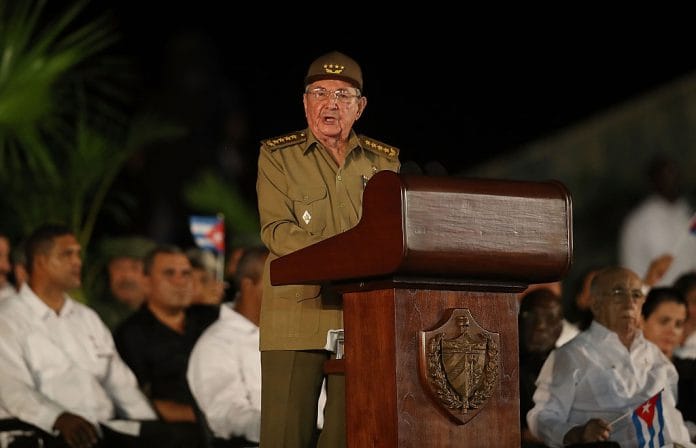


New Delhi: The US has indicted former Cuban president Raul Castro related to the 1996 shootdown of two planes–at a time when American President Donald Trump has threatened possible military action against the Communist government-led island.
The indictment – on charges of murder, conspiracy to kill American nationals and destruction of aircraft–brings a formal legal reckoning, however symbolic, to an incident that has frayed US-Cuba relations for nearly three decades.
Announced by the US Department of Justice in Miami on 20 May, the indictment centres on the events of 24 February 1996, when Cuban MiG fighter jets fired air-to-air missiles at two unarmed Cessna aircraft over the Florida Straits, killing four men, three of them US citizens. The planes belonged to Brothers to the Rescue, a Miami-based Cuban exile organisation. US prosecutors allege that Castro, then Cuba’s defence minister, approved or directed the operation.
The Trump administration framed the charges as a pursuit of “justice” for American victims. But Cuban President Miguel Díaz-Canel called the case an attempt to justify further aggression against the island and his government said the charges have “no legal basis”.
Castro, now 94 and living in Cuba, is unlikely to face extradition, but the indictment was being viewed by some as an escalation ahead of possible military action by the US, not unlike the one carried out in Venezuela.
In January this year, American forces stormed Caracas and extracted Venezuela President Nicolas Maduro, who is now facing drug-trafficking charges in New York.
Also Read: Will Trump’s dance with China nudge South Korea & Japan to cross the nuclear threshold?
Who is Raul Castro?
Raul Castro is the younger brother of revolutionary leader Fidel Castro and one of the most consequential figures in modern Cuban history. Born in 1931, he fought alongside Fidel in the revolution that overthrew dictator Fulgencio Batista in 1959.
While Fidel became the face of communist Cuba internationally, Raul controlled the country’s military and intelligence apparatus for decades. His tenure as defence minister, spanning nearly 50 years, is among the longest in that role in the world.
He became President in 2008 following Fidel’s illness, and during his presidency introduced limited economic reforms and helped broker restoration of diplomatic relations with the US during the Obama administration in 2014. Cuba remained a one-party communist state throughout, and his government faced persistent accusations of suppressing dissent.
Castro stepped down as president in 2018 and retired from Communist Party leadership in 2021, but is regarded as a continuing influence within the country’s military and political establishment.
What happened in 1996?
Brothers to the Rescue began as a humanitarian organisation, using small aircraft to locate Cuban migrants making dangerous sea crossings to Florida. Over time, it grew politically active against the Cuban government, flying near Cuban airspace and dropping anti-Castro leaflets.
Cuba, for months, warned the group and the US to stay out of its airspace.
On 24 February 1996, two of the outfit’s Cessna aircraft were intercepted by Cuban MiG fighter jets and destroyed with air-to-air missiles. All four people aboard were killed.
Cuba defended the action as a response to sovereignty violations, arguing the aircraft posed a security threat. But the International Civil Aviation Organisation (ICAO), of the United Nations, concluded the aircraft were likely shot down in international airspace and presented no immediate military threat.
Then US President Bill Clinton responded by tightening sanctions on Havana through what was called the Helms-Burton Act, which strengthened the US embargo against Cuba and remains a cornerstone of American policy toward the island.
Why does the case still matter?
The indictment matters less as a legal proceeding—Castro is unlikely to appear willingly before an American judge—and more as a statement about how Cold War-era conflicts continue to shape contemporary geopolitics.
For the families of the four victims and Cuban-American exile groups in Florida, the 1996 shootdown has never stopped being a grievance. Both have demanded accountability for decades; the indictment gives that demand formal legal expression.
The broader context also gives the timing significance.
Cuba is currently enduring one of its most severe economic crises in decades, with acute shortages of fuel, medicine and electricity – much of which is because of Trump’s latest embargo on supplies to the island. Some dissidents argue that the indictment could erode the Cuban regime’s standing symbolically, even without legal consequence. Analysts see the charges as part of Washington’s wider pressure campaign against Havana’s communist leadership — a pattern, they argue, of using criminal indictments as geopolitical instruments.
Havana, for its part, has characterised the charges as political cover for harsher American measures against the island.