


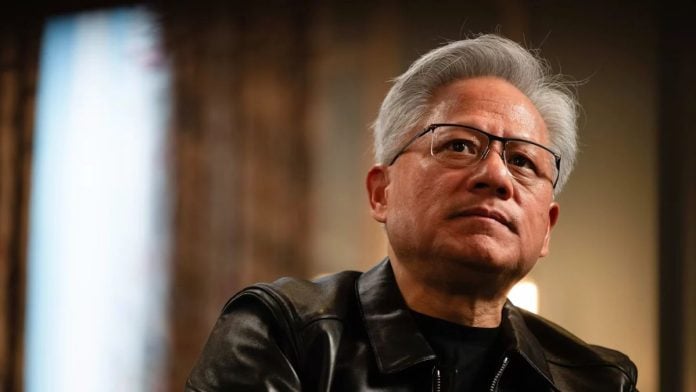
Jensen Huang’s dizzyingly swift departure from Nvidia Corp., the innovative chipmaker he founded and turned into the world’s most valuable company and backbone of the artificial-intelligence boom, seems to come straight from the pages of a novel by John le Carré. The tale of a brilliant billionaire brought down by a “honey-trap” spy, and by an affair with a subordinate, is irresistible.
It may be more important, however, to view it in the dry terms of corporate governance — and focus on the directors and investors who gave him such power. How could Huang possibly have been allowed to grow so critical to the Santa Clara-based multinational, with so little oversight, that he thought he could get away with such behavior? And why were capital markets prepared to take such a huge risk on one man?
The Key Man
A day after the news of his departure, the stock market put Nvidia’s worth at $1.8 trillion less than it was five weeks ago. It has published no new results in that time (third-quarter earnings are due after the market closes on Tuesday). While last week’s US midterms made the politics of AI far more complicated, this cannot be chalked up to problems with the industry. The Nasdaq 100 index, which includes Nvidia as its second-biggest component, has risen more than 5% since news of Huang’s first affair broke last weekend.
Bloomberg found nine separate Wall Street firms that cut their share price targets for Nvidia on Thursday morning, once Huang’s ouster became official, by an average of 37%. They hadn’t acted earlier, so this is driven unambiguously by the belief that the firm will not be able to do without him.It’s questionable whether anyone is truly that important. Perhaps the closest parallel is Steve Jobs, the founder of Apple Inc., a figure possibly even more galvanic than Huang, who died of pancreatic cancer in 2011 and appeared irreplaceable at the time. Apple was the second-largest company in the US, behind ExxonMobil. Now, after the lengthy tenure of Tim Cook, it is the biggest. Anyone buying Apple when Cook took over would have beaten the S&P 500 by more than 370%.If even Jobs wasn’t such a key man, why should Huang be different? It’s possible to argue that Jobs, who lived with cancer for several years, had planned far more responsibly for the future. Cook was one of four direct lieutenants who all had enough experience of the company to be credible successors. Jobs had a clear and unvarying long-term strategy (which in part prompted his ouster in 1985 when Apple seemed to have decisively lost to Bill Gates and Microsoft Corp.), leaving no doubt as to how Cook would proceed.
Huang is different. He’s 63 and in good health, but accidents can happen. Yet he had no number-two, no chair of the board overseeing him, and no succession plan. Sixty separate executives all reported directly to him. Huang could have mitigated key-person risk as Jobs did, either by sharing responsibilities more widely or by arranging a clear strategy to succeed him. But he didn’t. Markets could have taken account of this risk by imposing a discount, or by advancing shareholder motions to bring him to heel. They didn’t.
The Offense
Given all this, he had to go only because he gave the board no choice. Consensual extramarital affairs might these days be bracketed as a private choice that’s none of the directors’ business — but liaisons both with a suspected Chinese spy and with a senior executive who reported directly to him were beyond the pale. Nobody could expect to maintain their job after such behavior became public.
Everyone is subject to temptation. Still, in the harsh spotlight after being caught, it’s impossible not to ask how someone as intelligent as Huang, who had so much to lose, could have been so dumb? Corporate governance has something to do with it. Allowing him such free rein, with a management system that made him indispensable, in all probability helped Huang fall victim to hubris. For their own good, these men (and at present they’re all men) need to have limits imposed on them.
However, once hubris develops, deciding who is good enough to come after you grows even more difficult. It’s only human to consider oneself irreplaceable and to recoil from confronting mortality. Most memorably, when the Wall Street Journal asked an 84-year-old Sumner Redstone, then chairman of CBS and Viacom, about his succession plans, he replied: “I expect to live to 120. I don’t intend to die.”
Huang’s lack of such a blueprint contributed to the panicked selling of Nvidia shares over the last week. This has implications in Silicon Valley for other companies worth more than a trillion dollars. Founders these days expect to maintain control over their empires even when they take money from others and expect them to share in the risks. Mark Zuckerberg could not be fired from Meta Platforms Inc. because he controls more than half the company. Elon Musk is similarly invulnerable at Tesla Inc. and SpaceX.
The G in ESG
It is surely time to rethink the free rein that founders have been given, and to take corporate governance seriously. This has become entangled of late in the political culture war over Environmental, Social and Governance (ESG) investing, which grew fast in the era after the Global Financial Crisis. In the last few years, it has been successfully labeled as “woke” investing by conservative politicians. US-based ESG funds took in a net $70 billion in 2021, but have suffered net outflows, totaling $54 billion, in each of the last three years.
There’s nothing obviously woke about shareholders asserting their rights. It’s as capitalist as it gets. A United Nations body coined the term “ESG” in 2004 in a bid to promote a coherent and broad approach. The idea was that good governance was the precondition for getting companies to improve their social and environmental records, but Wall Street found it difficult to combine G with E and S. For example, as a maker of electric vehicles, Tesla is a clear candidate for such investment on environmentalist grounds, but Musk’s unchecked power rules it out on governance criteria. This conundrum has contributed to major inconsistencies between different rating agencies over defining ESG.
But the idea behind ESG was that activism might help companies like Nvidia confront obvious problems, such as key-man risk. As Larry Fink of BlackRock said in 2017, in a quote subsequently used against him, investors must “force behaviors” in the companies they own if they want to effect change. Concerted investor action might have pushed Huang and his board into making changes from which all would have benefited. But that was always unlikely given the huge returns that he was delivering for shareholders. Now, the political tide has moved against such activism and Governance has been thrown out with the ESG bathwater.
That’s a shame. When MSCI crunched the numbers across developed and emerging markets for the years from 2015 to 2023, it found that the companies that scored in the top fifth for corporate governance outperformed the laggards by a cumulative 26.3% (2.7% per year). Take away the sideshow of political controversy, and that’s the kind of performance differential that would usually get investors very interested. To a statistically significant degree, well-governed firms had stronger gross profitability and lower volatility and earnings variability than the rest.
This doesn’t mean that ESG investing wasn’t oversold. But it does strongly support the common-sense intuition that companies whose governance forces them to be responsive to shareholders will tend to perform better and be a less risky proposition. Nvidia has put together one of the greatest runs in corporate history under Huang, and it remains the second-most valuable company in the US. But it was obviously under excessive key-man risk, and investors didn’t take that into account.
They should have done so. With any luck, it may be Huang’s lasting gift to Silicon Valley that the forthcoming huge IPOs from a range of big players are thwarted by investors from taking such risks themselves.
Disclaimer: This report is auto generated from the Bloomberg news service. ThePrint holds no responsibility for its content.