


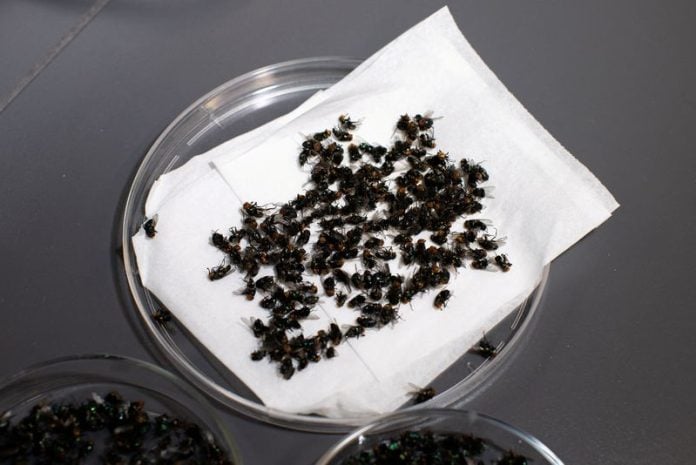
MEXICO CITY/WASHINGTON, Nov 9 (Reuters) – For decades, planes dropped billions of factory-bred sterile flies to keep the flesh-eating New World screwworm out of North America’s cattle. That controls the pest because sterile males mate with wild females – whose eggs then fail to hatch.
But the strategy works only if the supply of flies never runs short.
When the parasite broke through a barrier of sterile flies in Panama in early 2023, the region lacked the capacity to contain it. Efforts to scale up the fly population still lag more than three years into the outbreak, after the parasite ripped through Mexico and into the United States, according to Reuters interviews with 15 current and former officials and experts in the US, Mexico and Panama.
Short on flies, the administration of US President Donald Trump closed the border with Mexico to cattle imports for more than 15 months starting in May 2025, disrupting a multibillion-dollar trade. As the border began to reopen this year, dozens of cases were confirmed in US cattle.
Mexico and Panama currently produce a total of about 150 million sterile flies a week, according to US and Mexican government data.
That’s less than a third of the 500 million per week it took during a 1960s campaign that eradicated the screwworm in the US – and that experts recommend as the benchmark to keep the pest contained to south of Panama. The US has no sterile-fly plant of its own, and one under construction in Texas isn’t expected to start production until spring 2027.
Meanwhile, the parasite has spread across most of Mexico, with about 51,000 confirmed cases. The United States has recorded 120 cases to date.
“We don’t have enough flies,” said Sonja Swiger, an entomologist at Texas A&M University. “They knew that right away.”
Efforts to make more flies at several stages of the infestation have been hampered by political transitions, funding delays, bureaucratic hurdles and rising US-Mexico tensions, current and former government officials told Reuters.
USDA spokesperson Nancy McNiff said in emailed responses to Reuters that the agency has “acted urgently and pursued every practical avenue to get more sterile flies into the field as quickly as possible.”
Spokespeople for Mexican President Claudia Sheinbaum, Mexico’s agriculture ministry, the Panama-United States Commission for the Eradication and Prevention of Screwworm (COPEG) and Panama’s government did not respond to requests for comment.
ALARM IN PANAMA
Screwworm larvae tear through living tissue and can kill untreated animals. A single fly can lay up to 3,000 eggs.
Releases of billions of factory-made sterile flies eradicated screwworm in the US in 1966 and contained a flare-up in Florida in 2017.
In late February 2023, officials in Panama’s Darien province confronted about 800 cases of screwworm inside the jungle that had long served as North America’s last line of defense.
Maintaining that barrier is the job of COPEG, the US-Panamanian organization that gets most of its funding from the US. In April 2023, it decided to increase sterile-fly production to 100 million a week from 20 million a week, said a Panamanian official involved in the response.
By July 2023, Panama declared the spread of screwworm an emergency, expanding sterile-fly releases, tightening livestock controls and intensifying surveillance.
In December 2023, the administration of former US President Joe Biden announced nearly $110 million in additional funding for screwworm detection and sterile-fly production in Panama and elsewhere.
In November 2024, 19 months into the expansion, Panama’s plant reached 100 million flies a week, according to the Panamanian official.
That month Mexico confirmed its first cases in Chiapas, a southern state bordering Guatemala, and began releases.
By then, the authorities knew that 100 million sterile flies a week was not enough, the Panamanian official told Reuters.
GAPS IN MEXICO
Elections in the United States and Mexico slowed the response.
In September 2024, as President Andres Manuel Lopez Obrador’s administration prepared to leave office, outgoing officials warned their successors that the screwworm epidemic needed immediate attention, a Mexican official familiar with the response said.
Early planning centered on converting an existing fruit-fly plant in Metapa, Chiapas, rather than building a new plant.
The handover delayed the effort by three to four months, the official said, as the new government sorted out funding and prepared a proposal for President Claudia Sheinbaum.
In May 2025, the Trump administration announced $21 million in funding for the Metapa project. US and Mexican officials said the plant could eventually produce 60 million to 100 million sterile flies a week.
Sterile-fly drops from COPEG shifted to the Texas-Mexico border in February 2026.
Sheinbaum pushed agencies to accelerate Mexico’s plant project, seeking an April launch, according to the Mexican government official. In the end, the facility was inaugurated on June 27 – more than 18 months after the country confirmed its first screwworm case.
By then, the parasite had spread across 27 states, reaching major cattle-producing areas of Coahuila and Durango in northern Mexico, hundreds of miles from the southern border.
A PLANT IN TEXAS
The first US case was confirmed on June 3. But the US still had no production facility of its own.
USDA had begun discussing a facility in November 2024, and field staff met with Texas cattle industry groups about locations that month and in December, according to a former Biden official.
In June 2025, Agriculture Secretary Brooke Rollins said the USDA was considering Moore Air Force Base in Edinburg, Texas, home to a retired fly plant that had been key to the success of the 1960s campaign.
This March, the Trump administration awarded a $610 million contract to M.A. Mortenson to construct the facility, according to publicly available records of the contract through a US government spending database.
The USDA initially believed the project could take up to five years, spokesperson McNiff said.
Administration officials pressed to move faster. USDA limited bids on construction, arguing that open bidding could delay a time-sensitive project, according to the spending records.
At a September meeting of the Texas A&M Board of Regents, Rollins said Defense Secretary Pete Hegseth had moved the project to the top of the Army Corps’ priority list, cutting the timeline to about 18 months, or fall 2027.
John Bellinger, Rollins’ advisor on screwworm and a member of the board, said he pushed to move even faster. “For only $250 million more, we got it moved to April 1 of next year,” Bellinger told the regents, further shortening the timeline by about six months.
Mortenson spokesperson Cameron Snyder said in an email that the company is committed to working with the USDA and the Army Corps to deliver the plant quickly.
Until the plant opens, the United States remains reliant on sterile flies produced elsewhere, roughly 150 million a week combined from the plants in Panama and Metapa, Mexico.
Although Chiapas remains Mexico’s hardest-hit state, with about 8,200 confirmed infestations, USDA said all sterile flies produced in Panama and Mexico are currently being released in northern Mexico and the US.
The strategy aims to stop the parasite’s northward advance before working back south, leaving much of Mexico and Central America reliant on surveillance and treatment, rather than eradication.
Even where cases have been suppressed, protection depends on sterile flies arriving week after week, Swiger said.
Some experts estimate it could take as long as a decade to push the screwworm infestation back to Panama. That leaves North America’s defense against the pest dependent on a biological supply chain that – more than three years into the outbreak – still produces only a fraction of the needed sterile flies.
(Reporting by Cassandra Garrison and Adriana Barrera in Mexico City and Leah Douglas in Washington. Editing by Emily Schmall and Suzanne Goldenberg)
Disclaimer: This report is auto generated from the Reuters news service. ThePrint holds no responsibility for its content.