





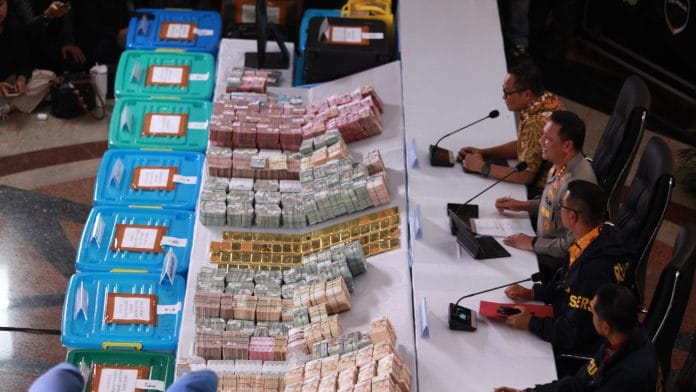


Rows of gold bars, stacks of US and Singapore dollars and seven suitcases found inside a locked safe have become the defining images of one of the biggest scandals to hit Indonesia’s law-enforcement establishment in years.
Police said they recovered 74 kilograms (163 pounds) of gold, plus more than $15 million in multiple currencies from a house linked to Febrie Adriansyah, who until last week served as Indonesia’s deputy attorney general for special crimes, and is now suspected of corruption.
Authorities estimate the bullion and cash found at the Sentul residence in Bogor, southeast of Jakarta, are worth about 476 billion rupiah ($26 million). Images of neatly arranged gold bars and bundles of banknotes have featured prominently across Indonesian television and news websites since the raids.
The scandal raises serious questions for Indonesia, where the rupiah tumbled 10% in the past year to become Asia’s worst-performing currency over concerns about institutional integrity and policymaking. A big question is whether the discovery of the riches shows that guardrails against graft are working, or whether a succession of scandals indicate corruption is worsening.
“Any corruption case involving a senior government official can negatively affect investor confidence, as it raises concerns about governance and the investment climate,” said Henry Wibowo, director at Alphagate Capital in Jakarta. “However, if this reflects a genuine commitment by the government to strengthen governance and clean up corruption, it could ultimately be viewed positively.”
The rupiah weakened to its lowest in more than a month on Monday as oil prices and the dollar advanced on the conflict in the Middle East. The 10-year government bond yield climbed 3 basis points to 7.26%, while stocks were little changed in volatile trading.
The case has created an unusual institutional dilemma. Police said the investigations would be transferred in stages to the Attorney General’s Office, meaning the institution Febrie led until days ago will now handle proceedings against its former senior official.
News outlet Tempo meanwhile reported an apparent confrontation involving police investigators and military personnel during the searches. The military said its presence was part of an authorized assignment to protect prosecutors and wasn’t intended to obstruct the investigation.
The episode reflects tensions dating to the separation of the police from the armed forces after the fall of President Suharto, according to Kevin O’Rourke, an independent political analyst who publishes Reformasi Weekly. The late dictator’s fall in 1998 ushered in both democracy and a security overhaul aimed at curbing the military’s role in politics and domestic law enforcement.
“This is the latest iteration of longstanding tensions originating in the change in the institutions’ respective roles upon the fall of Suharto,” O’Rourke said.
Police on Saturday named Febrie and businessman Don Ritto suspects in corruption and money-laundering investigations after questioning 15 witnesses, consulting two experts and searching 13 locations in Jakarta and nearby Sentul. Indonesia’s Corruption Eradication Commission separately said it suspects the Sentul residence was formally registered under the name of an unrelated nominee.
Febrie has acknowledged the property where the gold and cash were found was his longtime private residence but denied wrongdoing or ownership of the assets. He said the gold and money “have an owner,” without publicly identifying them, and that their provenance would be explained through the legal process.
Immigration authorities have barred Febrie and Ritto from leaving Indonesia for 20 days, but Febrie hadn’t been detained as of the latest public statements by prosecutors. Ritto couldn’t immediately be reached for comment.
The police announcement came a day after Febrie resigned. The Attorney General’s Office said his departure was intended to safeguard the integrity, objectivity and neutrality of law enforcement.
As Indonesia’s top corruption prosecutor and the operational head of one of President Prabowo Subianto’s flagship enforcement programs, Febrie wielded influence across criminal investigations, state revenue and natural-resource governance.
As head of the Attorney General Office’s Special Crimes Division, he supervised cases involving state tin miner Timah, oil company Pertamina, flag carrier Garuda Indonesia, the free meals program, and former Education Minister Nadiem Makarim.
There have been criticisms of some of those cases. Nadiem’s recent conviction and 10-year prison sentence raised questions among observers over how Southeast Asia’s largest economy distinguishes graft from disputed policy and business decisions.
Febrie also chaired the implementing team of Prabowo’s Forest Area Enforcement Task Force, helping lead the campaign to reclaim land and revenue from palm-oil and mining companies accused of operating illegally in forest areas.
In May, Prabowo presided over the handover of 10.3 trillion rupiah in penalties and other state revenue, along with 2.4 million hectares of recovered forest land. The government has also said the task force has taken control of almost 5.9 million hectares used for palm-oil plantations and more than 12,000 hectares used for mining.
On Monday, the Ministry of Defense convened a closed-door meeting of the group, and it was unclear if Febrie remained chairman. Representatives from the military and the Attorney General’s Office attended, though no police officials were seen, even though the National Police is also represented on the task force.
Task force spokesman Barita Simanjuntak said after the meeting that its work would continue uninterrupted because it was governed by institutional mechanisms rather than any single official. He declined to say who would replace Febrie, referring questions to the attorney general.
Police said Febrie is suspected of committing corruption offenses while serving as a state official, including in connection with the handling of a case involving state insurer Asabri. The investigations also involve alleged irregularities linked to coal supplies for state electricity company PLN and a debt settlement involving a Krakatau Steel-related entity, though authorities haven’t detailed his alleged role in each matter.
It’s unclear if the probe of Febrie will affect ongoing investigations connected with the high-profile prosecutor, but the likelihood is that the episode will reinforce concerns about graft in the country.
Indonesia ranks 109th in Transparency International’s 2025 Corruption Perceptions Index, below Zambia and Sri Lanka and down 10 places from 2024, when former general Prabowo was elected president.
Prabowo has repeatedly vowed to clamp down on corruption, though his flagship, roughly $15 billion food-for-kids program is currently the subject of a graft probe, with his handpicked head of the operation named as a suspect.
Disclaimer: This report is auto generated from the Bloomberg news service. ThePrint holds no responsibility for its content.