


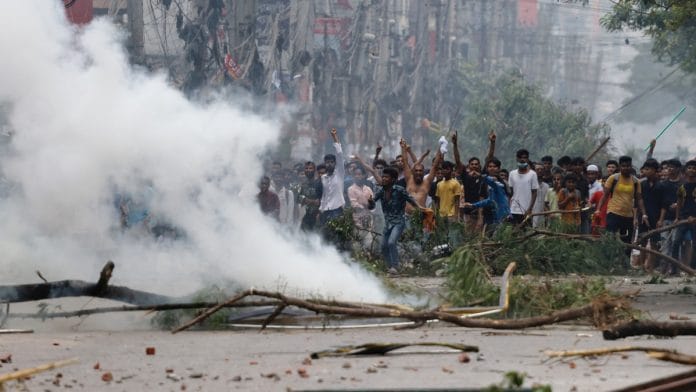
New Delhi: A new academic paper on the 2024 student-led movement that toppled Sheikh Hasina in Bangladesh looked into how universities across the country helped turn a narrow grievance into a nationwide revolt, offering young people the networks, visibility and collective strength to challenge a government. In that, universities acted as ‘incubators’ for a larger nationwide movement, the paper said.
The study, ‘Universities as Incubators of Mass Uprising’, by economists Sultan Mehmood and Ahmed Mushfiq Mobarak published as a Cowles Foundation (research institute at Yale University, Connecticut) discussion paper in September 2026, draws on high-frequency, geographically mapped protest data from Bangladesh’s 2024 uprising called the ‘monsoon revolution’, alongside Facebook activity, social connectivity measures, university enrolment figures and demographic details.
Three key patterns
Researchers identify three key patterns. First, protests on university campuses preceded their spread beyond campus. Second, districts with larger student populations witnessed greater protest activity, both on and off campus—a relationship that did not hold for non-student youth, educated adults, urban populations or areas with authorised but non-operational universities. Third, social connections to districts experiencing campus protests predicted the spread of demonstrations elsewhere a week later.
The paper’s central argument is that universities are not merely places where political dissent takes shape. They can also serve as incubators of mass mobilisation, bringing together young people, making grievances visible and providing the social networks needed to turn individual discontent into collective action.
“Why do universities play this distinctive role in political dissent, thereby becoming targets of state repression? Campuses bring educated young people into common physical spaces, generate repeated interaction, and sustain social and organisational networks that may make grievances easier to observe and collective action easier to coordinate,” the paper notes.
Why campuses matter
The paper argues that a university can thus help solve one of the central problems facing any protest movement— how to persuade individuals who are dissatisfied with a government that they are not alone.
The authors argue that universities offer a combination of conditions that are difficult to replicate elsewhere. They bring large numbers of young people into regular physical contact. Students interact repeatedly, share information and develop social relationships. Campuses also provide organisational infrastructure, including student associations, political groups and residential halls, through which collective action can be coordinated.
Just as importantly, they make participation visible. When students see their peers demonstrating, the perceived risks of joining a protest can change. Participation by others provides information about the strength of a movement and the willingness of people to challenge authority.
The researchers tested this proposition using protest data from Bangladesh’s 64 districts over 26 weeks, from 18 March to 9 September 2024. Their analysis combines information from the Armed Conflict Location and Event Data project (ACLED) with education statistics from the Bangladesh Bureau of Educational Information and Statistics.
The bureau measures student concentration as the number of university and college students relative to a district’s population. In Bangladesh, the term college also includes institutions providing education at the higher-secondary level, or grades 11 and 12.
The average district has 3.54 students for every 100 residents. The researchers compare changes in protest activity across districts with different student populations, accounting for factors including political support for the Awami League in 2008, population density, minority share and the composition of local economies.
They also examine whether the relationship can be explained by the proportion of young people aged 15 to 24, adult literacy, urbanisation or the presence of lawyers—another relatively educated and organised professional group.
The results point towards student concentration as a distinct factor. Districts with larger student populations experienced greater increases in overall protests after the quota ruling. The relationship was statistically significant for both on-campus and off-campus demonstrations.
In contrast, the share of young people, literacy rates and urban population did not show comparable patterns in the principal specifications.
The presence of lawyers, however, was also positively associated with protest activity, a finding that complicates the paper’s broader argument about universities being the principal organised constituency behind the uprising.
The study’s maps show how demonstrations were initially concentrated in cities with major public universities, including Dhaka, before spreading to other urban centres. Within approximately eight weeks, the protests had acquired a national footprint.
The campus-to-street effect
One of the study’s key findings concerns the sequence in which protests spread. The researchers found that demonstrations on university campuses increased first, with on-campus protests reaching a peak of roughly 48 events a week in July. Off-campus demonstrations peaked later, in early August, at around 67 events a week.
Facebook activity followed a similar pattern. Posts about student protests surged alongside the campus mobilisation, followed by a broader increase in posts about protests more generally.
The sequence suggests that university-based mobilisation preceded the wider expansion of the movement. The researchers go further, examining whether social connections between districts helped protests spread beyond their original centres.
Using Facebook’s Social Connectedness Index, which measures the strength of social ties between geographical areas, the researchers found that districts more closely connected to places experiencing campus protests in the previous week subsequently recorded more off-campus demonstrations.
The relationship was not significant when the researchers examined a two-week lag. The findings suggest that protest movements may travel through existing social networks, rather than simply spreading from one neighbourhood to the next. Large university cities could, therefore, act as starting points for mobilisation in other, geographically distant centres.
A pattern beyond Bangladesh
To examine whether the relationship between universities and protest mobilisation extends beyond Bangladesh, the authors looked at two other settings.
The first is the United States during the Vietnam War.
Using county-level data from 1963 to 1969, they found that areas with higher college enrolment rates in 1960 experienced more anti-war protests during the following decade. The proportion of young people in a county in 1950, however, did not show a comparable relationship.
A second analysis covers 226 countries between 1997 and 2025. Here, the researchers find a positive association between tertiary education enrollment and protest activity. Their estimates suggest that a 10-percentage-point increase in gross tertiary enrolment is associated with an approximately 12.7 percent increase in protests.
The authors describe the cross-country findings as suggestive rather than definitive evidence. Taken together, the three settings support their broader proposition: Universities can provide the organisational and social conditions that make collective political action more likely.
The argument also offers a possible explanation for why governments with authoritarian tendencies frequently seek to control universities, restrict student organisations or limit campus activism.
The study points to actions targeting higher education institutions in countries including Turkey, Hungary, Iran, India, Russia and Israel, as well as the Trump administration’s funding freeze involving Harvard University in the United States.
The underlying concern, the researchers suggest, is not necessarily that universities produce dissent on their own. It is that they can provide dissent with the infrastructure to organise and spread.
“This perspective helps explain why governments may devote substantial coercive attention to campuses even though university students constitute a relatively small share of the population. During periods of political crisis, universities may provide an institutional setting through which grievances acquire wider political reach, which makes them risky,” the paper concludes.
(Edited by Viny Mishra)
Also read ‘This struggle is not yours alone’: Bangladesh uprising student leaders back Delhi protesters