



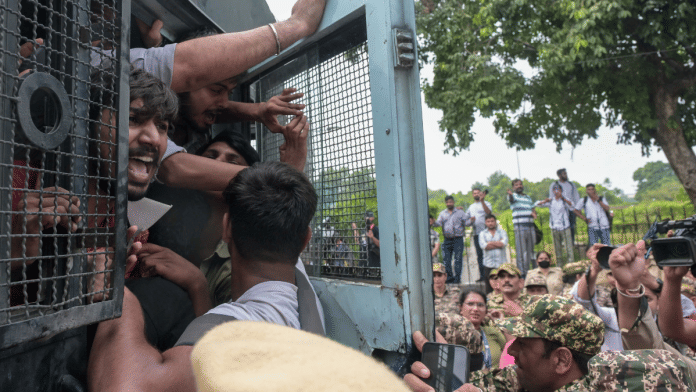
New Delhi: Student leaders in Bangladesh, known for their anti-India rhetoric, expressed solidarity with youths protesters in India, condemning the detention of demonstrators and journalists, internet suspensions and restrictions on protests in New Delhi.
Nahid Islam, the most prominent face of the protest who is now the convenor of the students-led National Citizen Party, said in a statement Sunday that concerns about electoral integrity and institutional independence required “transparent answers, not barricades and censorship.”
“This struggle is not yours alone. From Dhaka, we stand with you as friends bound by a common demand for accountable power, democratic institutions, and human dignity,” he said.
The statement drew parallels between the protests in India and Bangladesh’s July 2024 uprising, which began as a student-led movement against recruitment quotas before expanding into a nationwide uprising against Hasina’s 15-year rule.
“We stand in firm solidarity with the young people of India demanding electoral accountability and defending their democratic rights,” he said, citing the recent detention of peaceful protesters, organisers and journalists, as well as restrictions at Jantar Mantar.
“We know this struggle intimately, because we have lived it,” he added, recalling the support they received from Indian students, writers and independent voices during their movement.
They also invoked India’s history of democratic resistance, citing the women-led protests at Shaheen Bagh and student activism at Jawaharlal Nehru University and Jadavpur University.
“We recognize India’s rich traditions of democratic resistance. The women of Shaheen Bagh defended equal citizenship through a Delhi winter, while generations of students at JNU and Jadavpur University have sustained organised dissent. These remain invaluable democratic inheritances.
“Today, we once again see the courage of young Indian women on the streets,” the statement said. “In Bangladesh, women were also at the forefront of the July Revolution; their courage and sacrifices helped secure our victory.”
The leaders warned against religious majoritarianism and political intolerance across South Asia, saying that “Hindutva majoritarianism, fascism, and every form of religious supremacy must not define the future of South Asia.”
The statement also cited the continued imprisonment of student-activists Sharjeel Imam and Umar Khalid, who it said have been held for years without trial.
“We regard all of India’s young protesters and prisoners of conscience as comrades. Their courage inspires young people across South Asia,” it said.
The statement broadened its appeal beyond domestic democratic rights, pointing to unresolved disputes over border killings, water sharing, environmental protection and national sovereignty. It called for relations between South Asian countries based on equality rather than domination.
“To the democratic people of India: from Dhaka, and from the unfinished democratic aspirations of our July generation, we stand with you,” the statement said. “Stand firm, protect one another, reject communal hatred, and refuse to surrender the future of South Asia to fascism and division.”
Separately, Asif Mahmud, another prominent student figure associated with Bangladesh’s 2024 uprising, condemned the arrests of young protesters ahead of the demonstration in India, including social media commentator Dhruv Rathee and CJP leader Abhijeet Dipke.
In a statement titled “Release Detained Youth Protesters in India: Asif Mahmud,” he said it was “deeply disappointing that the Indian government has chosen to suppress and demean the voices of young people fighting for transparency and accountability.”
Release Detained Youth Protesters in India: Asif Mahmud
It is deeply disappointing that the Indian government has chosen to suppress and demean the voices of young people fighting for transparency and accountability.
I strongly condemn the arrests of young protesters ahead of… pic.twitter.com/xX5oBhCNPX
— Asif Mahmud (@AsifMahmud36) October 10, 2026
“Such actions raise serious concerns about the state of democratic freedoms and the right to peaceful assembly,” he said, calling on the Indian government to release all detainees and respect young people’s fundamental rights to assemble and protest peacefully.
“I also call upon young people around the world to stand in solidarity with the youth of India at this critical moment, as they face government crackdowns while fighting for the just cause of transparency and accountability,” he added.
Both leaders ironically are known for their anti-India rhetoric. Islam, before the Bangladesh elections earlier this year, had called for nationwide Victory Day rallies against “Indian interference,” while the party’s southern chief organiser, Hasnat Abdullah, warned that unrest in Dhaka could spill over into India’s northeastern “Seven Sisters” states.
“If Bangladesh is destabilised, the fire of resistance will spread beyond borders. Since you are housing those who destabilise us, we will give refuge to the separatists of 7 sisters too’,” Hasnat said at a rally.
“Even after 54 years of independence, Bangladesh is still facing attempts by ‘vultures’ to exert control over the country.”
(Edited by Ajeet Tiwari)
Also read: Bangladesh women take on Jamaat with memes and marches. Their future is at stake