



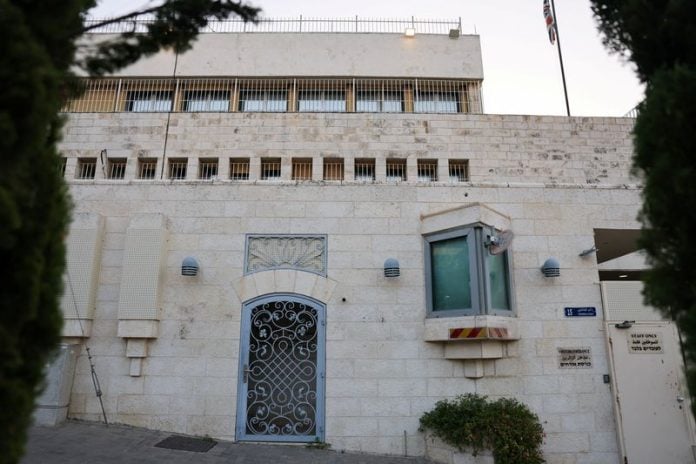
Oct 8 (Reuters) – Britain said on Thursday its nearly 200-year-old consulate in Jerusalem would continue operating on a smaller scale and be renamed as the “UK Mission” in the city, after Israel ordered it shut in a dispute over sanctions on settlements.
Here’s what to know about the dispute and diplomatic missions in the Holy City.
WHY IS THIS HAPPENING AND WHY NOW?
The dispute is over sanctions. Israel’s order for the consulate to shut was retaliation for Britain saying it would impose a ban on the trade of goods made in Israeli settlements.
On September 8, Israel ordered Britain to close the East Jerusalem consulate within 30 days and remove its diplomats from the city. The deadline expired on Thursday, with Britain and Israel announcing a compromise that would keep the facility open.
WHY IS THE CONSULATE IN JERUSALEM, AND WHERE IS THE EMBASSY?
The consulate is located in the Sheikh Jarrah neighbourhood of East Jerusalem and handles Britain’s relations with Palestinians in the city as well as in the occupied West Bank and in the Gaza Strip. It also provides consular services to Palestinians.
The consulate has been in Jerusalem since around 1839, according to the National Library of Israel, when the area was part of the Ottoman Empire and long before Israel’s establishment in 1948.
East Jerusalem is considered occupied territory under international law.
Britain’s embassy in Israel, like most countries’, is in Tel Aviv, which is also home to some government departments. The Israeli prime minister’s office, presidency and parliament are in Jerusalem.
WHY IS JERUSALEM’S STATUS SO COMPLICATED?
Jerusalem has long had a bitterly contested status.
It was under British control under the Mandate for Palestine. That ended around the time of Israel’s creation in 1948.
Under a United Nations resolution, Jerusalem was meant to come under international governance due to its special status in Judaism, Christianity and Islam.
In the event, Arab countries attacked Israel after its establishment, and the 1948 Arab-Israeli war resulted in Israeli control of West Jerusalem and Jordanian control of East Jerusalem, including most of the city’s holy sites.
Israel captured East Jerusalem in the 1967 Six-Day War and annexed it in 1980, coming to control the entire city.
Israel considers the whole of Jerusalem as its capital, but most countries do not recognise that claim and consider East Jerusalem occupied by Israel.
Palestinians want East Jerusalem as the capital of a future state. Decades of negotiations have failed to determine a final status.
WHICH OTHER COUNTRIES HAVE THE BRITISH CONSULAR ARRANGEMENT?
Turkey and several Western countries including France, Belgium, Greece, Italy, Spain and Sweden.
HAS ISRAEL CLOSED ANY OF THEIR CONSULATES?
No. France joined Britain in announcing sanctions, along with Canada, which does not have a consulate in Jerusalem. Israel has not taken action against Paris.
WHAT ABOUT THE UNITED STATES, ISRAEL’S CLOSEST ALLY?
The United States moved its embassy from Tel Aviv and merged it with its consulate in Jerusalem during President Donald Trump’s first term in 2018, the first US administration to make the move.
The US was meant to have moved it by 1999 under a Congressional law, but successive presidents postponed the move on national security grounds, in efforts to avoid scuttling chances for peace between Israel and the Palestinians.
(Writing by John Davison;Editing by Alison Williams)
Disclaimer: This report is auto generated from the Reuters news service. ThePrint holds no responsibility for its content.