


By Simon Jessop and Tuvan Gumrukcu
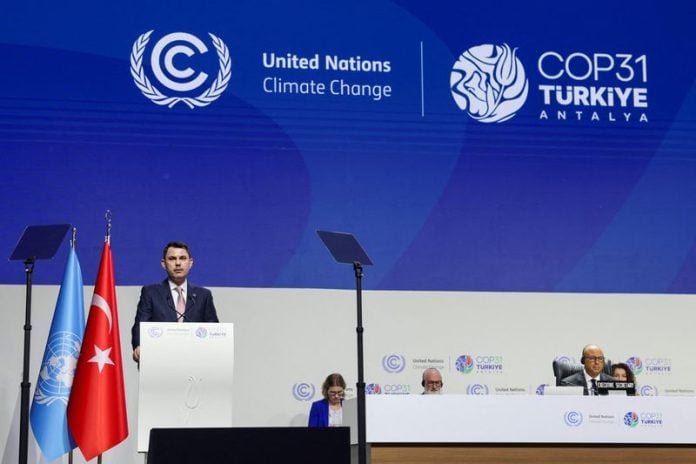
ANTALYA, Turkey, Nov 9 (Reuters) – Leaders of COP31 urged the world to accelerate the fight against global warming as they began their annual UN climate conference in Turkey on Monday against a backdrop of rising temperatures and worsening climate-driven disasters.
Kicking off two weeks of debate at Antalya on Turkey’s Mediterranean coast, UN and government leaders emphasised the need to focus on climate as it competes for attention with other international crises, including war, soaring inflation and the uncertainties caused by artificial intelligence.
“The urgency of this moment must drive us forward,” UN Climate Change Executive Secretary Simon Stiell said, adding progress so far was “nowhere near fast enough”.
A report by the United Nations Environment Programme published in October said the world was already poised to overshoot 1.5 degrees Celsius (2.7 degrees Fahrenheit) of warming, a threshold set at the 2015 Paris climate summit, and called for steep emissions cuts.
Tina Stege, COP31 climate envoy for the Marshall Islands and regional envoy for Oceania, said acting now was essential.
“For Pacific Island countries, this is not an abstract discussion about temperature targets. It’s about people, it’s about communities, it is about the places we call home,” she told reporters.
This year is on track to be one of the four hottest on record, as a powerful El Nino has compounded the impact of global warming, a UN report showed on Monday. The year has been marked by a series of extreme heatwaves across Western Europe and a glacier collapse in Nepal. The resulting flood killed more than 1,450 people and left thousands more still missing.
A GOAL TO ELECTRIFY
Turkish President Tayyip Erdogan said he hoped Turkey as the conference host could deliver tangible results.
“Our goal is to make this summit a platform where concrete results are produced, where countries turn their pledges into action, because it is no longer time to make promises that remain on paper,” Erdogan told reporters on a return flight from Azerbaijan, according to a transcript of his comments shared by his office on Monday.
The COP31 presidency has focused this year’s climate talks on a goal to electrify more than a third of the global economy by 2035, up from around a fifth today. It is asking nations to sign a pledge supporting that target.
Theoretically, it could reduce planet-warming emissions by speeding the global shift away from fossil fuel-powered vehicles, furnaces, boilers, cooking stoves, and other greenhouse gas-emitting equipment.
“We want people to feel the results of climate talks in daily life: in buildings that use less energy, in clean public transport, in energy they can afford and in new jobs,” Turkey’s COP31 President Murat Kurum said.
But climate advocates have criticised the electrification pledge because it does not require the additional electricity to come from low-carbon sources, setting up an early fight over whether electrification alone should count as climate progress.
WARS HAVE DISRUPTED FOSSIL FUELS
The US-Israeli war with Iran and Russia’s invasion of Ukraine have highlighted the economic consequences of continued dependency on fossil fuels as high prices linked to disruption have driven inflation higher.
While climate campaigners say the obvious solution is to increase use of renewable power, the oil and gas industry has made big profits and some countries that have domestic reserves of fossil fuel have sought to increase output.
US President Donald Trump’s administration — which is staying away from the climate talks for the second year running — has encouraged policies maximising oil, gas, and coal production to address the disruptions.
South Korea, India, Thailand and other Asian nations have increased their reliance on coal or taken steps to boost coal-fired power generation.
“A lot of people who previously might have been embarrassed to argue for continuing very high use of fossil fuel are now feeling empowered to make that case,” said John Holdren of Harvard University, who was a science adviser to Barack Obama when he was US president.
Still, the deployment of renewable energy has risen, driven by exports of cheap clean tech from China.
Stiell told the conference renewables were the clear answer to improving energy security.
“This year’s fossil fuel cost chaos has delivered a global shockwave, hitting households hard and spreading inflation like a cancer,” he said.
“But the solutions are clear,” he added, saying renewable energy installations had already saved the global economy hundreds of billions of dollars.
The rapid rollout of AI is also complicating talks as it drives global power demand higher and contributes to rising greenhouse gas emissions.
Turkey will call on governments, businesses and other institutions at COP31 to sign a pledge outlining principles to ensure AI is developed and deployed sustainably.
(Reporting by Ezgi Erkoyun, Tuvan Gumrukcu, Valerie Volcovici, Simon Jessop, and Sarah McFarlane; Writing by Richard Valdmanis; Editing by David Gregorio, Kate Mayberry, Jan Harvey and Barbara Lewis)
Disclaimer: This report is auto generated from the Reuters news service. ThePrint holds no responsibility for its content.