



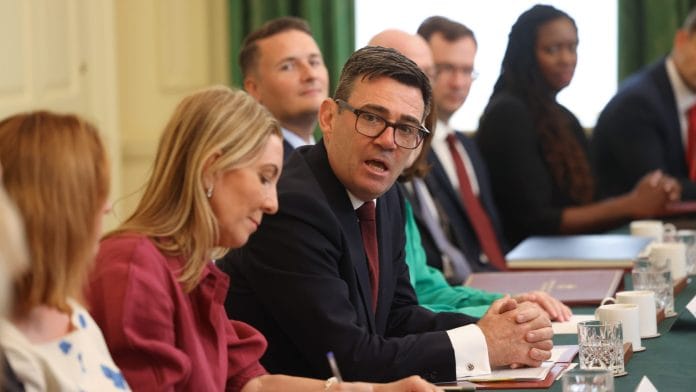
New UK Prime Minister Andy Burnham’s cabinet members are more at risk from Nigel Farage’s poll-leading Reform UK party than that of Keir Starmer before him.
Only six members of Burnham’s cabinet would retain their seats if a general election were held tomorrow, with 12 losing to Reform and another four losing to other parties, recent polling by More in Common suggests. By comparison, 10 members of Starmer’s cabinet would have kept theirs.
That precariousness of their hold on their seats may push Burnham’s team toward measures that blunt the threat of Farage’s right-wing populist outfit, including a focus on bringing immigration numbers down further, efforts to revive British high streets and reducing living costs for ordinary Britons.
“It will make them more likely to pursue policies that are absolutely important to their constituents, not issues of principle like foreign aid,” said Tony Travers, professor of politics at London School of Economics. “What people are interested in is the cost of living, therefore we’ve had three policies about cost of living already from Burnham’s government, one a day.”
Travers was referring to plans announced by Burnham in his first week in office to cut tax on household electricity bills, cap bus fares and slash business rates levied on pubs.
There are signs Burnham is already boosting Labour’s fortunes: According to Bloomberg’s composite poll, a rolling 14-day average using data from nine polling companies, the governing party has closed the gap on Reform by more than three points this month, though on 21.6%, it still trails Farage’s outfit on 24.5%.
But the More in Common poll, using multilevel regression and post-stratification methods that model constituency-level results, highlight the dangers for Labour. Burnham, his Chancellor of the Exchequer, John Healey, and Foreign Secretary Ed Miliband are among those projected to lose to Reform.
Home Secretary Shabana Mahmood, who has taken a hard-line stance on immigration that may chime with would-be Reform voters, is the only holder of one of the so-called four great offices of state who would not lose her seat. Under Starmer, she devised sweeping reforms making it harder for refugees and low-paid migrants to gain permanent settlement.
However, the poll — conducted June 5 to 28 on either side of Burnham’s sweeping victory over Reform in Makerfield — does not account for recent elections. The polling period also covers Starmer’s resignation and the new MP Burnham’s anointment as his most likely successor.
Burnham’s team is the first to have an even gender split, with 14 men and 14 women attend his cabinet meetings. If narrowed to those classed as full cabinet members, the premier has appointed 12 women to 11 men.
Nevertheless, Mahmood is the sole woman in Burnham’s cabinet to hold one of the four great offices of state: at the end of Starmer’s ministry, the home secretary, chancellor and foreign secretary were all women.
Gender was a key issue within Labour as the party considered replacing Starmer. It has yet to elect a female leader, let alone produce a female prime minister, while the Conservatives have had four female leaders — including the incumbent Kemi Badenoch — and three woman premiers.
On other measures, Burnham’s cabinet breaks down fewer social mobility barriers than Starmer’s. Data from the Sutton Trust show that almost a quarter of the new cabinet attended fee-paying schools. That’s well below the historical average, but a step back from Starmer’s team, which at one point contained no privately educated members.
Starmer’s administration imposed a 20% value added tax on private school fees, sparking accusations of class warfare from the opposition Conservative Party.
“Under the status quo, we can, sadly, expect private schoolers to be overrepresented in top jobs,” said Sophie Pender, founder and CEO of The 93% Club, named after the share of Britons who attended state schools. Even so, she said there is considerable optimism about the new cabinet’s approach to social mobility.
A majority of Burnham’s cabinet attended the universities of Oxford or Cambridge – more than under either Starmer or his Conservative predecessor Rishi Sunak. But because many come from state-school backgrounds, it reflects a good example of upward social mobility, said Carl Cullinane, director of research at the social mobility charity Sutton Trust.
“You want people in the position of power to have life experiences where they are representing the interests of the whole country in their decision-making,” Cullinane said. “It’s important that the most influential positions are genuinely open to a range of people.”
Disclaimer: This report is auto generated from the Bloomberg news service. ThePrint holds no responsibility for its content.