



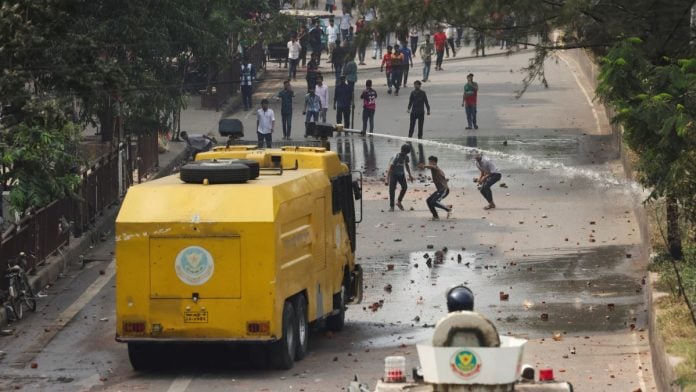
New Delhi: Garment workers in Bangladesh are demanding higher minimum wages as inflation drives up the cost of living. Thousands of workers from the country’s largest export industry took to the streets across Bangladesh’s major industrial hubs Sunday, blocking highways and clashing with police as protests demanding higher wages entered the third consecutive day.
The Bangladesh Nationalist Party-led government has moved to contain the unrest through wage negotiations. On Sunday, it formed a six-member minimum wage board under the Ministry of Labour and Employment, comprising representatives of employers, workers and independent members. Prime Minister Tarique Rahman also convened an emergency meeting with ministers and advisers.
The government also alleged that politically-connected industrialists and groups linked to ousted Prime Minister Sheikh Hasina of exploiting the protests to foment unrest.
The factories reopened Monday, but fresh clashes between police and workers demanding higher wages erupted in Dhaka and nearby industrial hubs, keeping manufacturers on edge. Reports in the local media said police fired tear gas to disperse workers attempting to block roads in the capital after protesters pelted bricks and stones at police personnel.
Police also fired tear gas and used water cannons to disperse demonstrators in Ashulia, near Dhaka, as workers pressed their demand for a minimum monthly wage of 30,000 taka (Rs 22,000), more than twice the current minimum of 12,500 taka (Rs 9,500). They are also demanding the reinstatement of dismissed employees and the release of those arrested during the protests, as well as assurances that those taking part in the protests will not be blacklisted.
The demonstrations had earlier spread across Dhaka’s Mirpur industrial area, the Savar-Ashulia industrial belt and Gazipur, including the factory clusters of Konabari and Chandra. Police maintained a heavy presence outside factories and at major intersections as authorities sought to prevent further disruption.
At least 529 garment factories in Mirpur, Savar-Ashulia, Gazipur and Mymensingh declared holidays amid the unrest, according to a statement by the Bangladesh Garment Manufacturers and Exporters Association (BGMEA).
The disruption followed protests that began Saturday, with workers blocking roads and some demonstrations turning violent. In Gazipur’s Kaliakair area, a warehouse storing discarded garment fabric and a pickup van were set on fire Sunday, Prothom Alo reported.
Demonstrators also allegedly obstructed firefighters attempting to reach the burning warehouse. Five platoons of the Border Guard Bangladesh were deployed to support police operations, the report added.
In Dhaka, workers blocked a major road in Mirpur, prompting authorities to close the gates of nearby metro stations as police moved to secure transport infrastructure.
Worker representatives on the new board have appealed to protesters to return to work, while calling for the release of detained workers and the withdrawal of cases filed against them, and assurances that workers would not face dismissal, harassment or blacklisting for taking part in the movement.
They said the absence of trade unions and meaningful dialogue between workers, employers and the government in many factories had allowed outside groups to exploit labour disputes. The board’s first step, they said, would be to consult garment worker federations and organisations to formulate a common wage proposal, Daily Star reported.
Also Read: Bangladesh economy, 2 yrs after Hasina’s fall: Inflation eases, forex gains but growth remains weak
Protestors ‘linked to Awami League’
Bangladesh’s Home Minister Salahuddin Ahmed said Monday that some factory owners with ties to Hasina’s Awami League, including former ministers and lawmakers, were involved in instigating disturbances. He alleged that groups aligned with the ousted government were using highway blockades, arson and violence to destabilise the country.
The minister said authorities had collected video footage, audio recordings and other evidence of violent incidents. He also accused some factory owners of deliberately shutting their establishments to aggravate the situation.
The BGMEA and the Bangladesh Knitwear Manufacturers and Exporters Association have agreed to provide the government with lists of factories allegedly closed for political reasons, as well as the names of labour leaders and organisations suspected of encouraging unrest, he said.
The wage dispute comes at a difficult time for Bangladesh’s ready-made garment industry, which recorded $38.48 billion in export earnings in 2024 and employs more than four million workers. The sector competes with manufacturing hubs in Vietnam, Cambodia and India, while facing rising production costs, uncertainty in energy markets and slowing demand in some export markets.
The sector accounts for over 84 percent of Bangladesh’s export earnings and supports millions of livelihoods, making it central to the country’s economy. However, it faces major structural challenges like heavy dependence on imported raw materials, port and customs inefficiencies, unreliable and expensive power, low-value production, a shortage of skilled workers and environmental pollution.
(Edited by Amrtansh Arora)
Also Read: Dinesh Trivedi has done what India’s Bangladesh policy needed—put Dhaka on the backfoot