




Argentina’s stock market is beginning to mirror the economy’s uneven growth under President Javier Milei as energy shares reap the benefits of high oil prices while other sectors stagnate.
The nation’s benchmark S&P Merval index is now down 9% in 2026 when measured in dollars, cooling off from a rally that started in 2023 when the Global X MSCI Argentina ETF was the top performer among single-country funds. The only local stocks posting strong gains now are those tied to the energy boom in the shale fields collectively known as Vaca Muerta.
Almost everything else, from banks and construction firms to consumer-oriented businesses, is down so far this year. The Merval has performed poorly compared to past rallies and is also visibly lagging in a region where election optimism has boosted equities in Colombia, Brazil and Peru.
“If you take energy out, the S&P Merval looks weak. There’s nothing as compelling as there was last year,” said Martín Polo, director of local consultancy Polomics.
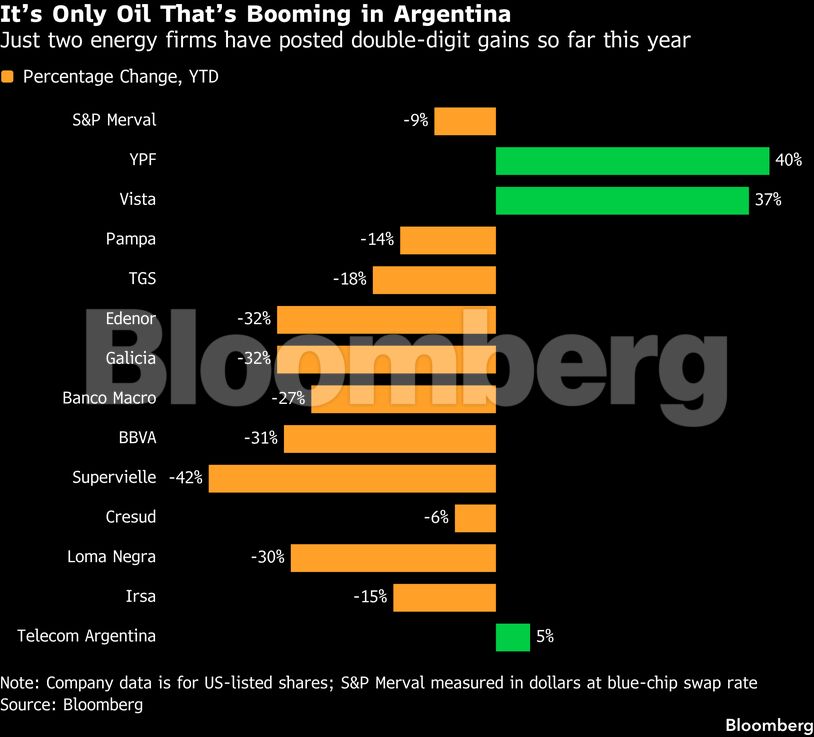
The rally in oil stocks has gone hand in hand with improved earnings. Aided by high prices stemming from the war in Iran, state-run YPF SA’s shale production jumped almost 50% from a year earlier in the second quarter, while Vista Energy SAB and Pampa Energía SA also reported strong increases in output and earnings.
“The performance of energy stocks has been driven half by oil prices and half by the reality of the sector,” said Ricardo Giménez, a portfolio manager at Buenos Aires-based Bull Market Brokers. “Vaca Muerta companies have been increasing production, posting strong results and, in some cases, starting to generate positive cash flow.”
The gap between energy stocks and the rest of the economy has been widening since Milei’s party won congressional midterm elections in 2025. YPF shares have nearly tripled since then and Vista has more than doubled, while many banks and companies more exposed to the domestic economy have lagged well behind. The Merval has also risen in dollar terms, but by only about half as much as the leading oil producers.
“Argentine stocks have run out of strong catalysts, trading volume has fallen and investors have increasingly shifted into” global stocks, said Federico Desprats, an economist at local broker Intervalores. “The only thing driving the Merval today is oil and gas.”
The divergence in stocks reflects a similar split in the real economy. Economic activity fell 1.4% from a year earlier in July and 2.9% from the previous month on a seasonally adjusted basis, according to the latest data. Manufacturing was among the weakest sectors, while mining continued to expand.
The weakness is also weighing on the outlook for stocks tied more closely to the domestic economy. Banks have been hurt by rising delinquencies and a lending business that has yet to fully take off, while construction companies remain dependent on a rebound in activity.
“If political risk remains, activity stays weak and businesses don’t recover, there are few catalysts for the main sectors in the S&P Merval index to move significantly higher in the short term,” Giménez said.
The only major Argentine stock outside the energy sector to see gains this year is Telecom Argentina SA, which is up a modest 5% on mergers and acquisition activity.
Argentina’s energy boom, against a backdrop of high international prices, is bringing a flood of dollars into the country and strengthening Argentina’s external accounts. The country accumulated a trade surplus of more than $16 billion between January and July, driven by higher exports.
Much of the improvement in the trade balance is tied to the boost in Argentina’s terms of trade from the conflict between the US and Iran. But it also reflects a slowdown in domestic activity, which is tempering the increase in imports.
That is the challenge now facing Milei’s model. The flow of dollars generated by oil, mining and agriculture has helped solve Argentina’s balance-of-payments problem, but at the same time it is contributing to a real appreciation of the peso that hurts much of the rest of the economy.
A stronger currency is helping to contain domestic inflation in part by making imports cheaper. It weakens demand for locally produced goods and raises dollar-denominated costs for manufacturers competing with foreign producers. Some see the remaining capital controls Milei has in place, along with political uncertainty ahead of next year’s election, as deterring foreign investment.
“Investors are still in wait-and-see mode and exchange controls are still in place,” Polo said. “Energy is one part of investment; the rest of the economy still hasn’t taken off.”
Disclaimer: This report is auto generated from the Bloomberg news service. ThePrint holds no responsibility for its content.