



Leia em português.Lea la nota en español
“We have been fighting against the environment.”
That is how Rosana Gonzaga, the vice mayor of Novo Progresso, explains the Amazon frontier town becoming one of Brazil’s strongest bastions of support for conservative presidential candidate Flávio Bolsonaro.
A cattle rancher affiliated with Bolsonaro’s Liberal Party, Gonzaga named President Luiz Inácio Lula da Silva and Brazil’s former Environment Minister Marina Silva among the town’s adversaries in a two-decade fight over protected land.
Gonzaga is now helping lead a campaign to give Flávio Bolsonaro 90% of Novo Progresso’s votes in Sunday’s presidential runoff, after he won 84.13% there in the election’s first round. It was the second-highest vote share for the candidate among Brazil’s 5,569 municipalities. The goal of local bolsonaristas is for Novo Progresso to give him the strongest support in the country in the second round.
The runoff on Sunday presents a stark divide over the Amazon rainforest and the environment. Lula, a leftist, has pledged to end net deforestation — Brazil’s largest source of carbon emissions — by 2030 and has tied his agenda to Brazil’s Paris Agreement commitments. Flávio Bolsonaro has questioned human-caused climate change and pledged to eliminate only illegal deforestation, leaving room for legally authorized forest-clearing. The race remains extremely close, with polls showing a technical tie. In the first round, the conservative candidate led 47% to 45.2%.
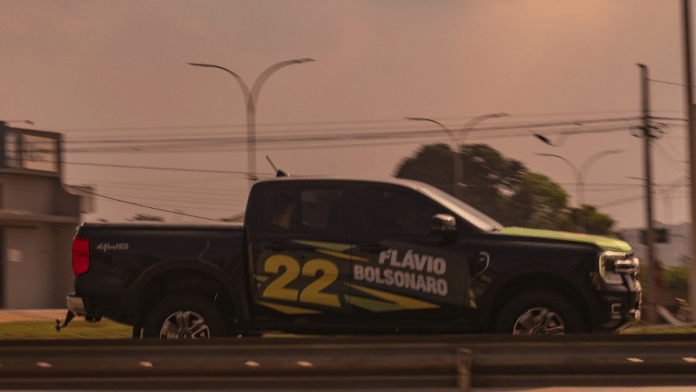
In Novo Progresso, Bolsonaro supporters have printed “90%” t-shirts and bumper stickers and organized a motorcade of pickups, cars, motorcycles and even excavators, which was joined by the governor-elect of Para state, Daniel Santos. Gonzaga wrapped her car in campaign imagery showing her alongside Flávio Bolsonaro, his father, former President Jair Bolsonaro — convicted over an attempted coup and serving his sentence under house arrest — and Jair’s wife, Senator-elect Michelle Bolsonaro.
The car bore the slogan, “I voted for the father, I’m voting for the son.”
Gonzaga’s family moved to Novo Progresso, in southern Para state, in 2003. They bought an area of primary forest from a private seller even though the land itself belonged to the federal government and came without formal title. Then, three years later, Lula’s government included it in a new conservation area. Gonzaga says the designation left the family and other farmers without access to credit and exposed them to fines and enforcement actions.
Her family story follows a model that has shaped Brazil for decades, if not centuries: Settlers of European descent pushing the agricultural frontier deeper into the country’s interior. In the Amazon, that expansion has taken place across vast stretches of undesignated public land. Land grabbers identify and take over those areas, clear the forest and create a paper trail for plots of land before selling them. States and the federal government often normalized such occupations, creating incentives for the practice to continue.
During Lula’s first term, his government, with Marina Silva as environment minister, sought to make the Novo Progresso region a showcase for slowing deforestation. The town sits along the BR-163 highway, important as an export corridor for soy produced in neighboring Mato Grosso state. To prevent forest loss from spreading along the route — the most common pattern of deforestation in the Amazon — the government rolled out a package of measures that included designating protected areas and tightening environmental enforcement.
In 2006, it created the Jamanxim National Forest, placing Gonzaga’s farm and several others inside a federal conservation area. In Brazil, national forests are publicly owned and intended only for sustainable use of native vegetation and scientific research. Gonzaga has since become one of the leaders of a movement seeking to privatize about 486,000 hectares (1.2 million acres) within this protected zone, roughly six times the area of New York City, a goal Flávio Bolsonaro has pledged to advance.
“I’m going to carry out the largest land regularization Para has ever seen,” he said during a visit to the city of Maraba on Monday. “Your land will be yours on paper.” He added, “We’re going to get rid of the environmental restrictions that exist for ideological reasons.”
During the four years of his term as president, Jair Bolsonaro didn’t push to legalize the settlers’ lands, but his weakening of environmental law enforcement led to a surge in deforestation. From 2019 through 2022, a period that largely overlaps his presidency, about 52,300 hectares were deforested inside Jamanxim National Forest, nearly double the area recorded in the period 2015 through 2018. From 2023 through 2026, under Lula, deforestation fell by about 86%, according to official data.
In 2019, Novo Progresso became a symbol of Jair Bolsonaro’s lax approach to the Amazon after local farmers organized coordinated fires to show support for his government and, according to reports at the time, in an effort to make satellite monitoring of deforestation more difficult. The episode made headlines across the world and became known as the “Day of Fire.”
After his reelection to a third term, Lula reinstated environmental law enforcement across the Amazon but also tried to build bridges with Novo Progresso and other cities with high deforestation rates. The government in 2024 launched the Union with Municipalities, a program that combines land-tenure and environmental reform with technical assistance to help family farmers access public programs and credit.
But the program had little impact, according to the mayor of Novo Progresso, Gelson Dill, a center-right politician who is not aligned with Bolsonaro. The town received some of the promised investment, he said, but not enough, and the initiative never became the “turning point” in the municipality’s relationship with the federal government that officials had hoped for.
Dill agrees that the region needs to legalize land already used for farming, including in Jamanxim. But as Bolsonaro supporters anticipate a change in environmental policy, the mayor also sees a risk.
“I hope this expectation around the new government doesn’t bring any rush to deforest here,” he said.
This report is auto-generated from Bloomberg news service. ThePrint holds no responsibility for its content.