





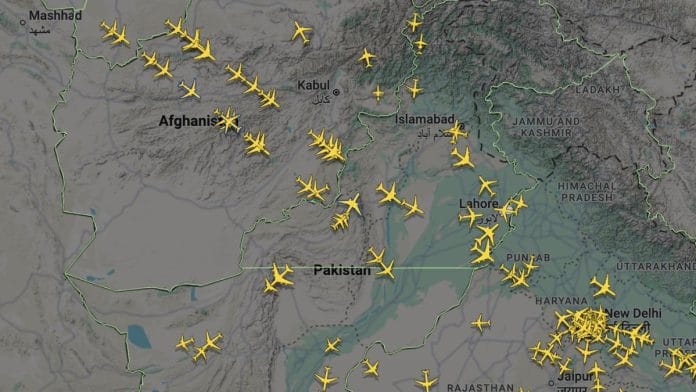



New Delhi: With air travel over West Asia uncertain amid the ongoing US-Israel war with Iran, Afghanistan has witnessed a sudden surge in commercial air traffic over its uncontrolled airspace.
Afghanistan’s airspace, or Kabul Flight Information Region, is classified as Class-G uncontrolled airspace because it lacks any ground-based Air Traffic Services (ATS) to guide or separate commercial flights.
Many flights originating from Europe are now flying over the Caucasus instead of West Asia and transiting through Kabul before reaching the airspace over South Asia.
Flightradar24, a global, internet-based service that tracks real-time aircraft flight information, posted on X, “We’ve been talking about ATC workload as air routes are compressed due to the war in the Middle East, but it’s worth noting again that the busy airspace above Afghanistan remains uncontrolled.”
Flightradar noted that due to the uncontrolled nature of the airspace over Afghanistan, all international and domestic flights must submit a flight permission request to the Taliban authorities via email at least 72 hours before their entry into the region’s airspace.
Why Afghan airspace’s ‘uncontrolled’
After the United States withdrew from Kabul in August 2021, the entire airspace over Afghanistan was classified as ‘Class-G uncontrolled’, indicating no air traffic control (ATC) was monitoring or directing flights.
In such airspace, pilots fly through the see-and-avoid principle while taking full responsibility for collision avoidance since no ATC separation is provided. Pilots are responsible for maintaining separation and for consistent traffic broadcasts to other aircraft in the vicinity.
The standardisation of airspace rules is established by the International Civil Aviation Organisation (ICAO), a United Nations-specialised aviation authority. This framework defines six main classes, from A to G, which ensure consistent rules for pilot responsibilities, ATC services, and separation worldwide.
According to the OPS Group, a community for aviation professionals, the Afghan authorities recently reissued several procedural ‘notices to airmen’ or NOTAMS to maintain 15 minutes of longitudinal spacing from preceding traffic at the same flight levels.
Pakistan-Aghanistan conflict
Due to renewed fighting between Pakistan and Afghanistan along the disputed Durand Line, the Afghan airspace has been more volatile.
The government in Islamabad has conducted airstrikes in Afghan territory, targeting alleged militant groups. In response, the Taliban has undertaken retaliatory action by capturing multiple border posts.
The OPS Group noted that no commercial aircraft had been the target of Islamabad’s action. However, it added that the border region with Pakistan should currently be treated as a higher-risk area.
Safe Airspace, another website that tracks airspace safety, mentioned that due to the strikes by Pakistan, the danger in the Kabul Flight Information Region—where commercial aircraft continue to fly despite volatility—remained high.
(Edited by Madhurita Goswami)
Also Read: A quick end to Iran war is in India’s interest. But Modi has no influence over US or Israel