



Tennis legend Vijay Amritraj was conferred the Padma Bhushan, India’s third highest civilian honour, by President Droupadi Murmu at the Rashtrapati Bhavan on 24 June. Representing India at a time when Tennis representation of the country in international arenas was low, he reached the Wimbledon quarter finals twice, while participating in the tournament 16 times.
Amritraj can also claim the distinction of having beaten World No.1 for an astounding 268 weeks, Jimmy Connors, five times out of their eleven encounters. He was also a constituent of the Indian teams which won the Davis Cup in 1974 and 1987.
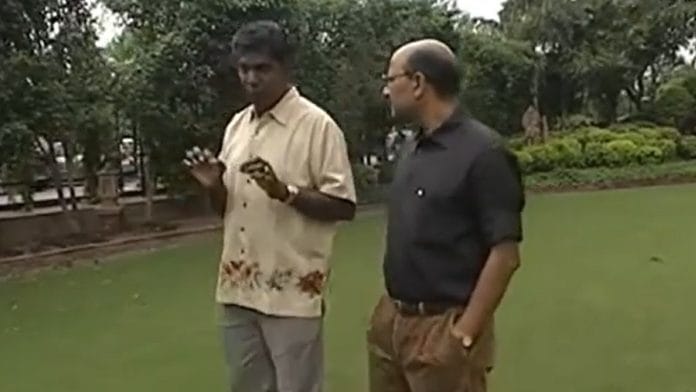
In a 2013 Walk The Talk interview, Vijay Amritraj spoke with ThePrint Editor-in-Chief Shekhar Gupta on how it was sharing the court with greats of the sport, how he handled public criticism calling him a nice guy, and also remarked on the rise of Sania Mirza.
Here’s the complete transcript of the interview, edited for clarity.
Shekhar Gupta (SG): We have seen many sporting icons in India, but what happens to them after their playing years? Most of them fade away, some prosper a little bit in the afterglow, very few, a very exceptional few reinvent themselves and become even bigger icons. My guest today on WalkTheTalk is one such Vijay Amritraj. Welcome to WalkTheTalk.
Vijay Amritraj (VA): Hi, thank you very much.
SG: Icon to many generations, mine and the next one and hopefully the next one.
VA: You’re very kind, thank you very much. It’s a unique thing to have been able to play for so long and play Davis Cup for a long time. And I think if you look back and I look back at a career, I always feel that my greatest achievement is longevity as opposed to performance. And you end up becoming like the old furniture, people like sitting on it.
SG: You’re being modest. I think in terms of performance, really no Indian has matched you in tennis. Because you played full tennis, a full circuit, not an amateur circuit. You played the full professional circuit against the best and you beat everybody, Borg, McEnroe, Lendl, a great match against Connors. We didn’t see it, but we remember the pain.
VA: Yeah, I mean, absolutely. I always say that again, longevity, I played in the era of Laver and Rosewall and Smith and Ashe and then Connors, Bogg and McEnroe. And then as the way that Becker and Edberg were coming along. So there were all generations of players that I was able to play against. And I always feel that I played at a wonderful time in the sport. And I was very fortunate to have played as long as I did against the best of each generation.
SG: But you also played tennis then on their terms, which is serve and volley. Not the usual Indian touch tennis, isn’t it?
VA: Yeah, I mean, I think also the fact that I was perhaps bigger than the average as far as height was concerned. And I’m about 6 ‘4″. So, it helped me with a good serve. It helped me with playing the net a bit more and playing more attacking tennis as opposed to kind of being a little bit more feel and touch. But I think that in those days, the continental grip was a big thing. It was important to be able to play sort of an all-round game. Skill was very much in play as opposed to the pace and power today.
SG: And of course, you had your famous luck with the net cords.
VA: Indian luck, Indian luck that is. We call it Indian luck. I don’t have the pattern with that one. But I think it comes from, I always think it comes from being Indian.
SG: There was a time, unfortunately, we did not watch you on television those days. But there was a time when this whole country had got obsessed with your overhead smash or with your problems with your overhead smash.
VA: Only because I missed one.
SG: You missed one.
VA: But it was the most famous one. What can you say?
SG: Just one. But that’s a regret.You could have gone on to win Wimbledon.
VA: Yes, I’d like to think so. And I think a lot of people, I suppose, believe so as well.
Even to this day, probably 32 years after that 1973 match against Jan Kodes, people still remember, oh, you destroyed my week by missing that smash. But yeah, I mean, you’re 19 years old at the time. And things went a little off perhaps at that one point. I guess I could have won it.
SG: I remember reading all the experts in The Indian Express, then the Times of India, the Hindustan Times, saying only if you could jump while smashing.
VA: But the strange thing is that was one of my good shots. The smash was one of my good shots. And I always felt that I would never miss it. It was perhaps one in a hundred at the time, and it happened to come at the wrong moment.
SG: And you know what is the other thing that became a national obsession at that time, besides your overhead smash? It was your alleged lack of killer instinct. Because everybody said and everybody wrote, Vijay beats everybody. But somehow he’s too nice a guy.
VA: I don’t know whether to take that as a compliment or whether to take it as a deficiency. But at the end of the day, you don’t win as much. If you really didn’t have it in you. For example, Borg did it one way and Connors did it one way. Federer does it one way and McEnroe does it a different way. So I think it’s kind of hard to pinpoint and say, well, he didn’t have the killer instinct. I think I won quite a bit and I was very proud of my wins.
SG: But you did not glare at your opponent. You didn’t bare your teeth. I remember the famous one with McEnroe. I think he irritated you a bit.
VA: Yeah, he constantly irritated most players.
SG: But even you.
VA: At the end of the day, you were able to overcome it with your own temperament. And I think a lot of it comes from also being Indian.
SG: I remember that one point where you actually lost it. I think you either spoke to the referee in exasperation or to the crowd and said, how do I handle this guy?
VA: No, I think the important thing of dealing with players with temperament and especially someone like McEnroe was to be able to use it to your advantage to some extent. And we did it to a great extent in the Davis Cup when we played them once in the US. But overall, I was fortunate to have beaten him a few times and it came from the fact that I had a decent temperament and the fact that that temperament came from being Indian. And I think the cultural background, the cultural bringing up made a lot of difference to your temperament and that was pretty much a part of it.
SG: Some of your successors are different. Leander, for example.
VA: Well, yes and no. Each individual is a different individual. My son is going to be different from me. Leander is going to be different from me. Each person has their own individuality that doesn’t make it right or wrong. It just makes it different. And I think each person has got to do what is right for him or her. And how do you perform? Sanya Mirza performing is to perform at the best of her ability and what do you need to do to do that? I’m not saying you should behave badly. I’m certainly not saying that. But within the rules of the game, you’ve got to do what is right for yourself.
SG: You don’t particularly regret having been a nice guy because you benefited from being a nice guy also.
VA: I don’t know.
SG: You became this great ambassador for tennis and more.
VA: I don’t even look at it that way. I don’t even look at it in that manner at all. I just look at it in the manner that I hope I represented my country in the proper manner.
SG: In fact, when you talk about using McEnroe’s temperament to his advantage, I remember when he almost threw away his racket and said, how can I play Ramesh Krishnan? This guy serves at 5 miles per hour. Were you behind this?
VA: I was right there when it happened. It was during the Davis Cup in La Costa in Southern California.
SG: And he’s never forgiven you for that.
VA: No, it was great. Actually, his father got a hold of me a week later and said, how did you do that to my son? Old man McEnroe.
SG: But tell us, what did you do?
VA: No, nothing much except that we got into his head. It’s not difficult, rather to get into McEnroe’s head. It’s easy. He’s just waiting to be exploited.
SG: Was it pre-planned? Was it a strategy?
VA: No, not to the most extent. That’s the way Ramesh plays. He’s a very surgical player, as we used to call him, a surgeon. But overall, I think he really put McEnroe off completely by the style of his performance. At the end of the day, McEnroe is such a genius on the court anyway. But the interesting thing is that his temperament affected him a lot.
SG: And that was the strategy. You couldn’t beat McEnroe stroke for stroke, but you could beat him in the mind.
VA: Yes, you had to work with something else. And to a great extent, we were able to work with it. Arthur Ashe, the late Arthur Ashe, was actually captain of the Davis Cup team in the US at the time. I was actually able to tell him at the captain’s meeting that, listen, we’re going to have to get into McEnroe’s head, and we will.
SG: And what did he say to you?
VA: He said, listen, you can’t do that. I said, yes, we can. It’s the Davis Cup. We can do anything. So it was fun.
SG: Let me ask you a question that I’ve wanted to ask you for a very long time. You talked about the 73 Wimbledon, which you could have gone on to win, but for that one overhead smash against Ian Kodesh, you went on to win. The second was the Davis Cup final, 87. If God gave you a choice of winning one of the two, which one would you rather have won?
VA: Well, the interesting thing is, for me, Wimbledon and Davis Cup was your country. I just happened to be the one sort of representing the country. To me, Wimbledon was not an individual event. To me, Wimbledon was a country’s event. I was an Indian playing. I just happened to be Vijay, or it happened to be someone else. But you were Indian. All other tournaments were profession. So to me, Wimbledon and the Davis Cup was the be-all and end-all of tennis. And that’s why we played the game to a great extent. So there would be no choice between the two. But when you’re winning for your country, you’re winning Wimbledon and the Davis Cup at the same time. But Davis Cup would mean just that much, a little bit more, simply because we don’t mention the name of the person. We mention the name of the country.
SG: Tell me your favorite on-court moments.
VA: My favorite on-court moments, I suppose, obviously for me, there were numerous. But in my early years, when I was a schoolboy, I won a college tournament, which was the biggest college tournament in India. At the time, I was 13 and a half years old. My first national championship victory, beating Ramanathan Krishnan in the final, was a very, very special moment for me and my family.
SG: By the way, many years later, I covered the match when Ramesh beat his father to become national champion. Well, Ramesh didn’t beat his father to become national champion.
SG: He beat him in Chandigarh.
VA: But actually, I was the next generation to Krish, and Ramesh came right after me.
SG: But by the time this happened, you were not really playing the nationals.
VA: No.
SG: Mid-70s. You were then on the international circuit.
VA: Overseas tournaments. And I think the important thing of those early matches gives you a feeling of accomplishment more than perhaps later stages.
SG: ’76, if I remember correctly, when Ramesh beat his father But you were then too valuable to play the nationals.
VA: No, we were on tour, obviously. Ramesh was still a junior. But I think the next generation, Ramesh led into the Leander generation, and thereafter, as we see today. But I think there were a lot of memorable moments. The one that really stands out is the Davis Cup final in 1974, having beaten Russia in the Soviet Union in Pune, getting to the final that year. And, of course, in ’87, coming from behind all through all of our matches and getting to the final against Sweden. So there were two very, very special years in the Davis Cup that were actually 13 years apart, believe it or not.
SG: Tell me something about the great match against Connors.
VA: Well, again, it was actually one at Wimbledon where I played Connors in ’81.
SG: And that match against Tanner, I think. But I think Connors was the big one.
VA: Roscoe was also in five sets at Wimbledon. Beat Noah there one year at Wimbledon in four sets. Beat Borg at the U.S. Open, which was a very special moment. But I think the big moments are when you’re younger. At 19 years old, I beat Laver at the U.S. Open. He was seeded number two, and I beat him in the third round in five sets. It was voted the best match of the decade on CBS at the time in the U.S. So there were some special moments. Indians started to get a hold of this sport, which has carried on to this day. So I think there are a lot of memorable moments when you have a fairly long career.
SG: Right. But there’s not one moment that you particularly cherish? An exchange with somebody? Connors said something to you in that match
VA: Well, Connors said a lot to me during the course of matches. Not all of it can be repeated again and again.
SG: Tell us a couple that are sort of marginal.
VA: No, I’ve got to keep it clean. I can’t do that. But same with McEnroe. There was a lot of verbal communication between these guys when they played against you. But the interesting thing is, just recently at Wimbledon this year, I had Connors come into our studio while I was doing television, covering Wimbledon. He had a long chat with me in the studio on camera. It was a live piece we did. We went back and talked about these various things. It was interesting to listen to him and what he had to say about the matches that we had together.
SG: So what did he say, since we missed this conversation?
VA: He was again very brash in this conversation, just as he was on the court. Then, during the interview, he reminisced about it and said, “You handled yourself so incredibly well at a time when things were so win-win-win for all of us, as it must have been for you as well.” So it was nice to listen to him. I think people followed players like Connors and McEnroe for years and generations so very well. Even to this day, we still talk about Connors and McEnroe.
SG: Yes, I heard him speak in the U.S. Open presentation ceremony the year before, and he had the crowd in splits.
VA: Yes, New York was really warm to him. He played those great matches.
SG: Because Indian sport has changed since your time. Indian sport has shed some of the “nice people” image or “happy losers” image. Indian cricket, for example, seems to have benefited from having…
VA: Happy losers! I’ve never heard that expression before. You’re not supposed to be happy when you lose.
SG: Indians were always known to be great losers.
VA: Well, I think you take defeat in the right way, in that we hope it makes you work harder, try harder, strive harder, strive for greater heights, and get better at what you’re doing, whatever your sport is, so that that defeat won’t happen again. That’s the goal of learning from defeat.
SG: But not to feel bitter or brood over it.
VA: Oh, absolutely not. Neither that. There will be disappointment, there’s no question. If you don’t feel disappointed when you lose, you shouldn’t be competing.
SG: Do you think about that 1973 quarterfinal a great deal? Or did you put it behind you?
VA: At 19 years old, you think you can do no wrong. There’s no question. That year in the U.S. Open, of course, I had a very good run. I beat Laver and went on to be perhaps top 10 in the world, almost made the Masters that year, and so on and so forth. It was a very special year for me. But then you go back, and newspaper reports are always saying, “How many times is this guy going to win Wimbledon?” or “How many times is he going to win the U.S. Open?” You don’t even think about it because you’re 19.
SG: It was the whole ABC of Wimbledon at the time—Borg, Connors…
VA: Which even Arthur Ashe said at the time. But then again, Borg and Connors went on to win so many Wimbledons and U.S. Opens and became such great champions. I remained a good player.
SG: But you built a huge following as well.
VA: Again, because of longevity, I think, to a great extent. Yes, I had my share of great matches, and I was very fortunate.
SG: You know what’s my favourite of all your great matches? Unfortunately, it was a match you lost. The 1988 Olympics at Seoul. I was there. You were playing Andre Chesnokov, and you were really at an age when most tennis players had given up. Yet you gave him such a tough time and almost won.
VA: Yes, it was five sets.
SG: I remember after the match you came and told us, “If only this wasn’t on Centre Court, I would have beaten him.”
VA: Well, I’m not quite sure about that.
SG: I think you said because it was Centre Court and because there was a big crowd, he was able to bring out some reserves in the end.
VA: Well, I think he was younger, stronger, better. Nobody expected… I mean, in 1988 he was at his peak in the world.
SG: Nobody expected you to give him trouble. You almost beat him.
VA: No question. Absolutely no question. It carried on for such a long time. Even in 1987, when I would have been 34 years of age, to be able to help India get to the final of the Davis Cup was what I call a “miracle on grass.” The Americans call that big victory in hockey against the Soviets the “Miracle on Ice.” I call that “Miracle on Grass.” To be able to get those matches together and pull a team together, even at the age of 34, and help the team get to the final.
SG: We’ll now move from the past. Tell me something. Rank Borg, McEnroe, Connors, Federer, Sampras and Agassi.
VA: That’s a question we should talk about at a bar, sitting by a fireplace.
SG: We are at the back of a bar.
VA: Okay. I don’t like comparisons between champions of yesteryear’s world champions and today’s world champions. Greatness always shows up in every generation. You’re great given the ability you’re given at that time and the equipment you’re given at that time. Laver was great in his time. Borg was great in his time. Sampras was great in his time. Federer was great in his time. I think any one of them, in any generation, would have been the best.
SG: So today, who’s the best?
VA: Today, Federer is the best. Without even an argument.
SG: Who would you most enjoy watching? Someone with more flair like Safin or Federer?
VA: I think today the reason Federer is such a wonderful champion is because he is incredibly worth watching. He has skill and variety in his game.
SG: He’s not a machine.
VA: It’s not like watching Andy Roddick, who’s a remarkable player. I would much rather watch Federer, as I’m sure most tennis lovers would. Marat Safin brings a lot of variety, colour and flair to the game, which is why he’s fun to watch. But my all-time favourites were Nastase, McEnroe, Connors, Rosewall and Laver. These guys stood their ground and showed skill I’ve never seen displayed on a tennis court.
SG: Do you see those guys lasting in today’s tennis? Artificial surfaces, power, baseline play?
VA: Oh, if you put them in today’s environment, with the greatness they had, absolutely. No question.
SG: How do you see Sania’s progress so far? Has she surprised you, or did you anticipate this when you first saw her?
VA: No, she always had the talent. There was no question. A lot of Indian kids have shown that talent. But the work has to go along with the talent. Nothing can be done without the work and commitment. Then, of course, you need the breaks. Over the last 18 months she’s improved remarkably, from the ranking she had to where she is today. The expectation levels are what concern me. We shouldn’t put too much pressure on her because that can bog her down. She’s going to have to learn from defeats. But I think the only people who can mess up her progress are you and me. Otherwise, leave her alone and she’ll be fine.
SG: Not you so much. If she listens to you, she’ll be fine. Do you see her breaking into the top 20 and staying there?
VA: I think she can make the top 10.
SG: Top 10?
VA: I think she can make the top 10. I always paid very little attention to rankings. To me, the more important thing was winning a Grand Slam, winning Wimbledon, winning the Davis Cup, and winning the Federation Cup. Those are the real pillars of achievement.
SG: Do you see her having the ability to win one of these?
VA: Yes. It’s very clear that off the back court she’s superb. The improvements she needs to make are in three or four clear areas:
SG: Beginning with the service.
VA: The serve, the volley, movement, and so on. She’s working very hard on all of that. The improvement will come. There will be setbacks and pitfalls along the way. But in the final analysis, people don’t remember losses. They remember victories unless, of course, you’re talking about me. Then they remember the losses.
SG: That’s because you’re such a nice guy. Nobody can beat you at that.
VA: It’s fun to watch the kids grow up into such fine players.
SG: Have you been speaking with Sania?
VA: Oh, we’ve had some nice conversations, especially during Wimbledon and even during the U.S. Open. I think she’s a delightful personality, which is great for our sport and for women’s tennis.
SG: Is there anything about her that worries you? Her injuries or fitness?
VA: Well, Shekhar, with any athlete, the biggest worry is injury. You don’t know whether you’re overdoing it or underdoing it. Even with Prakash, for example, the most difficult thing is that kids don’t understand that 50% is hard work, but the other 50% is the ability to relax and take care of yourself. That’s the hardest part. “I haven’t played enough today. I need to go to the gym more. I need to be on the court more.” But you also need to protect your body.
SG: Another very talented player like Irfan Pathan in cricket. A lot of people think he simply overdid his physical conditioning and picked up injuries.
VA: It can happen.
SG: He’s also very young, the same age as many of our young athletes today.
VA: In Formula One, with Karthikeyan, it’s difficult. Those guys lose two or three kilos just sitting in the car, and their neck muscles are under real trouble when you drive these things. How do you protect that?
SG: Fitness levels required are much higher, and that’s why you need to be mentally strong.
SG: I remember one thing Sania said on the show. I asked her what drives her. Is it money? Fame? She said, “What drives me is the idea of hitting the other woman as hard as possible with the ball in her belly.” And I said, this is a far cry for an Indian spokesperson.
VA: It’s great. I think an athlete drives himself or herself because of an overwhelming desire to win. That’s the key. It comes from the head—mental toughness. Gives you the overwhelming desire to win. If you have that, then you need the work and commitment to exploit it.
SG: At the international level, in the top 20, there usually isn’t that much to choose between players.
VA: Today, the depth of the game in both men’s and women’s tennis is so strong and so deep that if even a guy like Federer or Coria or Nadal have had a slightly bad day, the 150th guy is gonna win. And you see those things happening constantly. And it alsho happens in Women’s tennis, because the depth is so strong. That’s why achievements like Sania Mirza reaching world No. 32, or anyone getting into the top 100 in men’s tennis, are not easy accomplishments today.
SG: Vijay, tell me about how you reinvented yourself. Tell me a little about cinema, your entertainment business, and now your role as a UN Ambassador of Peace. You are a master at multitasking, aren’t you?
VA: I enjoy different things. I enjoy the world of media, film, music and television. I try to build my business in media, and I’ve been fortunate with it. Secondly, I enjoy using my knowledge of tennis on television. I do Grand Slam commentary.
SG: You are a great tennis ambassador now.
VA: Thank you. I enjoy covering the major Grand Slam events. It gives me a different viewpoint of the match. I’m able to share that with the viewer, which is the most important thing. The regular viewer who knows tennis understands what I’m saying, but I also try to bring in viewers who have never watched tennis before, explaining how much fun the game is.
SG: How do you see your role as UN Ambassador of Peace? You’re perhaps the only sportsperson who became an international icon, not just an Indian icon. A wonderful player and a wonderful man.
VA: Thank you very much. You’re very kind. Well, I think my role as Messenger of Peace is very special to me. Kofi Annan appointed me, the Secretary-General appointed me, about four and a half or five years ago. It’s a unique opportunity to make a difference. To visit parts of the world the UN sends me to, represent both the Secretary-General and the United Nations, highlight the good work being done, and make a difference in the lives of people, even if it’s two people or or five thousand—is a deeply rewarding experience.
SG: That’s part of your life as a tennis star, where the flag doesn’t matter so much, the passport doesn’t matter so much. You are an internationally acknowledged star, leveraging that for a good cause.
VA: And that we are all human beings living together in a global world.
SG: Well, that’s excellent, Vijay. Let me conclude by giving you one suggestion. Since all of us missed your great matches on television because there was no satellite television then, please do a DVD of your great matches, including that missed overhead smash. It would be a bestseller.
VA: Well, the good thing about tape is that you can stop the match at any time.
SG: Absolutely.
VA: And I will stop the match when I am two sets to one up.
SG: One way or the other, do that DVD. I’ll be the first to buy it.
VA: Thank you very much.
SG: Wonderful having you on the show.
VA: Appreciate it.