





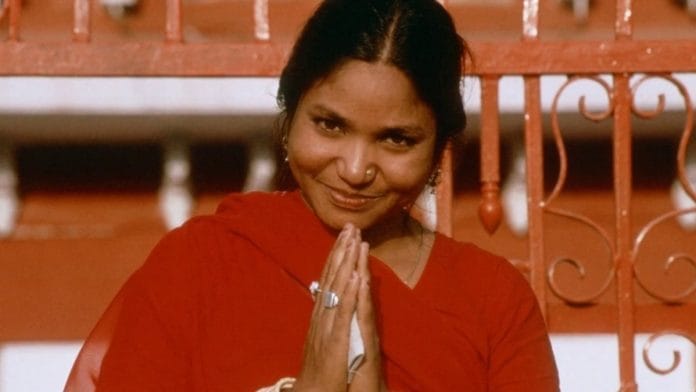


New Delhi: The last time Phoolan Devi saw Vikram Mallah alive, they were lying next to each other in the Chambal ravines. A gunshot split the night. She reached for the rifles, thinking the police had found them. But the guns were gone. Vikram sat up, then fell forward. He died with his head in her lap.
This 48-hour siege that marked a turning point in Phoolan’s life will be one key focus of Richie Mehta’s new film Phoolan, set to premiere at the Toronto International Film Festival on 16 September. The film is based on Phoolan Devi’s 1996 autobiography I, Phoolan Devi: The Autobiography of India’s Bandit Queen.
It was August 1980 when Vikram Mallah was killed. The men who murdered him were Sri Ram and Lala Ram, Thakur dacoits who had returned to the gang after prison. Their feud with Vikram was as much about caste as it was about power: a Mallah had taken command of a gang once led by an upper-caste man. After Vikram’s murder, the men gagged and bound Phoolan, took her by boat down the Yamuna to Behmai and held her captive, where she was repeatedly raped.
Six months later, Behmai would become the scene of one of the most infamous acts of revenge in modern Indian crime turning a traumatised young woman into one of India’s most notorious dacoits. Phoolan killed 22 men on 14 February 1981. Barely in her 20s then, Phoolan became the face of the massacre and the “Bandit Queen” .
The memory of Vikram’s murder remained central to the mythology around her.
Recalling that night years later, Phoolan told writer Mala Sen: “There was a loud noise, the sound of a bullet being fired.” She thought the police had surrounded the camp. “Then, Vikram fell forward.”
The story of Phoolan Devi is about how a poor, lower-caste girl was successively denied childhood, marriage, safety, dignity and justice — and then built an identity around refusing to remain a victim. The dacoit became a folk hero, the fugitive became a politician, and the woman who once carried a rifle through the ravines eventually entered Parliament. When cinema tried to tell her story, she fought back against that version too.
In a 1996 interview with The Atlantic, she said Shekhar Kapur’s Bandit Queen (1994), which she tried to get banned, showed her as “always in tears” and as someone who never consciously chose anything. She even said the family’s land dispute, central to her life’s struggles, were also omitted.
“I’m simply shown as being raped, over and over again,” she said.
Also read: The global Phoolan Devi story nobody talks about
Chambal to Delhi
For five years from 1979 to 1983, Phoolan ruled over the Chambal ravines. Years later, during an interview, Phoolan said she had only one regret in life: being born as a girl in a poor family.
“If I could go back in time, I will be a little girl again and not live the life of Phoolan Devi,” she said in Hindi in an old interview, archived by Wild Films India.
Phoolan was a woman with no aspirations, but she was a woman driven by a deep sense of justice — first as a dacoit, and later as a politician. As an MP, she missed the power and authority that she had as a dacoit.
She was a victim of caste oppression. However, she never wanted to highlight that to the world. Perhaps one of the reasons she disliked Shekhar Kapur’s film is that it victimised her in certain scenes. Phoolan wanted the world to look at her as a powerful woman.
Phoolan had a makeover after being elected as a Member of Parliament in 1996.
From trousers, she now wrapped a shawl on her shoulder. The red bandana and gun made way for crisp sarees. Devi was trying to be refined and polished to adjust to the life of an Indian politician.
She was uncompromising and determined because she created ripples in Indian politics dominated by men.
From the ravines of Chambal to Lutyens’ Delhi, Phoolan’s life had changed. She was now wearing designer clothes, and going to beauty parlours. But her fight against the poor did not stop. She remained bold and fearless.
After her 1996 victory, Phoolan returned to Parliament for a second term in 1999, both times from Mirzapur. As she increasingly emerged as a choice of the masses, her growing popularity made the political establishment uncomfortable. Her Ashoka Road residence was constantly thronged with people. Even after her assassination in 2001, crowds continued to gather outside the house — despite it being empty.
Phoolan, who lived near Rajnath Singh’s house on Ashoka Road, was killed by three upper-caste men outside her house. What was seen as a revenge attack, left the entire country in shock. Sher Singh Rana was sentenced to life and fined Rs 1 lakh for the murder, while the rest of the suspects were acquitted.
In one of her interviews, Devi was unfiltered about her experience as a politician. She felt strange looking at the political practices of parties.
“On one side, there are those raising slogans in the name of Ram, and on the other, they are beating, killing, and looting people. Seeing this brings a sense of disappointment. It makes me wonder — will the poor in this country ever get anything?” she said.
In her unapologetic tone, she said that in this country, rules are different for the poor and the rich. She talked about receiving threats and facing harassment, but insisted that it “does not mean I am going to stop speaking”.
During most of her appearances at Parliament, she raised the issue of the rights of women and fishermen, employment, drinking water, and irrigation.
When asked what she would like to become in her next life, Phoolan unhesitatingly said, “An animal”.
“But I don’t want to be a woman.”
(Edited by Aamaan Alam Khan)