





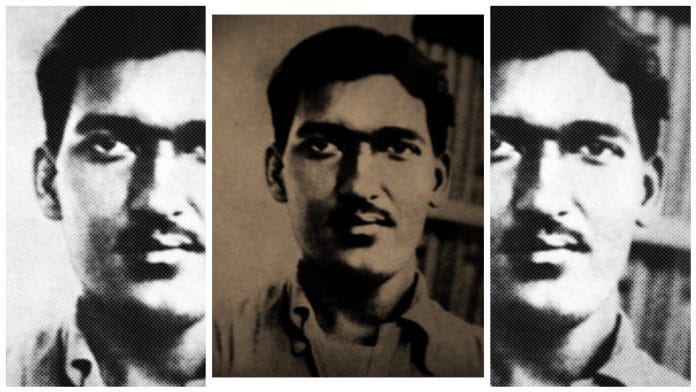

New Delhi: A martyr, a dacoit, a revolutionary — whatever name you call him by, Ashfaqulla Khan went down in history for heading the 1925 Kakori train robbery along with Ram Prasad Bismil, the leader of the revolutionary group Hindustan Republican Association (HRA) during India’s freedom movement. The plan was to loot a train carrying British state treasury from Kakori to Lucknow and use the loot to purchase arms for the freedom struggle. Khan, Bismil and nine other members were eventually captured and hanged by British forces.
Their story is depicted in the Bollywood blockbuster Rang De Basanti (2006), which follows the lives of five young men acting in a documentary film about five revolutionaries, one of whom is Ashfaqulla Khan, played by actor Kunal Kapoor.
Khan had a flair for Urdu poetry and wrote under the pseudonyms Varasi (or Warsi) and Hazarat. He wrote at length about the British ‘conspiracy’ in India: “Phoot daalkar shaasan karne ki chaal ka ham par koi asar nahi hoga aur Hindustan azad hokar rahega” (Your conspiracy to divide and rule India will not work; We will make Hindustan ours.)
As described by author Raja Anwar, Khan was one of the many “anti-imperialist firebrands of his time…”.
Redefining the freedom fight
Growing up, Khan heard stories from his eldest brother about the “bravery and shayari Urdu poetry of [Ram Prasad] Bismil”. When the 1922 Chauri Chaura incident prompted Gandhi to end the Non-Cooperation Movement, Khan was one of the many youngsters left disappointed. He felt a “dwindling faith in non-violent strategies” and started to believe that freedom from the shackles of colonialism called for more “radical methods”.
A tribute video, courtesy Doordarshan News, traces how the revolutionary’s political ideas eventually diverged from Gandhi’s and led him to join the HRA.
According to Khan’s grandson, Bismil was at first hesitant to accept him into the organisation. “Like other Pathans of Shahjahanpur, Khan’s family was rich and well-placed. His father was a kotwal and hence Bismil took time to draft him into the party. Bismil admitted that Khan had to bear a lot of pressure to disown him but never yielded. Their friendship was higher than the usual ones as it was based on common ideology, ideals and patriotism.” Bismil’s grand-nephew Raj Bahadur Tomar has also commented on the “life-long bond” between the two.
On joining HRA, the two knew an armed struggle required finances, which prompted them and nine other members of the group to carry out the Kakori train robbery on 9 August 1925. During the loot, a passenger was accidentally killed.
Labelled as terrorists by British forces, they were hunted down and captured. Khan was one of the four freedom fighters sentenced to death and at the age of 27, he was hanged in a jail in Faizabad. A memorial grave was set up in his hometown of Shahjahanpur.
The revolutionary was committed to his cause till the very end. Three days before his hanging, he wrote about “his anguish at the political developments” in an open letter to the public, writes historian S. Irfan Habib.
A disappointing remembrance
Shahdabullah, Khan’s grandson, once expressed his unhappiness with the way Khan’s sacrifice for the country has been remembered, and how the lack of it had taken a toll on the family.
“Since our grandmother came from a well-off background, we managed to survive,” he says. But “barring August 15 and his death anniversary, nobody has the time to remember him… After Ashfaqulla Khan was executed, the British government confiscated all the property and left our family to die.”
Also read: Chandra Shekhar Azad — the revolutionary who was at odds with Mahatma Gandhi