



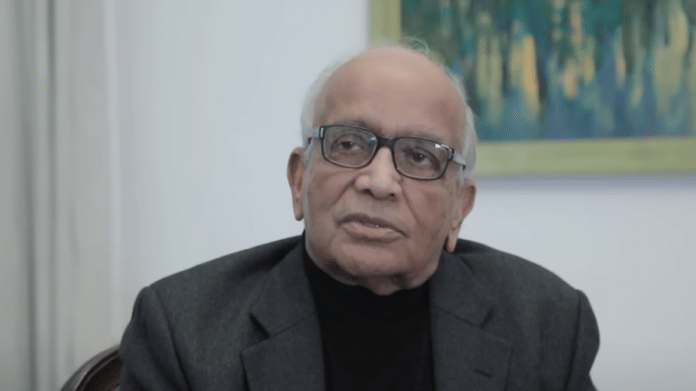

New Delhi: Relying on just electric vehicles to achieve the twin objectives of reducing dependence on oil import and lowering carbon footprint is not an appropriate solution for India, and the country should look at other options, including use of ethanol and biogas, said R C Bhargava, chairman of Maruti Suzuki India.
The auto industry veteran was in conversation with ThePrint’s Editor-in-Chief Shekhar Gupta and Associate Editor Yuthika Bhargava, during a session of ‘Off The Cuff’.
“I think one should be clear, why are we talking of EVs? What is the objective? One is that we want to reduce the carbon footprint from transportation…we want to reduce dependence on imports of oil from a few countries,” Bhargava said.
He reasoned that in India, about 75% of electricity is generated by burning coal. Hence, to run electric vehicles, more coal will be burnt, which is not environmentally friendly. Additionally, India is also dependent on imports for lithium and cobalt – the two major items that go into making batteries for electric vehicles.
“We have no resources of either lithium or cobalt. So, we will substitute import of oil by import of lithium and cobalt. The problem is that the reserves or at least the known reserves of lithium are very limited and roughly 80% of that is controlled by China in different parts of the world,” he explained.
He added that because of the growing demand for lithium all over the world, its price has already shot up two to three times in the last year.
“Yes, there is a requirement of EVs at a certain level who can afford…but we need other ways of getting the other two objectives of reducing import dependency on oil and carbon footprint. We have to look at those options such as ethanol – it is a very clean fuel in terms of carbon footprint, biogas, CNG, which the government is pushing. Then there is hybrid technology,” Bhargava, who was a former IAS officer, said.
Furthermore, he spelled out that Maruti Suzuki – the country’s largest car maker – is looking at all the other technologies and not just pushing for electric vehicles because it “doesn’t make sense for us at least. I don’t think it makes sense in the national context either”.
Maruti Suzuki India had previously announced that the company’s first electric car will hit the roads in 2025.
Bhargava also talked about the decline in the company’s market share from about 50% earlier to about 42% now.
“You can still produce what you intend to produce and sell all that you can produce and still lose market share or gain market share, depending on what’s happening to the rest of the market,” he said, adding that although the company has lost market share, it has been selling almost everything it produces.
“And I think that as long as a company is producing and selling all that it can produce and sell and selling it profitably, there’s nothing much to worry about,” the 88-year-old chairman said.
Responding to a question on the recent crash tests conducted by Global-NCAP – an organisation that works towards vehicle safety – in which three of Maruti Suzuki’s models fared poorly, Bhargava said the company follows the safety standards which are fixed by various governments.
“If governments all over Europe and Japan and America have enforced certain safety standards, do we mean to say that N-CAP – which is a charitable organisation – they’re not profit making, but funded by certain interested parties… that they know better about safety than all the governments of the world?” he questioned.
He further added that nobody is looking at what will be the impact on affordability of cars if all recommendations by Global-Nap are implemented.
“If the result of a particular standard is that much, fewer people will be able to use a four wheeler and will continue (with) the two wheeler. Is the benefit for the country more in terms of safety or less? Because two wheelers have the highest rate of deaths through accidents…if you put higher regulations, you will shrink the market further and it’s already happened even with the BS6 regulations,” Bhargava said.

Also read: Auto industry can’t grow with 50% tax on cars, says Maruti chairman R C Bhargava