


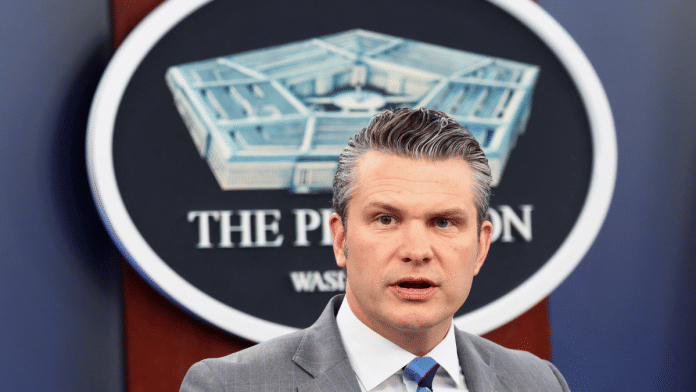
New Delhi: US Defence Secretary Pete Hegseth is facing an impeachment push led by Republican Congressman Thomas Massie, who has accused him of violating the Constitution through his handling of American military operations in Iran, Yemen and Venezuela.
The resolution, introduced on 9 November, contains eight articles of impeachment. Three concern the war with Iran, while the remaining five deal with civilian casualties, military strikes on suspected drug-smuggling boats, alleged retaliation against a US senator and military action in Venezuela and Yemen.
The move is significant because it comes from within President Donald Trump’s Republican Party, rather than solely from Democratic lawmakers. Massie has argued that Hegseth knowingly carried out unlawful military orders and poses a threat to the Constitution.
However, these are allegations contained in an impeachment resolution, not findings of guilt. Hegseth has rejected the accusations and defended the administration’s military operations.
The eight articles explained
1. Waging war against Iran without congressional approval
The first article accuses Hegseth of helping launch the US-Israeli military campaign against Iran on 28 February 2026 without a declaration of war or specific authorisation from Congress. It invokes the War Powers Resolution of 1973, which limits the circumstances in which a President can commit American forces to hostilities without congressional approval.
2. Ignoring Congress’s order to withdraw troops
The second article alleges that Hegseth continued military operations in Iran despite Congress passing a concurrent resolution directing the withdrawal of US forces. The House approved the measure on 3 June and the Senate on 23 June. The article further accuses Hegseth of continuing hostilities from 26 June onwards, disregarding Congress’s direction.
3. Continuing the Iran war beyond the 60-day limit
The third article focuses on the War Powers Resolution’s 60-day deadline. Under the law, the President must terminate the use of American forces within 60 days of notifying Congress about their deployment, unless lawmakers authorise the operation or extend the deadline. The impeachment resolution says the deadline expired on 1 May, with a possible additional 30-day withdrawal period also expiring on 1 June. It alleges that Hegseth continued the campaign beyond both deadlines.
4. Weakening safeguards against civilian casualties
The fourth article accuses Hegseth of dismantling safeguards meant to protect civilians during military operations. It cites cuts to civilian casualty monitoring, changes to military legal oversight and the rollback of policies designed to reduce civilian harm.
It also points to the bombing of a girls’ school in Minab, Iran, on 28 February, which killed at least 156 people, including schoolchildren and teachers, according to the resolution. It argues that the alleged dismantling of safeguards contributed to the failure to prevent such casualties.
5. Killing suspected drug smugglers without trial
The fifth article concerns US military strikes on boats suspected of carrying drugs in the Caribbean and eastern Pacific. It alleges that Hegseth authorised attacks that killed at least 221 people, instead of allowing suspected smugglers to be intercepted, arrested and prosecuted.
It also highlights an incident in which a second strike allegedly killed survivors clinging to the wreckage of a boat after an initial attack. The resolution argues that these operations amounted to extrajudicial killings and violated laws governing military involvement in civilian law enforcement.
6. Retaliating against Senator Mark Kelly over free speech
The sixth article accuses Hegseth of using the Pentagon to intimidate Democratic Senator Mark Kelly, a retired Navy captain and former astronaut.
Kelly had appeared in a video in November 2025 telling American service members they could refuse illegal orders. The Pentagon subsequently threatened to recall him to active duty for possible court-martial proceedings and issued a letter of censure. The resolution argues that Hegseth’s actions violated Kelly’s First Amendment rights and amounted to retaliation against a sitting senator.
7. Seizing Venezuela’s Nicolás Maduro
The seventh article concerns the US military operation that captured Venezuelan President Nicolás Maduro and his wife, Cilia Flores. It accuses Hegseth of overseeing an operation that amounted to an act of war against a sovereign country without congressional authorisation.
The resolution also alleges that the operation killed at least 83 people, including civilians, and went beyond the stated objective of apprehending a suspected criminal, effectively enabling regime change in Venezuela.
8. Launching an unauthorised military campaign in Yemen
The final article concerns Operation Rough Rider, the US military campaign against Yemen’s Houthi rebels between 15 March and 6 May 2025.
It alleges that Hegseth launched more than 1,100 strikes without the required congressional authorisation and that the campaign killed an estimated 224 civilians.
A key part of the charge concerns the Signal group chat controversy, in which Hegseth shared details of planned military strikes. The resolution cites messages in which Hegseth reportedly said the operation could easily be paused, arguing that this undermined the administration’s claim of an imminent threat requiring immediate military action.
What happens next?
Impeachment does not automatically remove Hegseth from office. The House of Representatives must first approve the articles by a simple majority. If that happens, the case moves to the Senate, which holds a trial. Conviction and removal require a two-thirds majority of senators present.
Massie’s move has put Republican lawmakers in an uncomfortable position. House Democratic leader Hakeem Jeffries has backed the impeachment effort, while Trump has criticised Massie and defended Hegseth. House Speaker Mike Johnson has also opposed holding an impeachment vote while American forces remain engaged in hostilities abroad.
Hegseth, meanwhile, has dismissed the effort as politically motivated and said he is prepared to defend the administration’s military actions.