



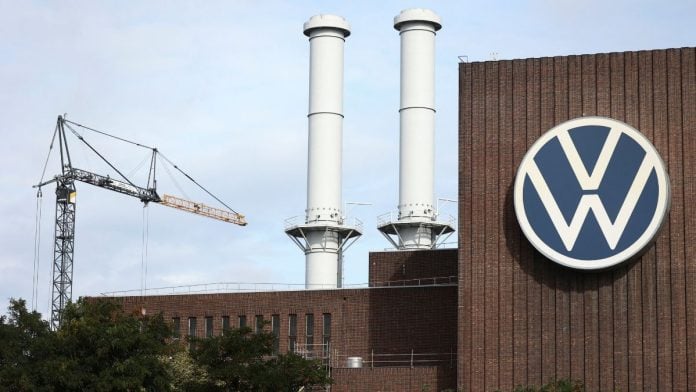
New Delhi: German carmaker Volkswagen has found itself in a fix as the company grapples with multiple crises like slashing profit margins, sweeping global layoffs and the potential winding down of its factories. The automotive giant is undergoing the largest restructuring plan in its 89-year-old history.
On Friday, the CEO of the second-largest automaker got a nod from the stakeholders for the overhaul in the company. However, he is pressured in Germany over job cuts and the firm’s stand of its on-ground strategy in the US.
The company’s supervisory board needs to settle the matter of Audi’s proposed US production plant—a move that requires clearance from the committee.
Additionally, the company has also decided to cut 50,000 jobs. The crisis has moved out of Europe and hit China—its most critical and profitable market. In April, Volkswagen eliminated 20,000 Chinese positions, bringing its regional headcount from 90,000 to 70,000 employees. With market demand being slow, the management signalled that further workforce cuts are expected.
“I had hoped that the measures agreed in 2024 would already be sufficient. Unfortunately, that has not been the case,” Volkswagen brand head Thomas Schaefer said. “We have absolutely no time to lose and will therefore significantly step up our performance programme once again. The company and employee representatives will discuss how to proceed.”
‘We cannot escape this trend’
Last week, the second-largest automaker flagged $11.5 billion in financial adjustments, largely driven by struggles at its Porsche brand and a sharp deterioration in the Chinese market. Consequently, it slashed the 2026 operating profit margin forecast to a maximum of 1 per cent.
Apart from Porsche, Volkswagen, which also includes Skoda and Audi, had previously forecasted profit margins between 4 per cent and 5.5 per cent. High tariffs, hard competition in Asia and a declining Chinese market are the three external pressures that have effectively broken Volkswagen’s legacy business model, eroding the premium once commanded by European engineering.
The development illustrates Europe’s struggle as the continent is caught in a high-stakes economic balancing act with both the US and China reshaping global trade through protectionism, industrial subsidies, and geopolitical rivalry.
Volkswagen said a “further deterioration in the market environment, especially in China”, where domestic competitors have eroded its market share. This is compounded by an accelerated demand shift toward electric vehicles (EVs), which remain less profitable for the group than combustion engine models.
Volkswagen’s profit in China has plunged more than 80 per cent in the last 10 years. The company has also fallen behind local Chinese competitors since 2025.
“The world’s largest single market has slumped by 20 per cent, with no consolidation in sight. We cannot escape this trend,” chief financial officer Arno Antlitz said.
Also read: Why is Kedarnath pilgrimage getting harder to manage? 50 tonnes of waste generated in 5 months
‘Most inefficient factories’
Heavy regulatory pressure, structural cost disadvantages, and intensifying global competition have forced Europe’s largest automaker into a historic existential crisis.
“Most managers have failed to keep pace with developments in e-mobility, digitalisation and battery technology, thereby causing the German automotive and supplier industries to fall behind,” said Horst Ott of trade union IG Metall.
Volkswagen is reportedly burning more capital on manufacturing than its competitors. Due to structural issues and rigid labour contracts in Germany, its production facilities are severely underutilised. For instance, factories like Zwickau are projected to drop to just 42 per cent capacity utilisation by 2030, transforming them into massive financial liabilities.
“VW’s (Volkswagen’s) factories are some of the most inefficient I have ever seen,” one of the former executives told Financial Times. “The first time I walked around Wolfsburg properly [VW’s main factory at its headquarters] I was just gobsmacked.”
Striking back against management’s aggressive cost-cutting plans, Volkswagen works council chief Daniela Cavallo and IG Metall union head Christiane Benner demanded stronger protection against unfair Chinese competition. The labour leaders also called for a more effective EU subsidy policy and the continuation of a phased retirement program to protect older workers.
This intervention from Germany’s most powerful labour leaders underscores the friction between corporate leadership, workers, and regional policy.
“We expect corporate leaders and management teams to take responsibility for Germany as an automotive nation, for employees and for jobs,” Benner said.
For decades, Volkswagen’s corporate governance model—which grants workers significant board-level influence—served as a shield against rapid, forced downsizing. However, as the structural realities of the EV transition set in, the traditional social partnership between German labour and corporate executives is fracturing.
Meanwhile, Volkswagen investors are claiming that the company has become self-obsessed and doesn’t focus on manufacturing better cars.
“VW spends too much time on itself, rather than worrying about what it should be hyper-focused on: the Chinese competition,” an investor told The Financial Times.