



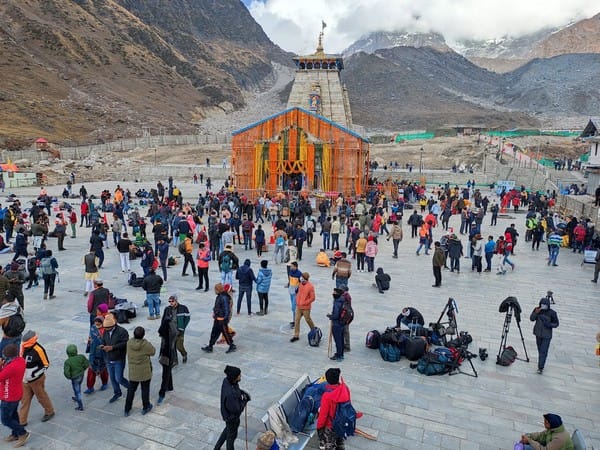
Kedarnath, one of India’s most visited Himalayan pilgrimage sites, generated 50.3 metric tonnes of waste in the last 5 Months this year, more than 2.5 times the amount recorded during the entire 2025 pilgrimage season.
The figures, provided by the Kedarnath Nagar Panchayat in response to a Right to Information (RTI) query, show how sharply the waste burden has risen at the shrine. The town generated 32.5 tonnes in 2023, 26.1 tonnes in 2024 and 21.4 tonnes in 2025. The 2026 figure is already higher than the full-year total for each of those three years.
This information was provided in response to a query raised by Amit Gupta, an RTI activist from Noida, Uttar Pradesh.
Around 20 tonnes of the waste generated this year was plastic. Of that, 18.5 tonnes had been processed, according to the Nagar Panchayat. The civic body says four landfills have been built in Kedarnath over the past five years.
So, why is managing waste at Kedarnath becoming increasingly difficult?
More pilgrims, more waste
One obvious factor is the sheer number of people travelling to the shrine.
More than 15 lakh pilgrims had visited Kedarnath by September this year, according to figures from the Uttarakhand Tourism Department’s yatra division office. That is a large floating population concentrated in a small Himalayan settlement during a limited pilgrimage season.
The monthly waste figures show how quickly the burden builds once the yatra gathers pace. Kedarnath recorded 1.7 tonnes of waste in April, but that jumped to 16.3 tonnes in May. The figures were 11.5 tonnes in June, 10.5 tonnes in July and 10.3 tonnes in August.
The peak season for visiting Kedarnath is during the summer months of May to June and the post-monsoon window of September to October
However, the RTI data does not establish how much of this waste was generated by pilgrims. It does not separate waste produced by visitors from that generated by local businesses, workers and other residents.
Why is Kedarnath so difficult to manage?
Kedarnath is not an ordinary tourist town where waste can easily be transported to a large processing facility.
The shrine sits high in the Himalayas, with limited road access and a narrow window for the annual pilgrimage. Moving waste out of such terrain requires additional logistics, while setting up large waste-processing facilities is constrained by the geography and ecological sensitivity of the area.
The problem is also not limited to solid waste. Sewage and wastewater present another challenge as the number of visitors rises.
In 2025, environmental activist Amit Gupta had raised concerns over the capacity of a proposed 600-kilolitre-per-day sewage treatment plant at Kedarnath, arguing that it would not be sufficient for the floating population during the peak pilgrimage period. The concerns were raised in the context of rapidly rising footfall.
The Himalayan environment makes the consequences of poor waste management particularly significant. Plastic and other non-biodegradable material can remain in the environment for long periods, while poorly managed sewage and waste can threaten fragile ecosystems and water sources.
Is the waste system keeping up?
There are signs that some of the waste is being processed. The Nagar Panchayat says 18.5 of the roughly 20 tonnes of plastic waste generated this year had already been processed.
But the scale of the overall increase raises a different question: whether waste infrastructure can keep pace with a pilgrimage that is drawing increasingly large crowds.
Kedarnath reportedly has 30,000 square feet of landfill capacity of which only 2,000 square feet has been utilised by creating four landfills over the past five years. Because RTI response uses square feet rather than the amount of additional waste it has accommodated it becomes difficult to determine exactly how long the existing landfill capacity can last.
Can Kedarnath handle more visitors?
That is ultimately the larger question behind the waste figures.
Kedarnath’s popularity has grown rapidly, with pilgrims arriving by road, on foot and by helicopter. The government has also expanded helicopter operations to improve access to the Char Dham sites. During the first phase of the 2026 yatra (April 22 through June 15, 2026), more than 78,000 pilgrims travelled through helicopter shuttle and charter operations across the Char Dham sector.
Easier access can bring more visitors, but it also means greater pressure on water, sanitation, waste collection, accommodation and transport systems in places where expanding infrastructure is difficult.
The 50.3-tonne waste figure does not by itself prove that Kedarnath’s pilgrimage model is unsustainable. But it does show that the waste burden is rising much faster than in recent years.
For a shrine located in one of India’s most environmentally fragile mountain regions, the challenge is no longer simply getting pilgrims to Kedarnath. It is managing what millions of visitors leave behind.