



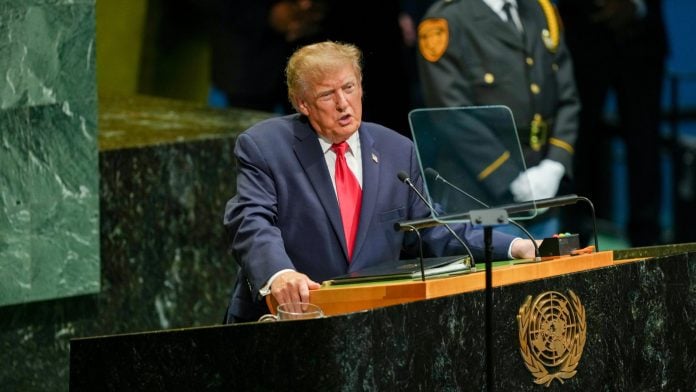
New Delhi: US President Donald Trump wants to replace the term “artificial intelligence” with “super intelligence”, saying the word “artificial” makes the technology sound fake.
Speaking at the United Nations General Assembly in New York on Tuesday, Trump said US government documents would henceforth use “super intelligence” or “SI” instead of artificial intelligence, and suggested other countries to follow suit.
The proposed name, however, is unlikely to change how researchers or the industry understand the technology. In fact, “super intelligence” already has a specific meaning in discussions about the future of AI.
What does ‘super intelligence’ actually mean?
Artificial intelligence is a broad term for computer systems capable of performing tasks associated with human intelligence, such as understanding language, recognising patterns, generating content and solving problems.
“Super intelligence” means something much more specific.
The term is generally used to describe a hypothetical form of AI whose intellectual abilities surpass those of humans across a wide range of areas. It is associated with discussions about AI systems that could potentially reason, learn and solve problems at a level beyond human capability.
That is different from simply giving today’s AI systems a new name.
Researchers have therefore questioned Trump’s use of “super intelligence” to describe existing AI. Experts cited by the BBC said the term is generally reserved for a much more advanced stage of AI, which does not currently exist.
In other words, “super intelligence” is not simply a more accurate synonym for artificial intelligence. It describes a possible future development of the technology.
Read Here: Xi unlikely to take along any CEOs to US summit with Trump
Why does Trump want to rename AI?
Trump’s argument is largely about the word “artificial”. He has said it makes intelligence “sound fake”, while arguing that the technology is real and increasingly capable.
The proposed change also fits into his broader approach to AI. Last week, Trump announced plans for an “AI Force” and said he would name an “AI czar” to oversee the industry. He has also pushed back against calls for tighter controls on AI, arguing that the US cannot afford to slow development while competing with China.
At the UN, Trump said the US would not “stifle the growth” of AI, which he described as a technology that could become bigger than the Industrial Revolution. He also dismissed warnings about AI posing an existential threat to humanity as a “hoax”.
His administration’s proposed terminology, however, does not change what AI is.
What other names were considered?
Trump had floated several alternatives on his Truth Social platform before settling on “super intelligence”.
Among the names discussed were “superior intelligence”, “extreme intelligence” and “supreme intelligence”. He later used polls on Truth Social to ask followers to weigh in, with “super intelligence” emerging as his preferred choice.
The terminology has already begun appearing among some people in Trump’s orbit, even as its adoption by the wider technology industry remains uncertain.
The proposed change has also drawn a degree of scepticism outside the US. Canadian AI minister Evan Solomon, when asked about the new name, joked that Canadians were “not enthusiastic” about renaming things, in an apparent reference to Trump’s earlier attempts to rename geographical features.
Will AI actually become ‘SI’?
For now, there is little indication that the technology industry is preparing to abandon the term AI.
The phrase “artificial intelligence” has been used for decades and covers a vast range of systems, from recommendation algorithms and chatbots to increasingly capable generative AI models.
“Super intelligence”, meanwhile, remains largely a theoretical concept. Using it for existing systems could therefore blur the distinction between what current AI can do and what researchers believe future systems could potentially achieve.
Whether “SI” becomes part of everyday technology language will depend not only on US government documents but also on whether researchers, companies, and the public begin using it. For now, the industry continues to call it AI.