



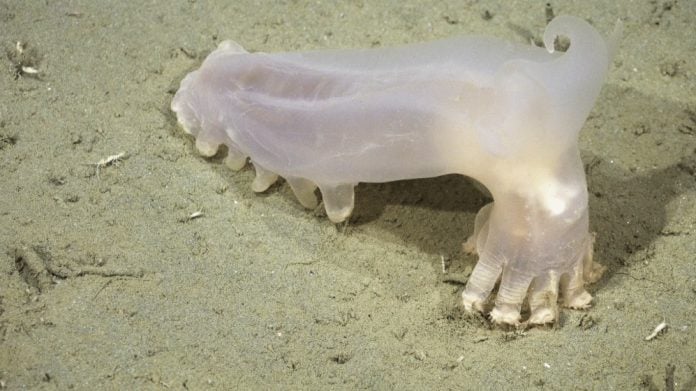
New Delhi: In just two weeks, scientists examining samples from a deep-sea canyon off Argentina identified 57 species previously unknown to science, along with five new genera. Among sea cucumber with horn-like appendages that researchers nicknamed “Loki”.them was a strange
The haul came from the Mar del Plata Submarine Canyon, one of the largest deep-sea canyons in Argentina’s waters. The specimens were collected during an expedition in 2025 and examined by 20 taxonomists and early-career researchers at an international species-identification workshop in Buenos Aires this year.
The discoveries are remarkable, but perhaps the bigger question is this: how can scientists still find dozens of completely new animals in a part of the planet that covers most of its surface?
The answer lies in just how difficult the deep ocean is to reach, observe and study.
What was found in the canyon?
The 57 new species belong to several very different groups.
The scientists identified 20 new copepods, tiny crustaceans that form an important part of marine food webs; 22 echinoderms, including sea cucumbers and crinoids; 14 cnidarians, including corals and sea pens; and one new scaphopod mollusc. Five previously unknown genera were also identified among the specimens.
One of the most striking animals was “Loki”, a deep-sea sea cucumber of the genus Peniagone. It gets its nickname from horn-like appendages that reminded researchers of the Norse god.
It was found at about 2,577 metres below the surface, in a world where there is no sunlight and pressure is hundreds of times greater than at sea level.
And even this collection does not represent everything scientists brought back.
According to Argentina’s National Scientific and Technical Research Council, researchers examined only about 10 per cent of the copepod samples collected during the expedition. Some coral specimens could also represent new genera or even a new family, although genetic work is still required to establish that.
In other words, 57 is not necessarily the end of the discovery story from this one expedition.
Why was this particular canyon so rich in life?
The Mar del Plata Canyon sits in an unusually dynamic part of the South Atlantic.
Two major ocean currents meet in the region: the warm, salty Brazil Current and the colder, nutrient-rich Malvinas Current. Their meeting point, known as the Brazil-Malvinas Confluence, is one of the most energetic regions of the global ocean.
That matters because ocean currents move nutrients, heat and organisms around.
The canyon also creates a complex three-dimensional landscape on the seafloor, with slopes and habitats that can support corals, sponges and other animals.
Scientists already knew the region could contain rich ecosystems. Expeditions in 2012 and 2013, using fishing nets and trawls rather than modern underwater vehicles, found new species and produced more than 60 scientific papers. They also provided evidence of cold-water coral and sponge gardens.
But researchers still did not know exactly where those communities were located or how they functioned.
The 2025 expedition was designed to change that.
Why can’t scientists simply map the ocean and see what is there?
Mapping is not the same as exploring.
A large portion of the ocean floor has now been mapped using sonar. As of April 2026, 28.7 per cent of the world’s seafloor had been mapped using modern standards. But a map tells scientists about the shape of the seabed. It does not necessarily tell them what animals live there.
To actually see those animals, scientists need to get there.
That is extraordinarily difficult.
The deep ocean generally begins around 200 metres, where sunlight rapidly disappears. Below about 1,000 metres, there is essentially no sunlight at all. The average temperature in the deep ocean is around 4°C, while pressure rises by roughly one atmosphere for every 10 metres of depth.
For humans, that environment is effectively hostile.
For scientists, it means building machines capable of travelling kilometres underwater while carrying cameras, lights and scientific equipment.
So how do scientists explore it?
The Argentine expedition used SuBastian, a remotely operated vehicle, or ROV, operated from the research vessel Falkor (too).
Unlike a crewed submarine, an ROV remains connected to the ship. Scientists can control it from the surface, watch live video and collect samples from the seafloor.
That makes it possible to examine animals where they actually live rather than relying only on specimens dragged up in nets.
During the Mar del Plata expedition, the ROV provided what researchers describe as the first in-situ observations of parts of this enormous seafloor feature.
The expedition was also streamed live, bringing the deep sea to millions of viewers. According to CONICET, the 21-day campaign attracted about four million viewers during the live broadcasts and nearly 22 million views across platforms.
But haven’t humans explored most of the ocean already?
The ocean covers about 70 per cent of Earth’s surface and has an average depth of roughly 3,682 metres. More than 90 per cent of it is considered deep ocean, meaning deeper than 200 metres.
NOAA says explorers have visually observed less than 0.001 per cent of the deep-ocean seafloor.
That number is easy to misunderstand. It does not mean scientists have no information about the rest. Satellites and sonar can reveal enormous amounts about the ocean’s shape, temperature, chemistry and currents.
But there is a huge difference between knowing that a canyon exists and knowing what is crawling, swimming or growing inside it.
It is similar to having a detailed map of a city while never entering most of its buildings.
Why are there still so many undiscovered species?
There are two separate problems: finding an animal and proving that it is new to science.
A creature can be photographed by an ROV and still not be formally recognised as a new species. Scientists often need to collect a specimen, compare its anatomy with known species and, increasingly, analyse its DNA.
That process has historically been slow because there are relatively few specialists capable of identifying particular groups of deep-sea animals.
The latest workshop tried to speed this up.
Twenty taxonomists and researchers from Latin America and Europe worked together in Buenos Aires, using what is known as integrative taxonomy, combining physical characteristics with other evidence to identify the specimens. Their findings were recorded in Ocean Census NOVA, an open-access platform designed to accelerate the identification of newly discovered marine species.
The result was 57 new species identified in just two weeks.
Why does finding them matter?
It is tempting to view the discoveries simply as a collection of bizarre animals from a dark part of the sea.
But knowing what lives there is important for a much bigger reason.
Deep-sea ecosystems are increasingly relevant to decisions about fishing, conservation, climate and potential exploitation of ocean resources. Scientists cannot properly protect an ecosystem they have barely documented.
The deep ocean also plays an important role in the climate system. The currents meeting near the Mar del Plata Canyon, for example, help redistribute heat between the tropics and higher latitudes.
And there is another reason the 57 discoveries matter.
Every time scientists explore a previously poorly studied part of the ocean, they are not simply adding names to a catalogue. They are discovering how much remains unknown.
The strange truth is that humans have produced extraordinarily detailed maps of Mars while still having only a partial picture of the world beneath our own seas.
The Mar del Plata Canyon is a reminder of why. The ocean is not one enormous, uniform body of water waiting to be mapped. It is a vast collection of mountains, trenches, canyons, currents and habitats, much of it in permanent darkness.
And somewhere in that darkness, there are almost certainly many more species that science has never seen.