


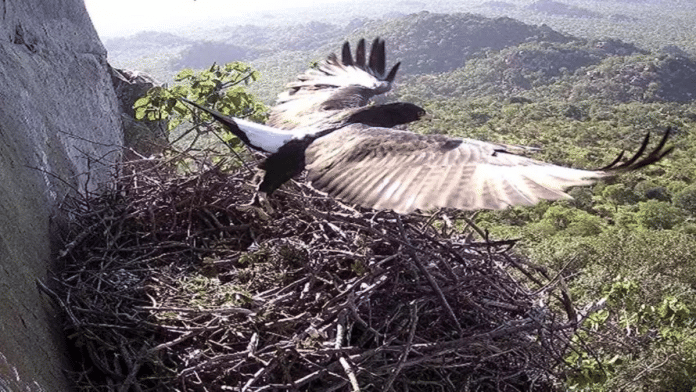
New Delhi: An eagle weighing barely four kilogrammes swoops down on a rocky cliff in the Sahara Desert. Its target isn’t a rabbit, a snake or a small bird. It is an adult baboon, a powerful monkey weighing more than six times as much as the eagle itself.
It sounds like an impossible fight. But scientists have uncovered evidence that eagles in northern Chad are hunting baboons weighing as much as 26 kg, overturning long-held assumptions about how large an animal these birds can kill.
The discovery, published Wednesday in the American Journal of Biological Anthropology, has also raised an unsettling possibility. Could giant birds of prey have hunted our early human ancestors?
How did scientists discover the attacks?
The discovery came from the Ennedi Plateau, a remote region of sandstone cliffs in the Sahara Desert.
Researchers studying an isolated population of olive baboons found the remains of at least nine adults bearing unusual injuries.
Several skulls had deep puncture marks around the eye sockets, while shoulder bones showed scratches consistent with powerful talons.
The likely culprit was the Verreaux’s eagle, a large African bird of prey known for hunting rock hyraxes, small mammals that resemble oversized guinea pigs.
These eagles have enormous gripping strength and talons capable of inflicting serious injuries.
Researchers estimated that the dead baboons weighed an average of 22.2 kg. The largest weighed around 26 kg.
Previously, scientists believed eagles could not successfully prey on primates weighing more than about 13 kg.
Why is this so surprising?
The weight difference is extraordinary.
A Verreaux’s eagle typically weighs around four kilogrammes, making some of the baboons more than six times heavier than their suspected attackers.
But the discovery does not mean eagles were lifting entire baboons into the sky.
The researchers believe the birds killed their prey on rocky terrain and transported portions of the carcasses to their nests.
The team also noticed something peculiar. Eight of the nine baboons were males.
One possible explanation is that male baboons sometimes sit alone on exposed cliffs, making them vulnerable to attacks from above.
Gisela Kopp, a researcher at the Max Planck Institute of Animal Behavior, said the baboons presented an unusual case because males often occupied exposed vertical rock faces.
However, some independent experts have urged caution, arguing that the injuries do not conclusively prove the eagles killed healthy adult baboons rather than feeding on weakened or already dead animals.
Also Read: A rat as heavy as a dog? Ancient Thailand was home to a giant rodent 35 million years ago
Could eagles have hunted early humans?
This is where the discovery becomes particularly fascinating.
Some of humanity’s early relatives were considerably smaller than modern humans.
Lucy, the famous 3.2-million-year-old Australopithecus afarensis fossil discovered in Ethiopia, is estimated to have weighed around 28 kg.
That is only slightly heavier than the largest baboon examined in the study.
Scientists already suspect that an eagle killed the Taung Child, a young human relative who lived in southern Africa around 2.8 million years ago.
Marks around the child’s fossilised eye sockets resemble damage caused by eagle talons.
The new findings suggest that even some adult human ancestors might have faced threats from above.
Researchers believe this could help explain why early primates developed defensive behaviours, including living in groups and warning one another about approaching predators.
Are humans at risk from these eagles today?
Eagles generally prefer smaller, easier prey, and attacks on humans are exceptionally rare.
The Sahara findings concern an unusual population of baboons living in a harsh environment with limited cover.
Scientists are now investigating whether the birds have developed a specialised hunting strategy.
For millions of years, researchers have examined how our ancestors escaped lions, leopards and other ground predators.
This discovery suggests they might occasionally have needed to look up as well.