


New Delhi: Imagine walking through a forest and coming face to face with a rat weighing as much as a golden retriever. Not exactly the kind of creature you would want scurrying across your kitchen floor.
But around 35 million years ago, an enormous rodent weighing an estimated 30 kg roamed the tropical forests of what is now Thailand.
Scientists identified the animal as Yakamys sirindhornae, a previously unknown species discovered through fossilised teeth at a coal mine in southern Thailand.
And the discovery suggests that giant rodents were roaming the Earth millions of years earlier than scientists previously thought.
How did scientists discover the giant rodent?
The story began in 2004, when geologist Pannipa Tian noticed something unusual in a coal mine in Thailand’s Krabi province.
A cream-coloured object was sticking out of the dark rock. At first, she thought it was a bone.
It turned out to be a fossilised tooth.
Researchers subsequently recovered another enormous tooth, providing enough evidence to investigate the creature’s identity.
After years of examination, an international team of scientists concluded that the teeth belonged to an entirely new species of prehistoric rodent.
The animal lived between 33 million and 35 million years ago, during a period known as the Eocene, when much of the world was warmer and tropical forests were widespread.
The species was named Yakamys sirindhornae in honour of Thailand’s Princess Maha Chakri Sirindhorn.
How big was this prehistoric rat?
The researchers estimate that the animal weighed approximately 30 kg, or 66 pounds.
For comparison, an ordinary brown rat generally weighs less than a kilogramme.
That would make the prehistoric creature dozens of times heavier than the rats commonly found in homes and cities.
But calling it a giant rat can be misleading.
Rodents are a much broader family of mammals that includes rats, mice, squirrels, beavers and capybaras.
Scientists identified the ancient Thai animal as a rodent, but that does not mean it looked exactly like an oversized modern rat.
Because researchers recovered teeth rather than a complete skeleton, its precise appearance remains uncertain.
The teeth nevertheless offer valuable clues about its size and evolutionary relationships.
Were there even bigger rodents?
Absolutely. And some were enormous.
One of the most remarkable examples is Josephoartigasia monesi, a prehistoric rodent discovered in Uruguay.
It lived roughly two to four million years ago and is widely regarded as one of the largest rodents ever identified.
Researchers have produced varying estimates of its weight, with some suggesting it could have exceeded 1,000 kg, although later calculations have been considerably lower.
Another giant, Phoberomys pattersoni, lived in South America millions of years ago and is estimated to have weighed several hundred kilogrammes.
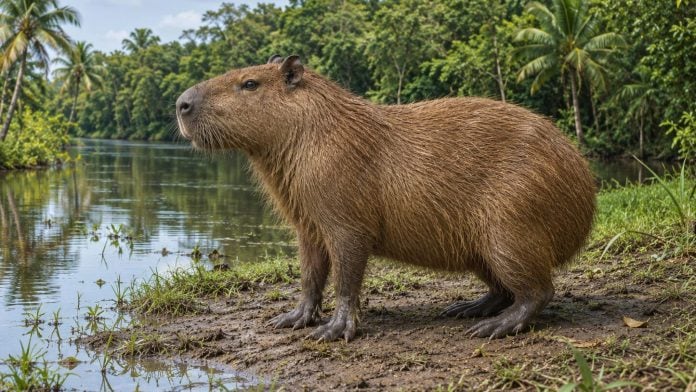
For comparison, today’s largest living rodent, the capybara, can weigh around 65 kg.
Unlike the prehistoric giants, capybaras still inhabit South American wetlands and are known for their unusually calm behaviour.
Why is the Thailand discovery important?
Until recently, much of the evidence for enormous prehistoric rodents came from later periods, particularly discoveries in South America.
The Thai fossils suggest that rodents were already evolving much larger bodies at least 15 million to 20 million years earlier than previously established.
That challenges scientists’ understanding of when giant rodents first appeared and how widely they were distributed.
It also raises questions about the ancient environment.
Researchers believe the creature inhabited a tropical ecosystem that supported a wide variety of mammals, although its precise diet and behaviour remain uncertain.
For scientists, the most exciting part is how little material was needed to uncover such an extraordinary animal.
Two fossilised teeth, buried in a Thai coal mine for millions of years, have revealed a creature that nobody knew existed.
And if those teeth are any indication, the ancient world had some seriously oversized rodents.