



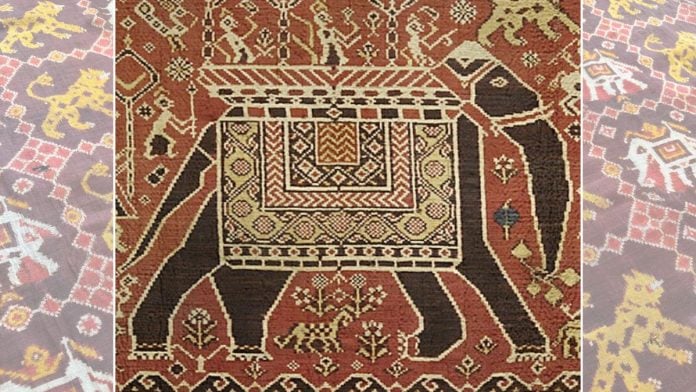
New Delhi: A common sight in Navratri celebrations, the Patan Patola is a beautiful weave, known for its ‘double ikat’ pattern that makes the fabric look alike from the front and back. So precise is the alignment of the threads that many find the weave to look almost digitally printed. Now, this traditional handwoven silk textile, one of the most expensive handwoven textiles in the world, has found praise from commerce minister Piyush Goyal.
In a recent post on X, Goyal congratulated Gujarat chief minister Bhupendra Patel and deputy chief minister Harsh Sanghavi on their “commendable efforts” in preserving and promoting the Patan Patola craft.
“A fabric so timeless that it is part of Gujarati folk tradition. The GI-tagged Patan Patola is a double ikat silk craft, reflecting generations of artistry and months of meticulous work by our weavers. This Navratri, let every Garba twirl celebrate this enduring heritage,” Goyal wrote.
The Patan Patola, exclusively produced in northern Gujarat’s Patan region, received the Geographical Indication (GI) tag in 2013.
Where does the craft come from?
The Patola was once reserved for royalty—notably the Solanki dynasty of Anahilavada, known today as Patan. While the history of the textile dates back centuries, experts and enthusiasts differ on how the craft came to be.
It is thought that the textile was brought to Patan by King Kumarpal of the Solanki dynasty in the 12th century. According to a legend, the king was barred from entering a Jain temple after the priest accused Kumarpal of wearing ‘impure’ clothes made from fabric that had previously been used as a bedspread. Deeply offended, Kumarpal decided to bring 700 Salvi craftsmen to Patan from Jalna, in present-day Maharashtra. It was Kumarpal’s attempt to ensure an unsullied procurement of the fabric.
The craft can be traced back to the 10th century, and weavers from South India are said to have carried the form with them. The craft is a monopoly of the Salvi community, which has passed its knowledge down through generations.
Also read: Who was buried in a Roman sarcophagus at Westminster Abbey? New study offers clues
How is Patan Patola woven?
While the technique of ikat weaving is practised in various parts of Africa, South America, and Asia, Patan Patola stands out in its use of the ‘double ikat’ technique, which produces stunning reversible designs.
Patolas are woven through a time-consuming process, where both warp and weft threads are resist-dyed before weaving. It uses a primitive hand-operated harness loom, made of bamboo and rosewood strips.
According to the website of Patan Patola Heritage, a Patola weaving business in Patan, each sari in this style can take anywhere between three and six months to complete. Two weavers work together on just about 8 to 9 inches of a 6-yard sari in a day. Four to five weavers may sometimes work together to complete a sari, depending on the intricacy of a design.
Geometric patterns dominate the Patan Patola fabrics, owing to the weaving style. Many designs draw inspiration from local architecture, including the stone panels of Patan’s 11th-century stepwell, Rani Ki Vav. Elephants, parrots, flowers, stars, and diamonds are popular motifs.
Possible technological innovations
While the GI tag has granted the craft an authenticity certificate, non-profit organisations and researchers are attempting to find digital solutions for its preservation and survival in the modern consumer market.
Two Gujarat-based organisations, Life Global and Gramshree, are working together to digitise traditional weaving techniques and layouts in an attempt to safeguard the knowledge of artisans.
Other interventions include the introduction of e-business platforms that help weavers bypass exploitative middlemen, and the integration of blockchain for traceability and AI-driven inventory management for scalable supply chains.
(Edited by Prasanna Bachchhav)