



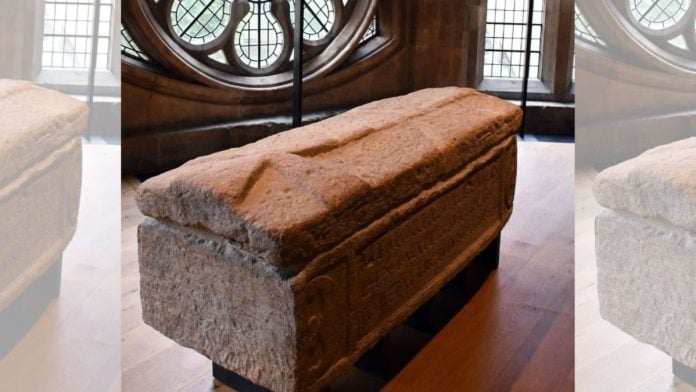
New Delhi: Archaeologists are close to solving the mystery of a formerly inexplicable Roman sarcophagus, discovered at England’s Westminster Abbey in 1820. While the skeleton’s definitive identity remains unknown, a recent study by Warwick Rodwell, published in the Journal of the British Archaeological Association, has narrowed the skeleton down to two candidates, who were both high-ranking monks in Westminster Abbey’s Benedictine monastery.
The sarcophagus has puzzled archaeologists ever since it was officially excavated in 1869 from what was once the yard of the sacristy built by Henry III.
The sarcophagus itself dates back to the 4th century CE, when the Roman Empire extended as far as Britain. It also bears a Roman decoration on its side, and a Latin inscription to Valerius Amandinus– a wealthy Briton who lived in the city around 300 to 400 AD.
However, the sarcophagus’ lid bears a more recent medieval cross, which belongs to the late Anglo-Saxon period (roughly 899 to 1066 AD). This chronological disjunction between the lid and the tomb led the archaeologists to believe that the sarcophagus possibly housed someone other than Amandinus.
They had also hypothesised that the sarcophagus had been reused after it was first constructed. However, they were unable to identify who was buried in it until now.
Who do the bones belong to?
Rodwell has identified the most likely candidate as Aelfwig, who served as Abbot of the medieval Benedictine monastery and died around 1020.
Another possible candidate is Wulnoth, who was Aelfwig’s successor. Wulnoth died in 1049, and is also presumed to have been buried at the Abbey.
“We do not know the date of birth of either. But either would fit equally well if we assume the Abbot was in his early twenties when the appointment was made and close to fifty when he died,” explained Rodwell.
“The fact Aelfwig was already a monk of Westminster might favour him,” he added.
Also Read: What were humans up to 60,000 years ago? Engravings on ostrich eggshells point to a clue
Recent developments
While the sarcophagus and the skeleton have long been the subject of extensive research, newer findings from Rockwell and his team have provided fresh insight into its history.
For instance, human bones specialist James Young Langthorne from Pre-Construct Archaeology (PCA) determined the age and height of the deceased man.
He determined the man to be between 35 and 49 years old, and of 5ft 9 inches in height. This differs from the 1800s assessment, which suggested that the skeleton belonged to a ‘robust young man’.
Older research had proposed that the man was around 5 ft 7 inches tall, and aged no more than 30 years.
Additionally, a bone sample sent to the Scottish Universities Environmental Research Centre for carbon dating indicated that the skeleton dates back to a period between 987 to 1052 AD, confirming the reuse of the sarcophagus.
(Edited by Maryam Hassan)