


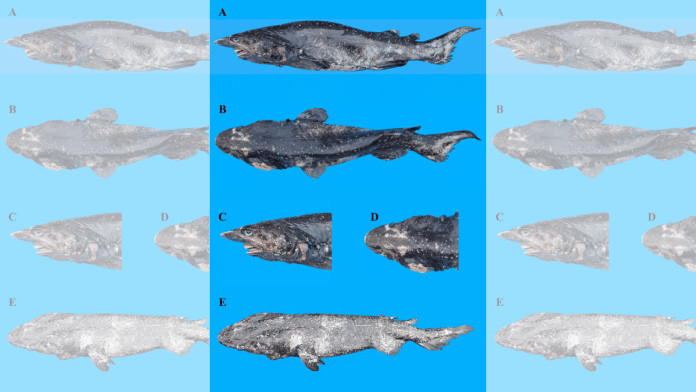
New Delhi: For decades, a shark lurking hundreds of metres beneath the Indian Ocean had scientists fooled. It was nearly three metres long, had a dark body covered in thorn-like structures and looked remarkably similar to a species found thousands of kilometres away in the Atlantic Ocean.
But the shark had been hiding a secret in plain sight. It wasn’t the Atlantic bramble shark at all.
Indian scientists have now identified it as an entirely distinct species, Echinorhinus roinee, or the Indian Bramble Shark, after examining its physical features and DNA.
The discovery, announced by the Zoological Survey of India (ZSI) and the ICAR-Central Marine Fisheries Research Institute (CMFRI) last week, raises an intriguing question. How many other species are swimming through Indian waters without scientists knowing they exist?
What makes the Indian Bramble Shark different?
The Indian Bramble Shark is hardly an animal that would blend into a crowd.
Found at depths of 350 to 450 metres along the continental slope, it can grow up to three metres long. Its dark brown or nearly black body is covered in thorn-like scales called dermal denticles, which develop into multi-pointed plates as it matures.
The specimens were collected at Sakthikulangara Fishing Harbour in Kerala’s Kollam district, where deep-sea shrimp trawlers had brought them ashore as accidental catches.
For years, researchers had classified such sharks as Echinorhinus brucus, the Atlantic bramble shark. However, closer examination revealed larger eyes, bigger pelvic fins and a longer distance between the snout and gills.
DNA analysis finally settled the question. The Indian shark belonged to a separate genetic lineage, distinct from its Atlantic and Pacific relatives.
The species was named after Roinee, daughter of ZSI Director Dhriti Banerjee, one of the study’s authors.
How did scientists miss it for so long?
The problem wasn’t that nobody had encountered the shark. Fishermen had been bringing similar specimens ashore for years.
The difficulty lay in identifying them.
Deep-sea sharks often share remarkably similar physical characteristics, making it difficult to distinguish closely related species without detailed anatomical comparisons or genetic testing.
The Indian Bramble Shark’s resemblance to its Atlantic cousin meant that previous fisheries records continued using the wrong scientific name.
Researchers now believe its range could extend beyond India to waters around Oman, Sri Lanka and Thailand.
Have other sharks been discovered this way?
This isn’t the first time Indian scientists have found a new shark species hiding behind an old identification.
In a study published in January 2025, ZSI researchers described Squalus hima, a deep-water dogfish shark from the Arabian Sea off southwest India.
It had previously been confused with two other dogfish species. Differences in its vertebrae, teeth, body measurements and fins eventually established it as a separate species.
Elsewhere, researchers identified Rhinochimaera costaricana, a new deep-sea ghost shark from waters off Costa Rica in 2026. Despite its name, a ghost shark is a chimaera, a relative of true sharks rather than a shark itself.
What other sharks are found in Indian waters?
India’s seas are home to far more than the sharks commonly associated with tropical beaches.
A ZSI research summary in 2024 documented 88 shark species appearing in commercial catches, including deep-sea varieties rarely seen alive.
They range from the enormous whale shark, the world’s largest living fish, to hammerheads, tiger sharks, bull sharks and thresher sharks, whose unusually long tails help them hunt prey.
Some, such as the Ganges shark, are associated with river systems and coastal waters, while others inhabit the deep ocean.
And the discoveries continue. In September 2026, scientists described the Arabian Skate, Dipturus dhritiae, another cartilaginous fish that had been mistaken for a different species for more than four decades.
For the Indian Bramble Shark, the new identification is more than a scientific name change. It means researchers can finally begin assessing its population, fishing-related threats and conservation needs as a separate species.
The shark had been there all along. Science has only just caught up.