


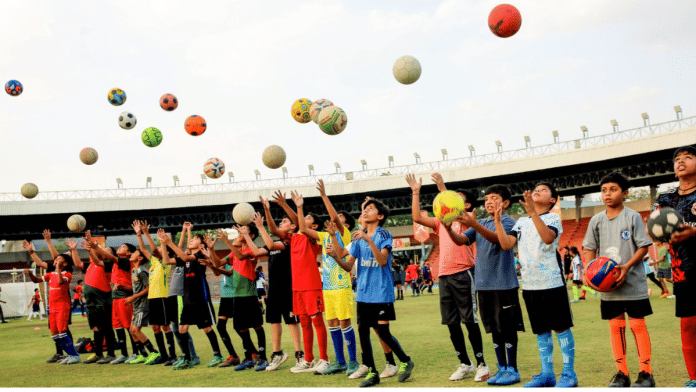
New Delhi: India has struggled to establish itself in international football at the senior men’s level, leaving hopes of a breakthrough increasingly pinned on its younger players. This is significant in a country where football remains one of the most popular sports. Yet, despite a network of youth competitions, the challenge of providing young footballers with enough competitive exposure remains.
India made its FIFA U-17 World Cup debut in 2017 as the host nation. The team, however, lost all three of its group-stage matches, underlining the distance it still had to cover to compete internationally.
The country has several youth football competitions, including national youth leagues and the historic Subroto Cup for school teams. However, having competitions in place does not necessarily mean young players get regular match time. One possible explanation for India’s struggles at the international level lies in how few competitive matches its young players get to play.
In 2023, the All India Football Federation (AIFF), India’s football governing body recognised by the Union Ministry of Youth Affairs and Sports, released Vision 2047, a long-term strategy to make the country one of Asia’s leading football nations.
The roadmap identified a strong competition structure as central to football development. It acknowledged that players in India’s top leagues were guaranteed fewer matches than their international counterparts and called for greater competitive exposure at the youth level.
To address this gap, AIFF set a target of at least 35 matches per season across state and national leagues by January 2027 for boys across age groups.
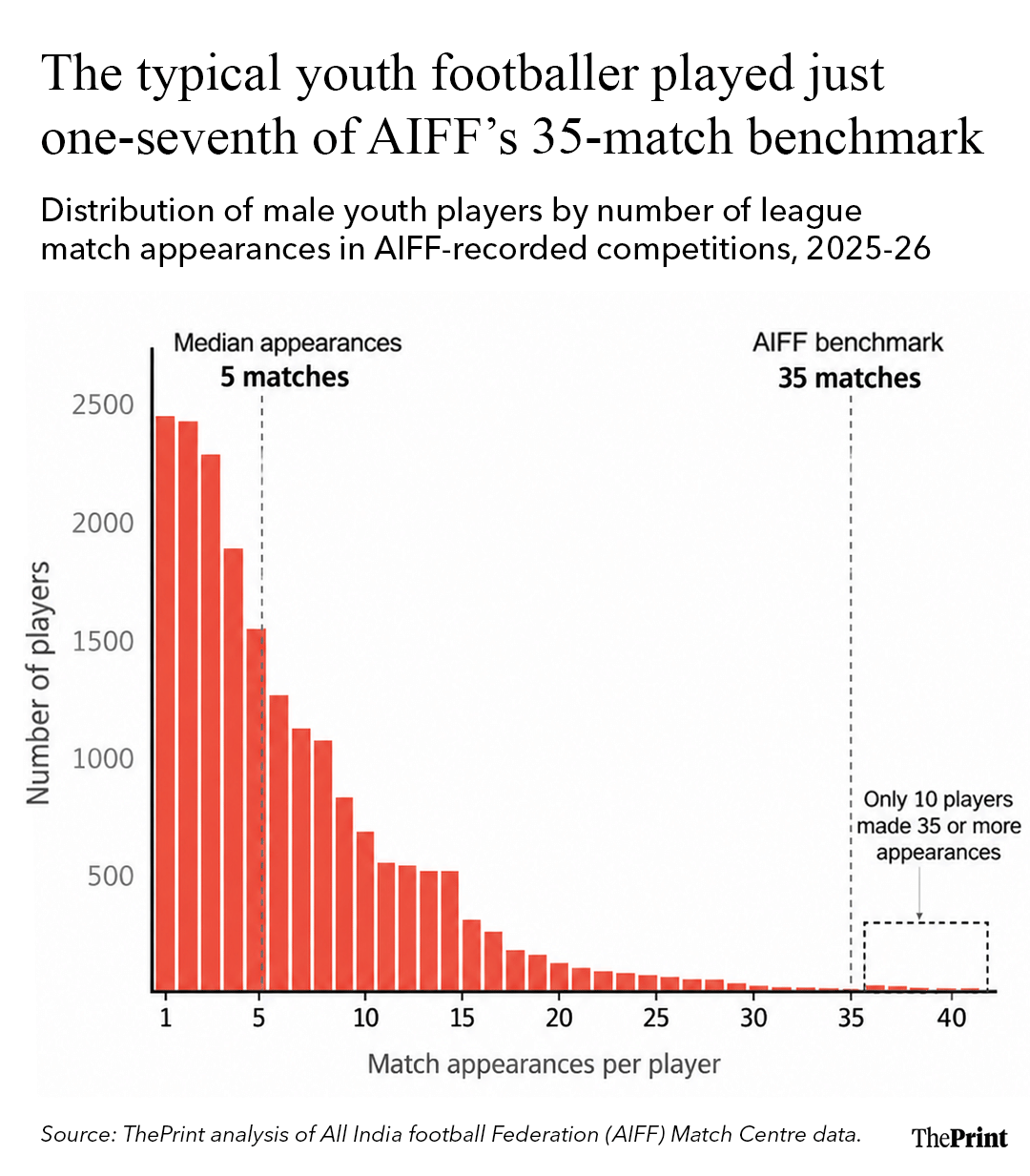
An analysis by ThePrint of 4,936 youth league matches conducted during the 2025–26 season found that just 10 of the 19,718 players analysed—or 0.05 percent—met this benchmark. The typical player appeared in just five matches, one-seventh of the target.
The analysis covered age-restricted and youth-development competitions, excluding senior and open-age events. Since AIFF’s 35-match target applies to league-format competitions, it included matches between clubs and academies in which team standings were primarily determined by results across multiple fixtures. Competitions involving state-representative teams, primarily knockout tournaments, and standalone cups or championships were excluded.
Most players made 10 or fewer appearances
ThePrint analysed fixture and player data from 51 youth league competitions recorded in AIFF’s publicly available Match Centre to estimate the number of matches played by individual footballers.
The analysis covered competitions recorded between July 2025 and May 2026, in line with AIFF’s 2025–26 competition calendar, and included only matches listed in its system.
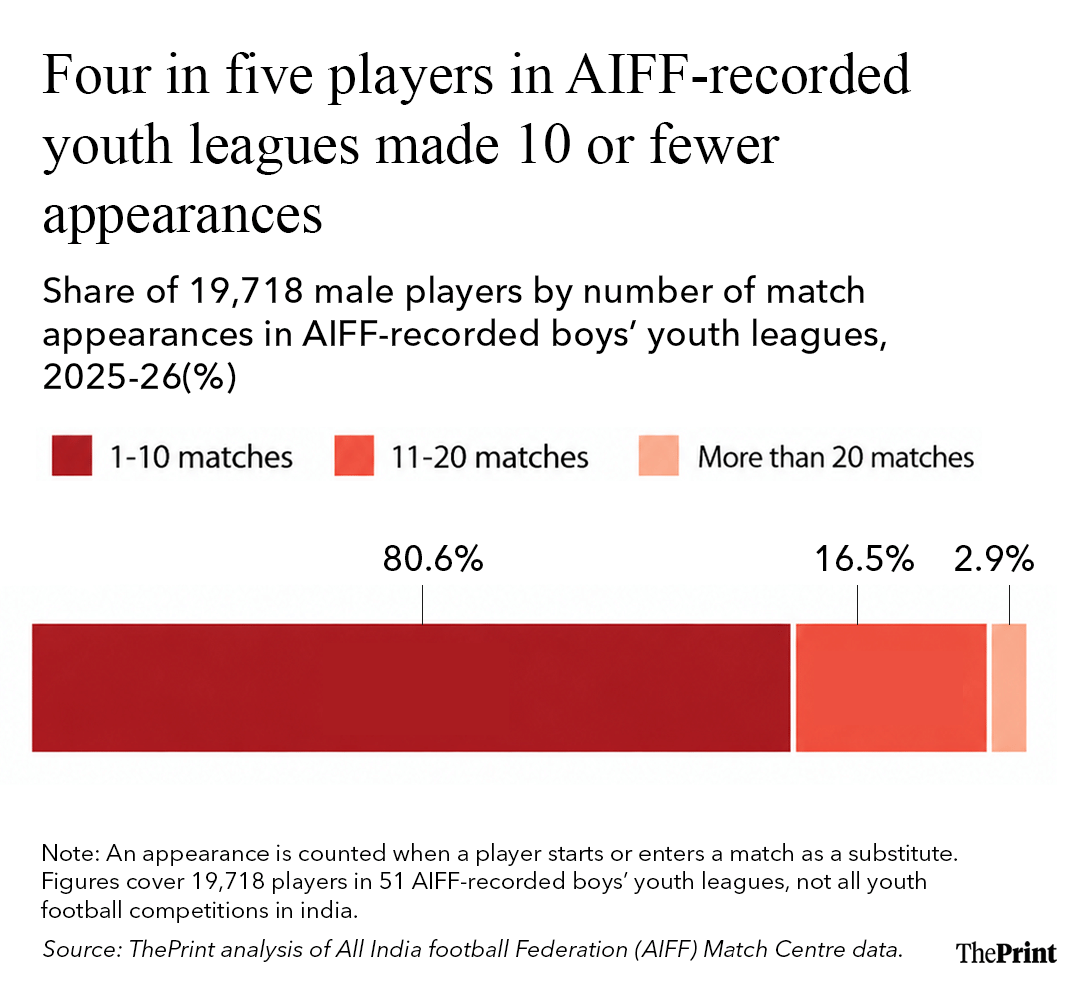
Of the players analysed, 80.6 percent, or 15,892, appeared in 10 or fewer matches during the season. Another 16.5 percent played between 11 and 20 matches, while fewer than 3 percent made more than 20 appearances. A match appearance was counted if a player started or came on as a substitute.
A senior AIFF official, who did not wish to be named, acknowledged that individual players remained far from the required number of matches. However, the official cautioned that AIFF’s Match Centre did not capture all competitions.
“Players at India’s leading academies and high performing states, particularly those reaching the final stages of national youth leagues, could accumulate 30–40 matches across state, national and private competitions,” the official said. Players in states with shorter leagues and fewer private tournaments had fewer opportunities.
“This was about building a habit within the ecosystem. The next cycle is about expanding the duration, level and frequency of matches,” the official added.
Private tournaments contribute to players’ overall match exposure, but are not included in the league-match targets outlined in Vision 2047.
Former India captain Baichung Bhutia told ThePrint that private organisers were helping fill gaps left by state associations, particularly in larger cities. However, organising such competitions remains difficult in smaller states such as Sikkim, Nagaland and Manipur. “Tournaments are a very important part of a young footballer’s growth,” he said.
ThePrint sought comprehensive youth competition and match data from AIFF to assess the coverage of its Match Centre, but had not received it by the time of publication.
95% of low-appearance players competed in just one league
The data also revealed a clear difference in the number of competitions players participated in. Among the 566 players who made more than 20 appearances, 97 percent competed in at least two competitions, while 75 percent played across multiple levels—national, state or district.
By contrast, 95 percent of players with 10 or fewer appearances participated in just one competition.
The pattern was also evident among the 10 players who met AIFF’s 35-match benchmark—nine competed in both national and state leagues.
Eight of these players were associated with Goa-based clubs, including SESA Football Academy, Dempo Sports Club and FC Goa. The other two represented Bengaluru FC and Mother’s Pride Football Academy in Himachal Pradesh.
Pradhyum Reddy, CEO of Dempo SC and a coach with more than two decades of experience, attributed the greater match exposure of some Goa-based players partly to the financial backing available to certain clubs. He said the high cost of travelling across India for multiple competitions could restrict opportunities for clubs without the support of professional teams.
Speaking to ThePrint, Reddy also pointed to Goa’s relatively better access to football grounds as an advantage. “It shouldn’t be the case that teams who have more money get to play more,” he said, calling for more regional and hyperlocal competitions to make regular participation affordable.
Youth leagues concentrated in a few states
Youth league football in India is organised at three levels—national, state and district. National leagues bring together clubs and academies from across the country, while state and district competitions involve teams competing within their respective geographical areas.
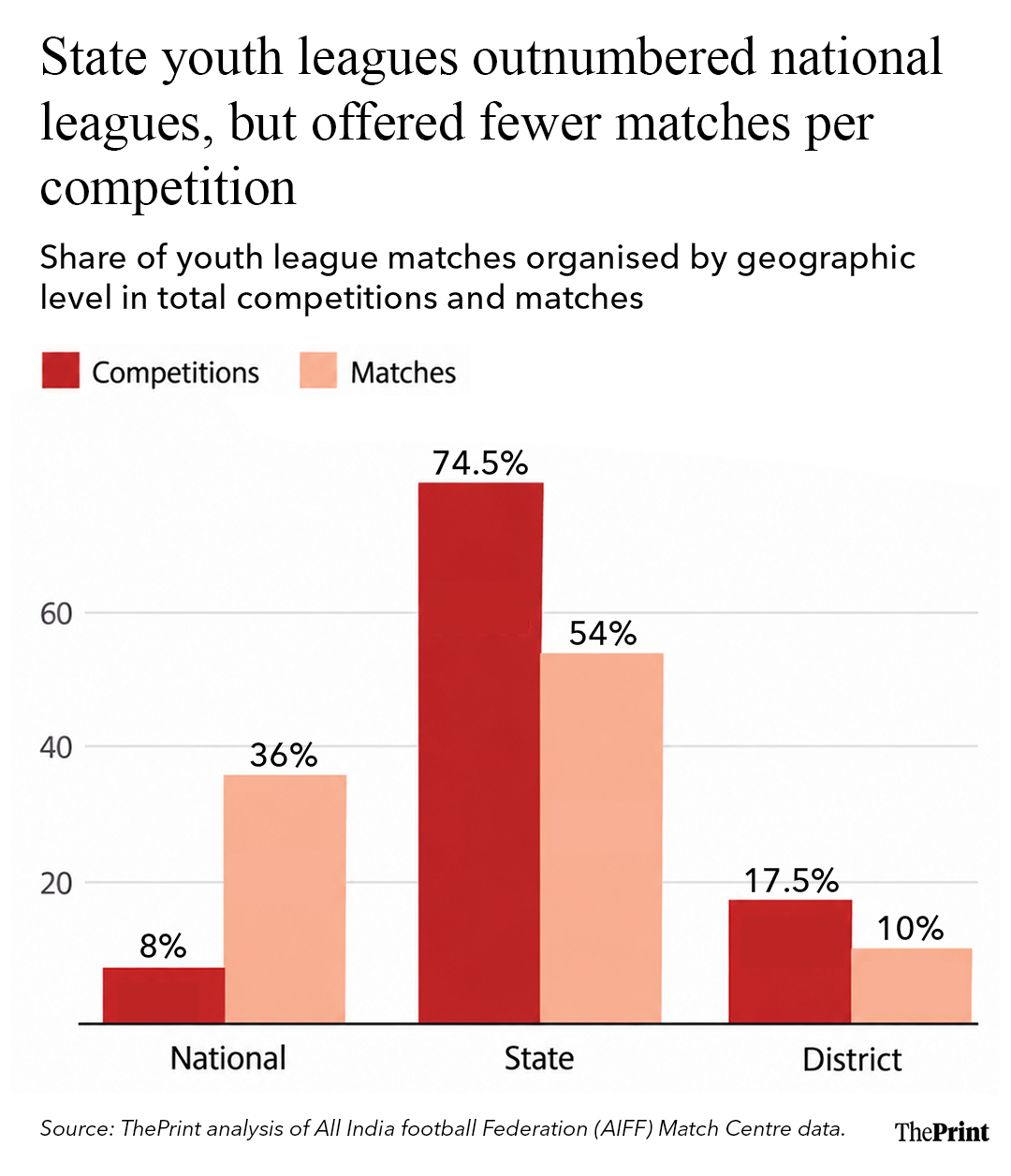
Of the 51 boys’ youth club leagues analysed, four were national, 38 state-level and nine district-level competitions.
The four national competitions—the AIFF Sub-Junior, Junior and Elite Leagues, and the Reliance Foundation Development League—accounted for 36 percent of all recorded matches despite making up just 8 percent of the competitions identified.
State leagues, meanwhile, accounted for nearly three-quarters of the competitions but only 54 percent of matches, indicating fewer fixtures per competition on average.
Their distribution across the country was also uneven. Just six states—Goa, Karnataka, Maharashtra, Gujarat, West Bengal and Kerala—accounted for 66 percent of the state leagues identified. The remaining 13 leagues were spread across eight other states and union territories.
Even the presence of state-level competitions, however, does not guarantee equitable opportunities across a state.
Ranjit Bajaj, founder of Minerva Academy, a premier football institution in Punjab, told ThePrint that state youth leagues were often concentrated in major cities, potentially limiting opportunities for players elsewhere. Access to competitive football, he said, depended not just on a player’s ability but also on where they lived and the resources available to them.
The concentration was even more pronounced at the district level. The analysis identified only nine district youth leagues, all in Maharashtra and Delhi. Maharashtra accounted for seven, while Delhi had two.
Ishfaq Ahmed, head coach of Real Kashmir FC and a former India midfielder, echoed Reddy’s call for more local competitions. Speaking to ThePrint, he argued that leagues should be organised in every district or cluster so that travel distances and financial constraints did not prevent young players from participating.
The senior AIFF official quoted earlier also pointed to the challenge of balancing accessibility with competitive quality. Local leagues reduce travel costs but may not provide sufficiently strong competition for better players, the official said. Zonal and national leagues, meanwhile, involve greater travel and logistical expenses.
The official advocated longer zonal leagues with regular home-and-away fixtures, followed by centralised final rounds. This, the official argued, would allow players to compete consistently throughout the year without placing an excessive financial burden on academies.
Bhutia, however, said expanding local participation should take precedence over concerns about the quality of competition.
“It’s not a matter of good or bad players. Just organise it, get the teams there,” he said, adding that wider participation would eventually help identify and nurture talent.
More matches do not always mean more opportunities
The number of matches organised in a state did not necessarily translate into more playing opportunities for the average player.
Goa, which had the highest number of competitions, recorded 613 matches across its youth leagues. Maharashtra followed with 599 and Karnataka with 488—considerably more than Himachal Pradesh’s 168 and Madhya Pradesh’s 59.
Yet, the median number of appearances per player in the first three states was lower than in the latter two.
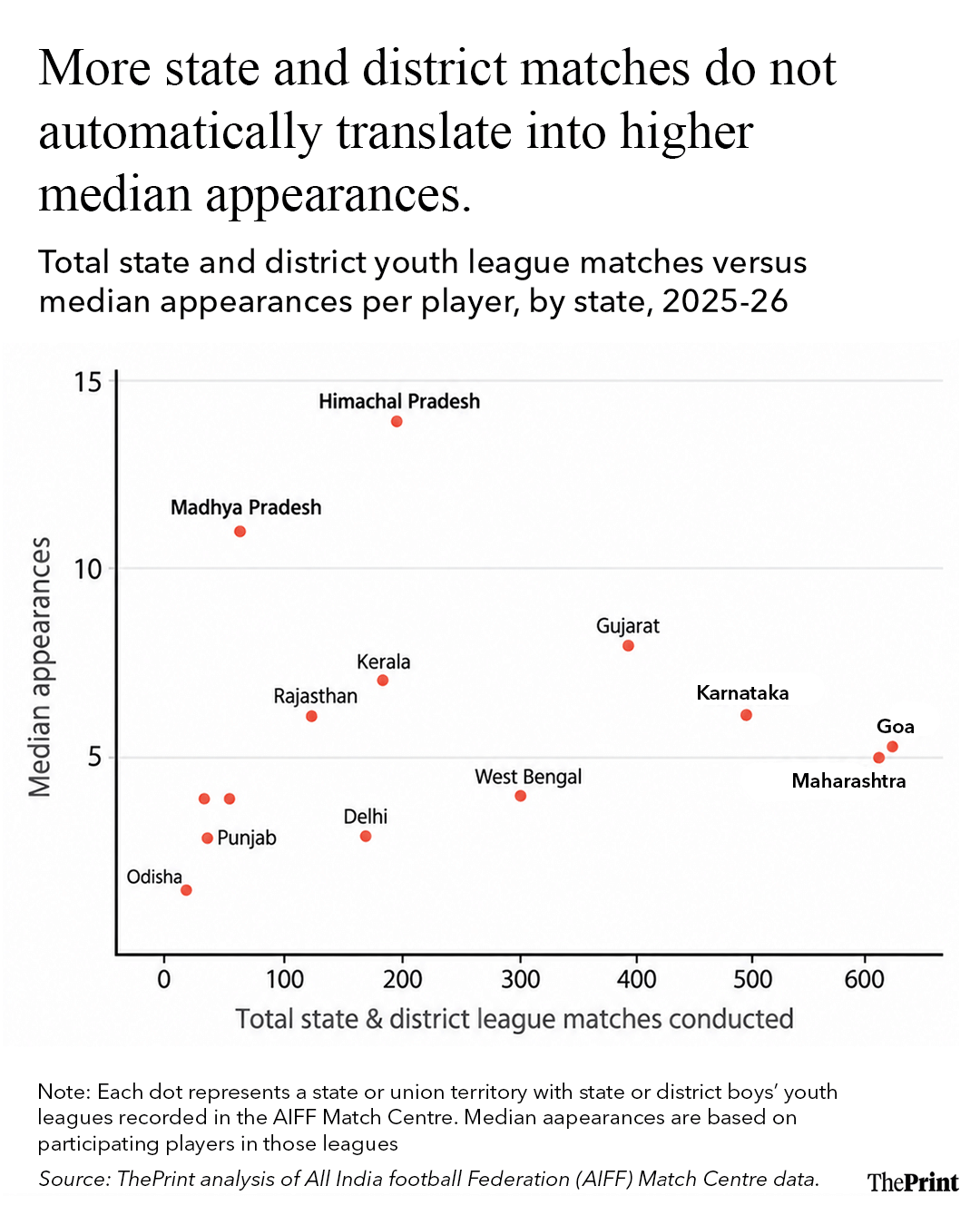
One important difference was the size of the participating player pool. Goa’s 613 matches involved 2,377 players, compared with 302 players across Himachal Pradesh’s 168 matches. Similarly, Maharashtra’s 599 matches involved 2,551 players, while Madhya Pradesh’s 59 matches involved just 153.
The total number of matches organised, therefore, offered only a partial picture of the competitive exposure available to individual players.
Asked why a high number of matches in a state might not translate into more appearances for the typical player, Reddy said the existing youth league structure often favoured stronger teams.
He attributed this partly to the absence of tiered leagues, in which teams of similar abilities compete against one another. In competitions dominated by stronger teams, their players could accumulate more appearances by progressing further, while players from weaker teams had fewer opportunities.
“Your level of where you are should not determine how much football you get to play,” Reddy said, adding that the current system was “geared towards the top teams getting more football”.
Stakeholders interviewed by ThePrint also called for competitions across more age groups, better-paced calendars spread throughout the year, improved infrastructure, including suitable football grounds, and better coaching to support young players’ development.
Recalling his early footballing days, Ahmed told ThePrint that local mohalla tournaments and district leagues had provided much of his match exposure while growing up in Kashmir in the early 2000s.
A school football club supported by the YMCA covered his tournament expenses, while a trip to Bengaluru with the Jammu and Kashmir state team, funded by the state football association, gave him the opportunity to compete beyond Kashmir.
Ahmed said young footballers today had access to better coaching and facilities than players of his generation, but opportunities to compete regularly remained uneven. Reflecting on his own journey, he emphasised the importance of giving young players a platform to demonstrate their abilities.
“When you’re young, you need a platform to express your skills, to feel important and valued, and league football was perfect for that,” he said.
Vision 2047 identifies greater competitive exposure as central to player development and India’s ambition to become one of Asia’s leading football nations. But with just one season remaining before AIFF’s January 2027 benchmark, the data shows that the vast majority of young players remain far from the target.
(Edited by Chingkheinganbi Mayengbam)
Also Read: Manchester United’s revolving door of managers is no way to build a winning team