



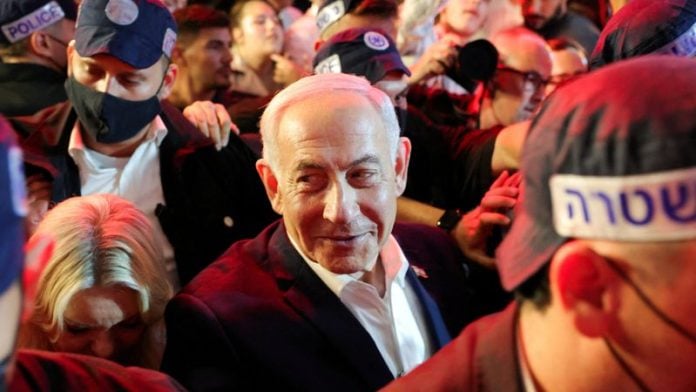
New Delhi: Israel’s Benjamin Netanyahu has built a political career on surviving moments when his opponents believed his time was up. But the election taking place on 27 October 2026 presents a different test: the man who made national security the centrepiece of his political brand is asking voters to return him to power after the Hamas-led 7 October 2023 attack exposed one of Israel’s gravest security failures.
The central question is not simply whether Netanyahu’s Likud party can win the most seats. It is whether he can assemble a parliamentary majority, even if his opponents collectively win more seats. Israel’s proportional electoral system makes coalition arithmetic, smaller parties and the ability to block a rival government as important as the result for any single party.
Netanyahu won in 2022 despite a divided electorate. How he could hold on to power again
Benjamin Netanyahu has made a career out of political comebacks. In November 2022, after five elections in less than four years, Israel’s longest-serving prime minister returned to office with a 64-seat parliamentary majority. Now, after the October 7 attack and the subsequent wars, he is fighting to retain power in another election that could reshape Israeli politics.
The paradox is that Netanyahu’s opponents have substantial reasons to believe voters should remove him, yet they still face the harder task of turning opposition to him into a functioning government.
The key to understanding his chances lies in a lesson from 2022: in Israel, winning an election is not just about how many people vote for you. It is about how efficiently those votes translate into seats, and whether your allies can assemble a majority.
How Netanyahu won the last election
The November 2022 election was Israel’s fifth in less than four years. The country had been trapped in political deadlock, with rival blocs repeatedly failing to secure a durable majority. Netanyahu, who had served as prime minister for much of the period since 2009, was seeking a return after losing office in 2021.
His comeback depended on three factors.
First, he built a more disciplined political bloc. Netanyahu’s Likud joined forces with far-right and ultra-Orthodox parties, including the Religious Zionism alliance associated with Itamar Ben-Gvir and Bezalel Smotrich. These partners brought voters who wanted a harder line on Palestinian issues, stronger nationalist policies and protection for religious interests. Their combined strength gave Netanyahu a route to power that Likud alone could not have provided. Reuters reported that the alliance secured 64 of the Knesset’s 120 seats.
Second, his opponents failed to coordinate effectively. The anti-Netanyahu camp contained parties with different ideological priorities, from centrists to the left and Arab political parties. They struggled to coordinate electoral lists and surplus-vote agreements, which can help allied parties convert votes into additional seats.
The consequences were striking. According to the Israel Democracy Institute’s analysis of the 2022 results, the two broad blocs were separated by only about 30,000 votes. Yet Netanyahu’s camp secured 64 seats. Meretz and the Arab party Balad both failed to cross the electoral threshold, leaving roughly 300,000 votes without representation in the Knesset.
Third, his supporters turned out. The same analysis found increased participation in right-wing and ultra-Orthodox strongholds, while the centre-left failed to mobilise at a comparable rate. Netanyahu did not need to persuade a dramatically larger share of the electorate to support him. His bloc needed to be better organised and waste fewer votes.
Why this election is harder for him
The biggest obstacle is October 7. Hamas’s attack happened while Netanyahu was prime minister, exposing a catastrophic failure of Israel’s security apparatus. His critics argue that a leader who built his reputation on protecting Israel must answer for the failure to prevent it.
The subsequent wars have given him a counterargument. Netanyahu presents Israel’s military campaigns against Hamas, Hezbollah and Iran as evidence that his government has restored deterrence and reshaped the region. His campaign has continued to portray him as the leader best equipped to defend Israel in a hostile neighbourhood.
But this is a difficult argument to sustain when voters are also asking who was responsible for the original failure, whether the wars achieved their objectives and why a formal investigation into October 7 has not resolved questions of accountability. Reuters’ analysis of his campaign describes a familiar strategy under unprecedented pressure.
His rivals have also changed. Former military chief Gadi Eisenkot leads the Yashar party and has sought to present himself as a credible security-minded alternative. Other challengers, including Naftali Bennett, are competing for voters who may be right-wing but are dissatisfied with Netanyahu’s leadership.
How could Netanyahu still win?
The first route is to turn the election into a choice about security rather than accountability. Netanyahu’s campaign stresses military achievements and warns that rivals would be weaker in confronting Israel’s enemies. If enough voters prioritise those achievements over October 7, he could limit his losses.
The second is coalition arithmetic. Israel’s 120-seat Knesset requires 61 seats for a governing majority. Polling ahead of the vote suggests neither the Netanyahu bloc nor the opposition has a clear path to that number. Reuters’ polling analysis, using estimates through October 20, suggested anti-Netanyahu parties could collectively reach 62 seats, but that does not automatically mean they can form a government. Smaller parties, electoral thresholds and disagreements over partners could change the outcome. Reuters polling tracker
The third is to prevent his opponents from uniting. Netanyahu’s camp has warned that a government led by his rivals could depend on Arab parties, framing that prospect as a security risk. Such messaging could reinforce divisions among opposition parties whose leaders disagree on policy and on which partners they are willing to accept.
There is also the possibility of a unity government. The Washington Post reported on October 26 that Netanyahu’s camp had promoted the idea of a partnership with Eisenkot, potentially allowing Netanyahu to remain prime minister even if his bloc does not win the most seats. Eisenkot has repeatedly rejected serving under Netanyahu, making such an arrangement far from certain.
If no bloc can form a government, Netanyahu could also remain caretaker prime minister while coalition negotiations continue, potentially setting the stage for another election.
The real test is what happens after the vote
Netanyahu’s 2022 victory was a lesson in political organisation: a relatively small advantage in votes became a decisive parliamentary majority because his allies coordinated better than their opponents.
This time, his security credentials have been badly damaged, and polls suggest his coalition could lose seats. Yet his opponents must still agree on a government, its policies and the parties it can include.
That is Netanyahu’s possible opening. He does not necessarily need to win a sweeping personal mandate. He needs a route to 61 seats, or a political deadlock that leaves him with another chance to negotiate.
His political survival has often depended on the gap between voters wanting him gone and his opponents being able to replace him. The October 27 election will test whether that gap is still wide enough.