



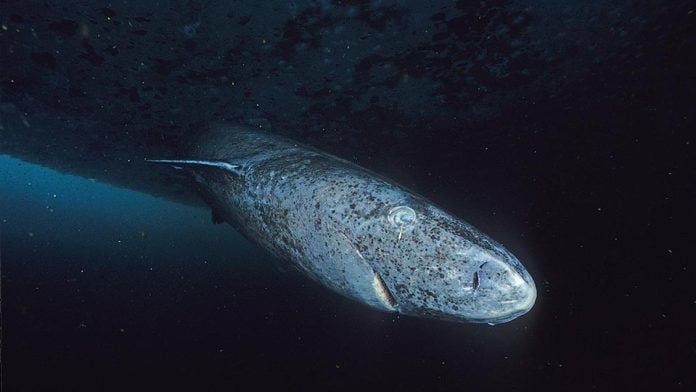
New Delhi: A shark that can live for centuries is at the centre of an unusual dispute in Greenland, where some fishermen want its numbers reduced because the animals are damaging fishing gear and taking fish from their lines.
Earlier this year, the municipal council in Avannaata, which includes the major fishing town of Ilulissat, approved a plan to cull 1,000 Greenland sharks. The proposal offered fishermen 300 Danish kroner for every shark heart brought in. The plan was later dropped after Greenland’s fisheries ministry questioned its legal basis, but the argument over what to do with the sharks has not gone away.
So why are fishermen asking for a cull, and why are scientists so alarmed by the idea?
Why do Greenland’s fishermen want the sharks gone?
Greenland sharks are regularly caught as bycatch in fisheries targeting Greenland halibut and Atlantic cod. They can become tangled in longlines and other fishing gear, while also eating fish caught on hooks.
For small-scale fishermen operating in remote Arctic waters, losing equipment is expensive and can mean losing valuable fishing time. One fisherman in the Ilulissat area told the Guardian that he had lost around 6,000 hooks this year and sometimes suffered losses of about 30,000 Danish kroner a day.
The frustration is not new. Greenland sharks were historically hunted for their enormous livers, which were used to produce oil. Targeted fishing declined sharply after the mid-20th century, but the animals have continued to be regarded by some fishermen as a nuisance because of their interactions with fishing gear.
What makes the Greenland shark so unusual?
The Greenland shark, or Somniosus microcephalus, is one of the strangest large predators in the ocean.
It is the slowest known shark, cruising at roughly 0.34 metres per second. Yet it can grow to more than six metres and is a major Arctic predator and scavenger.
Its most remarkable characteristic, however, is its age.
Scientists have estimated that Greenland sharks can live for at least 250 years, with some estimates putting the lifespan of the largest individuals at more than 400 years. The species grows extremely slowly and is not thought to reach sexual maturity until it is more than a century old.
That creates a problem for any attempt to reduce its population. A species that takes roughly 150 years to reach maturity cannot replace lost adults quickly.
The shark is already classified as Vulnerable globally by the IUCN.
Would culling actually solve Greenland’s problem?
Conservation groups argue that it would not.
Oceans North Kalaallit Nunaat says Greenland sharks are highly mobile and can travel long distances. Removing sharks from one fishing area, therefore, would not necessarily keep other sharks from moving in.
There is another complication: sharks might not even be the main reason fishermen are losing gear.
Lost or abandoned fishing equipment, known as ghost gear, can become tangled with new lines and cause further damage. Conservationists have also pointed to changing fish stocks, fishing pressure and the cost of equipment as wider problems facing Greenland’s fishing industry.
Instead of paying fishermen to kill sharks, conservation groups have proposed removing ghost gear, improving fishing equipment, changing the design of lines and testing acoustic devices that could deter sharks from fishing areas.
Why is this debate bigger than one shark?
The Greenland shark has become the visible face of a much larger problem: how to balance an Arctic fishing economy with the protection of a poorly understood species.
At least 3,500 Greenland sharks are estimated to be caught as bycatch globally each year, although scientists warn that the real number could be higher because monitoring is incomplete. The species is also still recovering from decades of targeted fishing.
There is also an irony to the dispute. Scientists know remarkably little about an animal that could have been swimming in Arctic waters before many of the countries now debating its fate even existed in their modern form.
Researchers are still trying to understand where Greenland sharks reproduce, how many young they produce and how widely individual sharks travel. Recent research has even challenged the long-held idea that the animals are effectively blind.
That uncertainty makes a large-scale cull particularly difficult to justify scientifically.
For Greenland’s fishermen, the sharks are a costly nuisance. For conservationists, they are one of the ocean’s most extraordinary and vulnerable predators. The unresolved question is whether Greenland can protect both the fishery and a shark that might outlive several generations of the people now deciding its fate.