





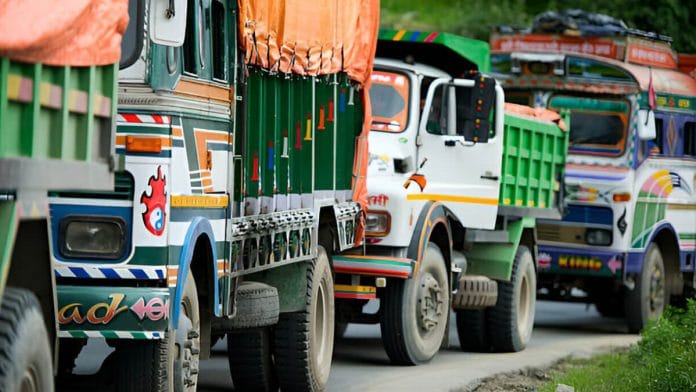


New Delhi: Prime Minister Narendra Modi announced Wednesday evening that the Union Cabinet has approved a Rs 9,585 crore scheme for Bharat Stage-VI or BS-VI vehicles to “reduce air pollution in Delhi”. The scheme will incentivise over 2 lakh truck and bus owners in Delhi to switch from lower-emission BS-IV vehicles to cleaner BS-VI vehicles or electric ones.
The scheme will support vehicle owners in scrapping older BS-III and BS-IV vehicles through measures such as fuel vouchers, loan subvention, and tax concessions. The scheme also says that certain auto manufacturers will offer an 8 per cent discount on ex-showroom prices on new electric and BS-VI vehicles. The scheme will offer a 5 per cent interest subvention on loans for five years after vehicle registration, said the press release.
“The scheme will improve air quality, support sustainable transport and benefit vehicle owners,” said PM Modi in a post on X.
Bharat Stage Emission Standards (BSES) are norms for manufacturers in designing vehicles to control the emission of polluting substances, including PM2.5, sulphur dioxide, and nitrogen oxides. India’s BS standards loosely follow the European Union guidelines, and have introduced new stages progressively to move toward more advanced vehicle designs that emit even fewer toxic pollutants.
BS-VI standards were first announced in 2016, and in 2020, it was mandated that all vehicles sold in India should comply with them. Ten years later, the Union Government is taking steps toward enforcing the norms for buses and trucks.
“The transport sector contributes 14% of PM 2.5, 40% of Carbon Monoxide (CO), and 63% of Nitrogen Oxide (NOx) emissions in the Delhi-NCR,” said the press release. “Within the transport sector, trucks and buses account for 36% of PM 2.5 emissions with only 3% of the total fleet.”
According to a policy brief by the International Council on Clean Transportation (ICCT), the emission norms under BS-VI for trucks and buses would lead to more than 50 per cent cuts in particulate matter emissions as compared to BS-IV. The standards also enforce including diesel particulate filters (DPFs) in all trucks and buses to trap particulate matter.
How will the scheme work?
Currently, the Delhi government enforces BS standards as part of air pollution action under the Graded Response Action Plan—during heavy pollution days, only BS-VI or EVs are allowed to ply on Delhi’s roads. However, there has been no concrete scheme to incentivise the purchase of BS-VI vehicles in the Delhi-NCR region—until now.
“It is estimated that a single Pre-BS heavy-duty vehicle emits as much as 14 BS-VI compliant vehicles,” said the press release shared by the government. “Hence, the newer fleet is expected to reduce the vehicular pollution substantially.”
The new scheme gets Rs 5,041 crore outlay from the Central Government and Rs 1,601 crore from NCR state governments—Delhi, Haryana, Rajasthan, and Uttar Pradesh—in tax concessions.
While the policy is aimed at truck and bus owners to buy BS-VI or EVs, it also has a section outlining how to dispose of older vehicles. For any bus or truck that is BS-III or less compliant, the only route is to scrap it. BS-III norms were introduced in 2005 and are no longer considered efficient for pollution reduction.
However, for BS-IV vehicles, owners can choose to either scrap or sell them, but they can only sell outside Delhi-NCR, in a town that is not mandated by the National Clean Air Programme (NCAP).
(Edited by Prasanna Bachchhav)