



New Delhi: For passengers, a sudden aircraft descent is not experienced as a number on a flight tracker. It can feel like the floor has disappeared beneath you.
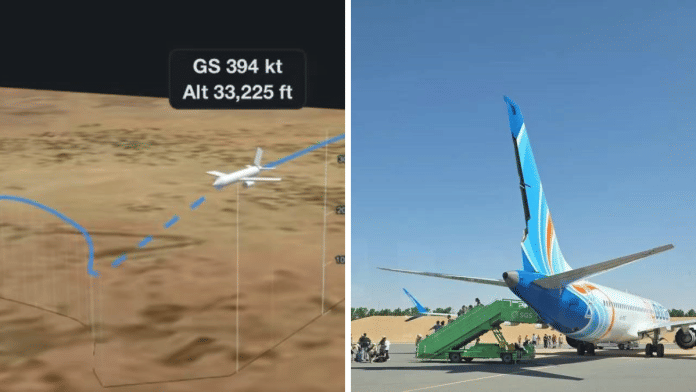
Passengers aboard flydubai flight FZ1073, which plunged more than 14,000 feet in about 30 seconds on 30 September, described a terrifying sensation of dropping, spinning and not knowing what was happening. One passenger told CBS News the movement felt “much worse than a free-fall”, with the aircraft turning sideways and moving up and down for what seemed like an eternity.
Another passenger, Almog Italie, said it initially felt like “massive turbulence”. He described the aircraft dropping for 20 or 30 seconds, levelling out and then dropping again.
So what actually happens to the human body when a passenger jet suddenly loses thousands of feet?
Why your stomach seems to drop
The first sensation is familiar to anyone who has been on a roller coaster: your body suddenly feels lighter.
That happens when the aircraft accelerates downward. The seats, floor and your body are no longer being pushed against each other with the same force as during normal level flight.
In a sufficiently abrupt manoeuvre, passengers can briefly experience reduced effective weight, sometimes described as a feeling of floating. If the aircraft’s vertical acceleration becomes negative enough, unsecured objects and people can actually move upwards relative to the cabin.
That does not mean the aircraft is falling like a stone.
A passenger jet can descend extremely rapidly while still moving forward at hundreds of kilometres per hour. Its wings continue generating lift, while the aircraft trades altitude for speed and changes its flight path.
The distinction matters because a sudden loss of altitude and a stall are not the same thing.
What passengers actually feel
The body does not experience “14,000 feet”. It experiences acceleration, changes in direction and forces acting on it.
That is why the movement can feel much more violent than the altitude figure suggests.
The Federal Aviation Administration (FAA) classifies severe turbulence as involving large, abrupt changes in altitude or attitude, with occupants potentially being forced violently against their seat belts. Its guidance notes that unsecured objects can be tossed around and that walking can become impossible.
In the flydubai case, passengers described both a vertical drop and a spinning sensation.
Daniel, another passenger, told Israel’s Channel 12 that the aircraft suddenly went sharply nose-down and began spinning. He said the sensation lasted what felt like two or three minutes, even though the actual period of the most dramatic descent was much shorter. His description was stark: “That’s it, it’s over. September 11 is happening again.”
The difference between the clock and the passenger’s perception is important. Fear and sudden acceleration can make a short event feel considerably longer.
‘We need help’: What passengers saw inside the cabin
The physical sensation of the descent was only part of what made the flydubai incident terrifying for those on board.
The Guardian reported that a video recorded during the flight showed a passenger with blood running from an open wound on his head pleading for help. The man said in Hebrew that the aircraft was in the Tabuk area of Saudi Arabia and that the passengers were safe except for one of the pilots.
“Whoever is hearing me, we need help,” he said.
Haaretz, citing another passenger, reported that the aircraft appeared to lose control and begin diving. Passenger Dalia Shpigel said there were suddenly “terrible screams throughout the plane” before three to five men rushed into the cockpit, subdued the alleged attacker and began treating an injured pilot.
Shpigel told Haaretz that passengers then realised the situation was stabilising. Information about what had happened in the cockpit emerged gradually as the flight continued.
The accounts offer a glimpse of what a rapid descent feels like from inside the cabin: passengers have little way of knowing whether the aircraft is in a controlled manoeuvre or something much more serious is happening.
Why seat belts matter so much
The biggest immediate danger during a sudden manoeuvre is not necessarily the aircraft breaking apart. It can be the passenger becoming a projectile inside the cabin.
If the aircraft suddenly accelerates downward, an unrestrained passenger’s body continues moving according to its previous motion until another force acts on it. That can send someone into the ceiling, a seat, another passenger or the cabin structure.
The FAA therefore recommends keeping seat belts fastened whenever seated, even when the sign is off. The belt is designed to restrain the passenger and limit forward movement during unexpected aircraft movement.
That is also why flight attendants routinely ask passengers to keep their seat belts fastened while seated. Unexpected turbulence or manoeuvres can happen with little warning.
Why passengers don’t necessarily black out
A rapid descent is not automatically the same as a loss of cabin pressure.
If the aircraft remains pressurised, passengers do not suddenly run out of oxygen simply because the aircraft has lost altitude.
Hypoxia becomes a concern if cabin pressure is lost or oxygen is otherwise unavailable at high altitude. The FAA notes that rapid decompression at or above 30,000 feet can sharply reduce the amount of time a person can remain effective without supplemental oxygen.
That distinction is important in the flydubai incident. There is no indication from the passenger accounts that the dramatic descent itself represented a cabin decompression.
Why the body can feel worse than the aircraft
Aircraft are designed to withstand forces and manoeuvres that can be extremely uncomfortable for people inside them.
The human body is comparatively fragile when it is not restrained.
During a sudden change in direction, the aircraft changes its motion as a whole. A passenger’s body has inertia, meaning it tends to continue along its previous path. The seat belt, seat and cabin then provide the forces needed to bring the body along with the aircraft.
This is why the same manoeuvre that an aircraft can survive can leave passengers terrified, bruised or injured.
In the flydubai incident, passenger accounts show how quickly the psychological effect followed the physical movement. Italie said the aircraft initially felt as if it had encountered massive turbulence. Then passengers saw people moving around the cockpit and realised something more serious was happening.
Why it felt like the plane was falling
There is another reason a sudden descent can be so frightening: passengers cannot see the aircraft’s attitude.
A pilot looking at instruments can know whether the aircraft is descending at a controlled speed, what its pitch is and whether it remains within its operating limits.
A passenger sees none of that.
Instead, the sensation might be a sudden lightness, a powerful downward movement, noise from the engines changing, objects moving and people shouting around the cabin.
One flydubai passenger told CBS that the aircraft seemed to be moving “up and down in all different kinds of directions” and that it was difficult even to estimate how long the episode lasted.
Another passenger, Chaim Nazarovitz, said he briefly felt he was “not among the living”. Passenger Naama Bershadski recalled thinking, “We’re going to die,” as she closed her eyes and prayed.
The strange part: the plane can still be flying normally
This is perhaps the most counterintuitive part.
A dramatic descent on a flight-tracking map does not by itself tell us that an aircraft was in a stall, free-fall or structural failure.
An aircraft can point its nose down and descend rapidly while its wings continue producing lift and the aircraft remains aerodynamically controllable.
In flydubai’s case, the aircraft was eventually stabilised and landed safely at Tabuk in Saudi Arabia after reserve flydubai pilots aboard the flight took control.
For the passengers, however, there was no way to know that while it was happening.
They felt the aircraft drop. They saw the cabin erupt in panic. And they had no view of the instruments that could tell the pilots whether the aircraft was still within a recoverable flight condition.
That gap between what the aircraft is doing and what the human body feels is why a rapid descent can be terrifying even when the aircraft itself remains capable of flying.