



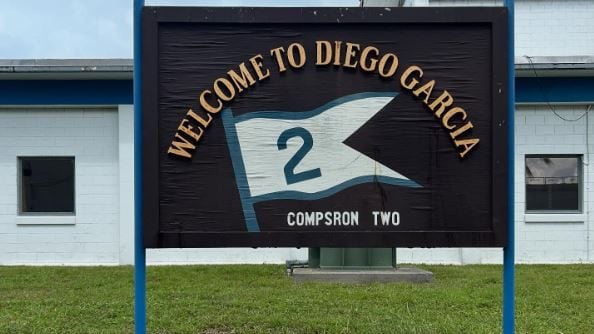
New Delhi: As Britain seeks to transfer sovereignty over the Chagos Islands to Mauritius, the future of the joint US-UK Base on Diego Garcia has come into question, with British Prime Minister Andy Burnham saying on Monday he was determined to resolve a dispute over the future of the US-British military base on Diego Garcia.
The comments came after Burnham spoke to his Mauritian counterpart Navin Ramgoolam and ahead of meetings at the United Nations General Assembly in New York. Britain, Mauritius and the US have yet to reach an agreement on how to move forward with the deal.
The dispute has gained added significance because Diego Garcia has also featured in the US-Iran war. In March, Iran unsuccessfully targeted the base with ballistic missiles, according to US and British officials cited by international media.
Why does Diego Garcia matter?
Diego Garcia is the largest island in the Chagos Archipelago, a group of about 60 islands in the Indian Ocean. It lies roughly halfway between East Africa and Indonesia.
There are no commercial flights to the island and access is tightly restricted. The US-British military facility has an airfield, deep-water port and communications and surveillance infrastructure, giving Washington and London a strategic base between the Middle East, Africa and Asia.
The base has supported US and British military operations across the region for decades. Its importance became particularly visible in March, when Iran attempted to strike it during the war. The missiles did not hit the base.
Read Here: Mystery lights over Tehran revive memories of Iran’s 1976 ‘UFO’ encounter
Why does Mauritius claim the islands?
The dispute dates back to British colonial rule.
In 1965, Britain separated the Chagos Archipelago from Mauritius and created the British Indian Ocean Territory. Mauritius became independent three years later under a decolonisation process that remained legally incomplete for decades due to the unlawful separation of the Chagos Archipelago.
Britain subsequently reached an agreement with the US to use Diego Garcia for defence purposes.
The Chagossian population was removed from the islands during the late 1960s and early 1970s to make way for the military facility. Many were taken to Mauritius and the Seychelles.
Chagossians have since campaigned for the right to return to their homeland.
In 2019, the International Court of Justice said Britain’s administration of the Chagos Islands should end and that the archipelago should be returned to Mauritius as part of completing the decolonisation process.
What is the UK-Mauritius deal?
Britain and Mauritius signed a treaty in May 2025 under which Mauritius would exercise sovereignty over the Chagos Archipelago, including Diego Garcia.
Britain would retain rights over the military base for 99 years, while the US and UK would continue operating and maintaining it.
The UK agreed to pay Mauritius £101 million annually, with the agreement’s total value estimated at £3.4 billion.
Why is the deal still unresolved?
The UK introduced legislation to implement the agreement, but its passage stalled amid US objections, with US President Donald Trump calling the deal a “big mistake”.
Trump’s concern is also tied to China’s growing strategic presence in the Indian Ocean, where Beijing has expanded its military and maritime footprint in recent years.
The British government said earlier that it must ensure Washington is content with the agreement before proceeding with ratification. It continues to engage with both the US and Mauritius.
The existing UK-US arrangements remain in force, with no change to the day-to-day operation of the military base.
Why does it matter now?
The dispute over Diego Garcia is no longer just a question of colonial history and sovereignty.
For Mauritius, it concerns control over the Chagos Archipelago and the rights of Chagossians who were removed from their homeland.
For Britain and the US, it concerns the future of a military facility that remains strategically important to operations across the Indian Ocean, Middle East and Asia.
And for the US-Iran conflict, the March missile attempt showed that the remote base can itself become part of the military geography of the war.
For now, the base continues to operate under existing arrangements. But Britain, Mauritius and the US are still trying to resolve who controls the territory around it, and under what terms.