



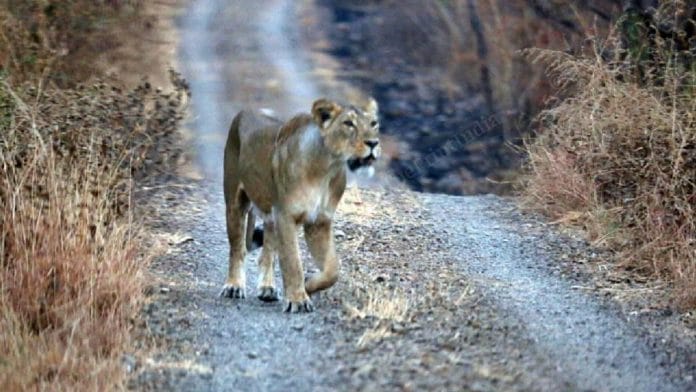
New Delhi: A lioness in Gujarat’s Amreli district attacked five people within about 12 hours before forest officials tranquilised it. The animal was taken to a care centre, where it developed convulsions and died less than a day later.
Forest officials suspect rabies, although laboratory tests are still awaited. Brain tissue samples have been sent for confirmation. The five people injured in the attacks have received anti-rabies treatment.
The incident has drawn attention to one of the most frightening consequences of rabies in wild animals: a disease that attacks the nervous system can also change how an animal behaves, potentially causing a normally wary animal to approach, bite or attack people.
So what happens to an animal when it contracts rabies, and why is the disease so dangerous?
What rabies does to an animal
Rabies is caused by a virus that attacks the central nervous system. It affects mammals, including wild animals, domestic animals and humans.
The virus usually enters the body through the saliva of an infected animal, most commonly through a bite. It then moves through peripheral nerves towards the brain and spinal cord. Once it reaches the central nervous system, it can cause severe inflammation and neurological dysfunction.
That neurological attack explains why rabies can produce such dramatic changes in behaviour.
An infected animal can become unusually aggressive, restless or disoriented. Other signs include difficulty swallowing, excessive salivation, weakness, seizures, paralysis and loss of coordination. Not every infected animal displays exactly the same symptoms, and some can become unusually quiet rather than aggressive.
In the Gujarat case, officials said the lioness displayed abnormal behaviour before developing convulsions and dying. But those signs alone cannot establish rabies. Laboratory testing is needed.
Why can rabies make wild animals attack?
The disease interferes with the brain and other parts of the nervous system that control movement and behaviour.
An animal that would normally avoid humans can therefore behave very differently when neurological disease takes hold.
Aggression is particularly dangerous because biting is also the most effective way for the virus to reach another host.
Rabies is therefore unusual in that some of the symptoms of the disease can help the virus spread. An infected animal becomes neurologically abnormal, may lose its normal fear response and can become more likely to bite. The virus is present in its saliva, allowing a bite to introduce the virus directly into another animal’s tissue.
This does not mean every unusually aggressive wild animal has rabies. Animals can attack because they are defending territory, protecting cubs, injured, cornered, sick for another reason or encountering people because their habitat overlaps with human settlements.
That distinction is particularly important in the Gujarat incident.
Why is a rabid wild animal especially dangerous?
A wild animal is difficult to assess from its appearance.
A lion, leopard, fox or other carnivore displaying abnormal behaviour may not immediately show an obvious wound or other sign explaining what is wrong. Unlike a domestic animal, it cannot be safely examined simply by approaching it.
And an animal infected with rabies can become dangerous before its condition is obvious.
The virus is also extremely difficult to treat once clinical disease begins. In both humans and animals, rabies is almost invariably fatal after symptoms appear.
There is, however, an important difference between exposure and developing rabies.
A person bitten by a potentially rabid animal can often be protected if treatment begins before symptoms appear. Post-exposure prophylaxis involves thorough wound washing, vaccination and, when indicated, rabies immunoglobulin or monoclonal antibodies.
That is why the five people attacked by the Gujarat lioness were given anti-rabies treatment.
What happens if a human gets rabies?
For humans, the disease can begin deceptively. After the virus enters the body, there can be an incubation period lasting weeks or months, although the timing varies depending on factors such as the location and severity of the exposure.
Early symptoms can resemble those of many other illnesses, including fever, weakness, headache and discomfort or unusual sensations around the wound. As the infection reaches the nervous system, neurological symptoms can develop.
These can include anxiety, agitation, confusion, hallucinations, difficulty swallowing, excessive salivation and an intense difficulty swallowing water, known as hydrophobia. Some patients develop paralysis instead of the classic form of furious rabies.
The critical point is that once clinical symptoms appear, rabies is almost invariably fatal. There is no reliably effective treatment that can reverse established clinical rabies.
But rabies is also unusual because death can often be prevented after a person has been exposed but before symptoms begin.
A person bitten or scratched by an animal suspected of having rabies should immediately wash the wound thoroughly with soap and running water and seek medical attention.
How does a lion get rabies?
Rabies is not limited to dogs.
The virus infects mammals, and wild animals can maintain what scientists call a sylvatic, or wildlife, cycle. Depending on the region, species such as bats, foxes, jackals and other carnivores can carry and transmit it.
In Gujarat, forest officials have suggested that the lioness could have acquired the infection through contact with an infected animal or potentially through exposure to infected material. They have also noted the presence of stray dogs and livestock around the area.
But these are possibilities, not a confirmed source of infection. There is currently no laboratory confirmation that the lioness had rabies.
Why the Gujarat case matters
The incident is striking because five people were attacked in a short period, followed by the animal’s rapid deterioration and death.
But it is also a reminder of how difficult rabies can be to detect and contain in wildlife.
The disease does not simply make an animal “angry”. It attacks the nervous system, potentially disrupting movement, swallowing, coordination and behaviour. In a large predator such as a lion, those neurological changes can create a particularly dangerous encounter with humans.
For now, the key question is whether laboratory testing confirms rabies in the Amreli lioness.
If it does, the five attacks would illustrate one of the disease’s most dangerous characteristics: a virus that reaches the brain can change the behaviour of an animal in ways that increase the chances of the virus reaching its next host.