





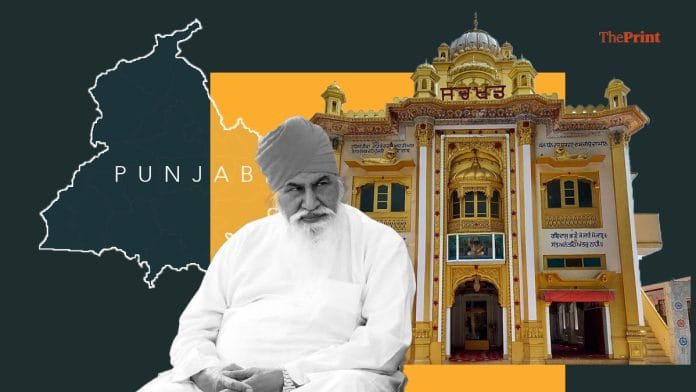



Chandigarh: Prime Minister Narendra Modi is scheduled to visit Dera Sachkhand Ballan near Jalandhar on 1 February on the occasion of Guru Ravidas Jayanti, a move seen as part of the Bharatiya Janata Party’s (BJP) political outreach in the state to woo Dalit voters ahead of next year’s Assembly polls.
The visit comes within days of the dera head, Niranjan Dass, being honoured with the Padma Shri. In December, the dera head, along with senior party leaders, met Modi and invited him for Gurpurab celebrations on 1 February.
The dera head also requested the prime minister to centrally organise countrywide celebrations to mark the 650th birth anniversary of Guru Ravidas next year.
With one year to go for the assembly polls in the state, experts see the prime minister’s visit as a more targeted strategy to reach out to specific caste communities that hold the key in closely contested electoral battles, particularly the Ravidasias and Ad-Dharmis, who constitute the largest subgroup among the Dalits in Punjab.
“Ravidasias and other Dalit voters do not vote en bloc for a single party; they often shift depending on local issues, candidates and coalitions. The overt reaching out to the Ravidasia dera is strategically significant for the BJP,” says Dr Kanwalpreet Kaur of the department of political science, DAV College, Sector 10, Chandigarh.
“The Ravidasias have been demanding recognition as an independent community, and the BJP intends to do just that—leverage identity recognition, aligning with the community’s demands for national visibility and respect for its spiritual leadership,” she added.
ThePrint explains the significance of the prime minister’s visit to the central institution of the Ravidassia sect in the state.
Also Read: BJP’s Ravidas Jayanti push to woo Dalits in poll-bound states — shobha yatras, sant sammelans
BJP’s bid for a slice of the pie
The BJP, once a junior partner of the Akali Dal, has been trying to build an independent electoral footprint in Punjab after the SAD-BJP alliance ended in 2020 over the contentious farm laws brought in by the BJP-led centre.
The BJP’s strategy in the state has been successful enough for it to improve its vote share from 6.60 percent in the 2022 Vidhan Sabha elections to 18.56 percent in the 2024 parliamentary elections, cutting into the vote share of the AAP and the Congress.
In the past year, the party has focused on increasing its foothold in rural areas dominated by Sikh peasantry.
Dalits constitute almost 32 percent of Punjab’s population, the highest in the country. However, the Dalits are divided among Sikhs, Hindus and Christians, many of whom also follow deras.
Deras, widespread on Punjab, are socio-religious centres of various sects and organisations. Unlike Sikh gurudwaras, where the Guru Granth Sahib is considered a living guru, derad are generally led by a living guru with a personal following.
Dera Radha Soami Satsang Beas, Dera Sacha Sauda (headquartered in Sirsa) and Dera Sachkhand Ballan are the three most followed deras in Punjab, commanding a following running into several lakhs.
Among the Dalits, the Ravidasias, Ramdasias and Ad-Dharmis are the major sub-groups, concentrated in the Doaba region districts of Jalandhar, Hoshiarpur, SBS Nagar and Phagwara.
According to Dalit studies expert Ronki Ram of Panjab University in Chandigarh, the Ravidasias are the most prominent Dalit community in Punjab.
“Out of the 39 SC castes in Punjab, the four major castes of Chamar (23.45 percent), Ad-dharmi (11.48 percent), Balmiki (9.78 percent) and Mazhabi (29.72 percent) constitute 74.44 percent of the total SC population,” he said.
“Chamars are further divided into Ravidasias (leather workers) and Ramdasias (weavers). The Ravidasias are the most prominent for several reasons. They utilised the availability of reservation in education well, and are the most upwardly mobile. Many went abroad and constitute a large section of the NRIs from Doaba,” he added.
As a result, Ronki Ram said, they have “become financially well-to-do”.
“They have invested in Guru Ravidas deras and now have substantial social capital. They are also networked and, as a community, enjoy political clout,” he added.
Guru Ravidas
The Ravidasia identity is rooted in the teachings of Guru Ravidas, a 15th-century Bhakti saint and social reformer of the Chamar caste whose egalitarian message resonates with Dalit communities.
“Ravidas was born into the Chamar caste, also known as Kutbandhla, one of the Scheduled Castes (SC) in Uttar Pradesh. Chamars are known by their profession of leather and tanning. They were oppressed and their touch and sight were considered polluting by the upper castes. Ravidas revolted against this inhuman system of untouchability. He adopted bhakti as a mode of expression for his revolt,” said Ronki Ram, quoting from his research paper.
Guru Ravidas’s poetic hymns are also included in the holy text of the Guru Granth Sahib, considered a living Guru by Sikhs.
“Ravidas holds a special place in the heart of Dalits, as he was one who unleashed a frontal attack on the traditional practice of caste-based social exclusion and oppression. Belonging to one of the lowest castes, his iconic figure continues to act as a catalyst in the emergence of a separate Dalit identity in Punjab,” said Ronki Ram.
“Ravidas, as a spiritual figure who Omvedt (Gail Omvedt, an American sociologist) boldly called ‘the bhakti radical’, commands a massive following among his caste fellows, especially the Chamars in Punjab, who consider him their guru. They have built temples, gurdwaras, bhawans (memorial halls), educational institutions/ chairs, cultural organisations and hospitals in his name all over Punjab,” he added.
Sachkhand Ballan
The Ravidasias share a spiritual narrative centred on Guru Ravidas, including a distinct set of religious practices centered at places like Dera Ballan and the Shri Guru Ravidas Janam Asthan (Varanasi).
Every year, trains full of devotees from this dera head to Varanasi to mark the guru’s birth anniversary.
The Sachkhand Dera at Ballan in Jalandhar is the largest dera of the Ravidasias in Punjab. It is a central institution for this tradition and a hub of social cohesion, education, and identity for the Ravidasias.
A faultline among Ravidasias and radical Sikhs emerged in 2009 when six armed men attacked a Ravidasia congregation in Vienna in Austria, where Sant Ramanand, the then second in command of the dera, was killed.
Sant Niranjan Dass, the dera chief who was accompanying Sant Ramanand, was also injured.
Sikh extremists saw some Ravidasia practices as divergent from orthodox Sikh canon. This attack triggered protests in Punjab with clashes among the Sikhs and Ravidasias reported in Jalandhar, Hoshiarpur, and other areas.
The incident was pivotal in galvanising the community’s sense of separate identity. The next year, the Ravidasias, refusing to align either with Sikhs or the Hindus, declared themselves to be part of a separate religion, with a distinct identity, religious traditions, and scripture (Amritbani Guru Ravidass Ji).
Political significance
Over time, Dera Ballan has expanded its influence beyond spiritual matters into education, healthcare, and community welfare, making it a focal point of social life for many Dalits in Punjab and abroad.
The dera commands significant social influence in at least 19-20 assembly seats of Doaba. Politically, the Ravidasias—like many Dalit sub-groups—do not vote as a monolith, but their collective influence in key constituencies makes them a prize for any party seeking power in Punjab.
All major political parties in the state—the Congress, Aam Aadmi Party (AAP), the Shiromani Akali Dal ( SAD) and others—have courted this community, with prominent leaders making a beeline for the dera to seek blessings, especially during the election season.
When Congress leader Charanjit Singh Channi, now an MP, became the first Dalit chief minister of Punjab in 2021, one of his first visits after he became CM was to the Sachkhand Dera Ballan, where he was welcomed by the Dera chief. Channi has also promised to establish a research institute to study the life and teachings of Guru Ravidas.
Dalit voting pattern
Unlike other states where cohesive Dalit parties, like the Bahujan Samaj Party (BSP) in Uttar Pradesh, have a united Dalit vote bank, in Punjab, no single Dalit political party has sustained major success beyond a few early victories in the 1990s. It has not won a single seat since 1998.
The BSP, founded by Kanshi Ram who hailed from Punjab, saw some early success but its vote share has been depleting over the years.
Dalits in Punjab have never voted en bloc. Their votes are generally divided among a number of parties.
However, according to a Lokniti-CSDS report of 2021, Dalits have consistently preferred the Congress over the SAD, and even the AAP, the party that made its assembly election debut in the state in 2017.
According to Lokniti-CSDS, in the 2017 assembly polls, 41 percent of the Dalit Sikh vote went to the Congress, followed by the SAD (34 percent) and AAP (19 percent). Similarly, 43 percent of the Hindu Dalit vote went to the Congress, followed by the SAD (26 percent) and AAP (21 percent).
In the 2019 Lok Sabha election, the Congress mopped up 58 percent of the Hindu Dalit votes and 35 percent of the Sikh Dalit vote. The SAD-BJP alliance secured 27 percent Hindu Dalit and 26 percent of the Sikh Dalit votes.
The AAP, which entered electoral politics in the 2014 Lok Sabha election, was initially seen to be eating into the BSP’s Dalit vote bank.
However, in 2022, the AAP swayed almost the entire Dalit vote bank to itself. The Congress managed to win only five of 34 reserved seats (out of 117), and the then Dalit CM Channi lost both seats he contested from.
(Edited by Sugita Katyal)
Also Read: Road to power in Punjab runs through its farms. How BJP’s laying groundwork to go solo in 2027